TSA: Search your iPhone? Yes we can!

The TSA has been tasked with finding “weapons, exposives, and incendiaries” and preventing them from making their way onto airplanes. See 49 CFR § 1540.5 (“Screening function means the inspection of individuals and property for weapons, explosives, and incendiaries.”) and ad nauseum court decisions. To that extent, the TSA can lawfully conduct an “administrative search” for only that purpose. This means that if they’re searching in a way that is intended to find evidence of other unrelated crimes (most often, finding small quantities of drugs), they’ve exceeded their authority and are conducting an unconstitutional search with neither consent nor warrant. Courts have repeatedly slapped down evidence found by TSA searches not aimed at finding WEI as inadmissable.

Last week, the government filed a motion to dismiss my lawsuit relating to them illegally detaining me for refusing to let them grope me (now the fourth motion to dismiss so far in this case, none so far yet granted). Part of the suit was that while detaining me, the TSA went through every inch of my bags, including reading my books, credit cards, and anything else that had print on it. Naturally, this offers no value to the search for WEI, but you could see on their faces that they were so upset that someone would dare to say no to being groped that they wanted to find evidence of any crime just to “show me what happens” when people argue with their authoritah.

This motion to dismiss stated that the TSA has the right to search bags not only for WEI, but also for “identification media.” They reason that a terrorist might be using a fake ID, and therefore if they can find a fake ID in your bag, they might stop a terrorist from boarding an airplane.

This term (“identificaiton media”) is not defined in their motion or in their internal policy that discusses it. At the least, they claim ID cards, credit cards, and the like are covered. What about a bank statement, insurance bill, or official letter? Often times a DMV will ask for something along those lines as proof of your identification. How about those prescription bottles? Everything has your name on it and nothing looks “suspicious” about the pills inside, yeah? What about every other document? Might have to read it to make sure it’s not a bank statement, bill, official letter, etc. What about turning on your iPhone to see what name shows up in there? You laptop will presumably identify you and all your e-mail “aliases,” right? And what are you doing with that “suspicious” amount of cash? A terrorist might deal in cash, after all.

Make no mistake: the TSA will use this policy to justify any search of your belongings, including checking out the pictures of your wife on your cell phone, “investigating” your credit cards and bank accounts (stealing iPads was so last year, bank fraud is the new thing), and doing whatever they can to find evidence of any impropriety whatsoever, at which point the police are called. At that point, if you forgot to pay that traffic ticket, you forgot about the half-gram of medicinal marijuana you left in your pants pocket, or if you’re just generally pissed off about your rights being shredded (or in TSA parlance, “disorderly” and “interfereing with checkpoint screening”), you’re going to jail.

All this, ladies and gentlemen, is to ensure compliance. Don’t want to be groped? You better go through this radiation machine and let us take a nude picture. Don’t want the TSA up in your iPhone? They only save that search for the “troublemakers.” Just do what you’re told, don’t argue, and the TSA may let you pass.

This is truly “papers, please” — it can happen now on any mode of transportation, and if the search can include taking nude pictures of our bodies, touching our genitals, and reading our documents, there is truly no limit left on these searches. All that’s left are full strip searches and literally putting their fingers inside of us — oh wait, both have happened time and time again (from the last link: “I sobbed even louder as the woman, FOUR TIMES, stuck the side of her gloved hand INTO my vagina, through my pants. Between my labia.”). There should be no doubt left that this is not “for our safety.”

As a glimmer of hope, this “identification media” reasoning has already been declared unconstitutional by a federal judge! In US v. Fofana, the TSA had a man arrested after going through his bags and finding additional passports, then reading the passports and determining that they were fake. There was no possiblity that reading the passports would have resulted in discovering a bomb, and the TSA used the same “could have been someone other than the person he claimed to be” justification. U.S. District Judge Algenon L. Marbley suppressed the evidence, noting that the TSA “went beyond the permissible purpose of detecting weapons and explosives and was instead motivated by a desire to uncover contraband evidencing ordinary criminal wrongdoing.” However, the TSA apparently feels it can ignore the courts, as it did in the EPIC case.

Corbett v. TSA – Motion to Dismiss IV
Corbett v. TSA – Motion to Dismiss IV (Memorandum in Support)

TSA: We Can Detain You (…and other false statements)

I just filed my opposition to the TSA’s motion to dismiss my lawsuit for illegally detaining me in FLL airport. The TSA’s motion, as to be expected, was full of contradictions, failures at logic, and other absurdities. For example, in order to avoid liability under a statute that creates a cause of action against “any officer of the United States who is empowered by law to execute searches,” they argued that TSA screeners are not empowered to execute searches. (My response was substantially: “Great! Then I can ignore them when I see them in the airport, right?”)

But perhaps what stood out the most was their assertion that they constitutionally detained me. They freely admit that screeners are not law enforcement and have no power of arrest, but at the same time argue it was totally cool for them to hold me — because it was brief.

Either one has powers of arrest or one does not. It doesn’t become “ok” simply because you do it briefly. Once again, the TSA has asked the court to carve out a new exception to the law to allow for its thuggery. Here’s to hoping that U.S. District Judge Joan A. Lenard gives them the bench-slap that they deserve.

Corbett v. TSA – USA & TSA’s Motion to Dismiss (.pdf)
Corbett v. TSA – Opposition to USA & TSA’s Motion to Dismiss (.pdf)

TSA & FLL Airport Admit Lying in FOIA Response, Say They Can

If you’ve been following along for a while, you know that I have a lawsuit against the TSA for unlawfully detaining me at FLL airport after I told them they couldn’t “touch my junk,” in addition to the lawsuit that’s now sitting at the US Supreme Court which hopes to ban the scanners and the groping. After the FLL incident, I requested, via the Freedom of Information Act, the checkpoint videos of the TSA illegally holding me for one hour. I eventually got responses from all parties who could have possibly had the videos saying that no video exists:

This despite signs at the checkpoint that say, “Checkpoint under video surveillance” and at least 14 visible camera domes at the checkpoint. Eventually, the truth came out: Broward County has (or at least had) the videos, but formally lied to me “for security purposes.” Follow this logic: there are signs that say there is video being taken, there are more than a dozen visible camera domes, and every idiot expects they are being video taped while inside an airport, but the TSA and Broward County think that, for security reasons, they can’t admit to having a video of me at their checkpoint.

Or, you know, maybe Broward is lying about that too, since the more likely explanation is that they hid the video evidence of the TSA telling me that I could not leave the security checkpoint when no lawful authority to hold me exists (remember, the TSA screeners are not police officers, and even a police officer needs probable cause to detain you).

So, naturally this violation of the FOIA is a part of my lawsuit, and Broward has now twice asked a judge to dismiss these claims because the TSA and Broward feel that they have the legal right to lie to the public, so long as they think it’s in the interest of security (their first motion was denied for procedural reasons). But, we can’t actually call it a “lie” since that would make them feel bad about their false statements:

What kind of democracy would we be in when the government is allowed to lie to its citizens? How can we meaningfully exercise our constitutional rights to vote, petition our government for redress, and due process when the government not only hides from us the facts, but affirmatively says the exact opposite of the truth?

Luckily, there is no precedent for allowing deception in FOIA responses based on a designation of “sensitive security information,” and I do fully expect the judge to slap down Broward’s motion. The best they can lawfully do, if there were legitimately a security concern about disclosing the existence of the videos, is to have simply said, “We can’t confirm or deny if a record exists.” Lying is simply unjustifiable, and it’s truly sad that a judge has to tell them that lying to the public is wrong.

Corbett v. TSA – Broward’s Second Motion to Dismiss (.pdf)
Corbett v. TSA – Plaintiff’s Opposition to Broward’s Motion (.pdf)

TSA Nude Body Scanners & Groping to U.S. Supreme Court

Petition Filed at Supreme Court

What a busy week and it’s only Tuesday! On Monday, I attended the TSA’s Aviation Security Advisory Committee’s public meeting at TSA headquarters in Arlington, VA (TSA Administrator John Pistole in attendance, surely loving my attendance), and this morning I presented my assessment of several security flaws (including the one in my March video, How to Get ANYTHING Through TSA Nude Body Scanners) to several members of Congress. More on these in a later post.

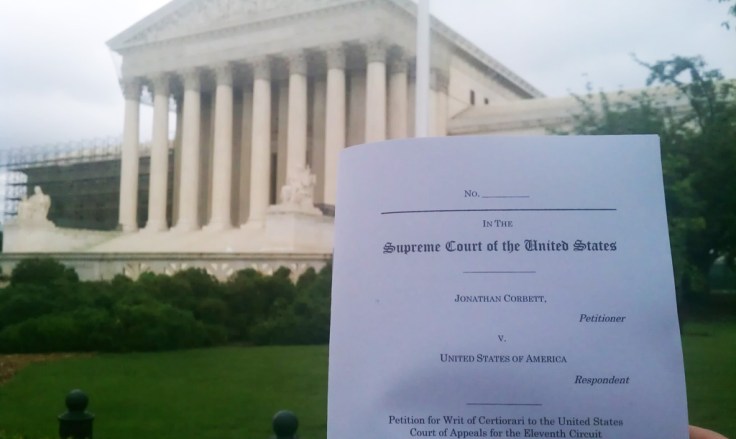
After my presentation, I headed to the U.S. Supreme Court and filed my petition for certiorari, asking the highest court in the land to take my case and, eventually, rule that I have the right to a full trial to review my claims of unconstitutional searches by the TSA — a trial which so far has been denied to me and everyone else who has asked. It is troubling that I have to go to the highest court in the land in order to get something that so obviously is guaranteed to us by our Constitution, but I look forward to getting due process back on track.

The filing requirements of the Supreme Court are actually a bit absurd. First, all documents (relevant to my petition, anyway) had to be specially printed on 6.125″ x 9.25″ paper, bound in a booklet. The court specifies the exact font and size to be used, the margins, the exact line spacing, and even the thickness of the paper it must be printed on (and supposedly, they indeed measure!). Any documents attached (such as lower court decisions) must be re-typed by the filer, since every other court prints on 8.5″ x 11″ paper (and “shrinking” is expressly verboten!) Everything must be filed with 40 copies, so a 50 page petition is now 2,000 pages to print. Not exactly environmentally-friendly, nor the most accessible to the people.

Then, when you get to the court, you’re not actually allowed to bring the documents into the clerk’s office. This is apparently for security reasons, because you could hide weapons in between thousands of pages of paper, I gathered. Instead, all documents must be brought to a security guard outside the back of the building, who will — get this — hand you a garbage bag, ask you to insert your documents, and then leave the documents on the curb for security processing. Perhaps it’s time for the court to consider allowing e-filing like every other federal court does. 🙂

Petition for Cert At the Printers, OPEN CALL FOR AMICI CURIAE!

The final version of my petition is at the printers:

Corbett v. US – Petition for Certiorari – Final (.pdf)

If you’ve read the draft, there’s not much changed.

In the Supreme Court, a lot of weight is given to “amicus” briefs. These are briefs written by non-parties to the action to support a position. If anyone has connections to any kind of civil rights organizations that may be interested in writing on my behalf, please put them in contact with me: jon [at] fourtentech.com. If you need a brief “sales pitch:” My petition for cert to the US Supreme Court is on the issue of whether a citizen is entitled to a full trial when challenging the constitutionality of government actions. My case against TSA body scanners and groping was dismissed, and dismissal affirmed, on a law that exempts TSA “orders” from district court review.

Petition gets filed on Tuesday!

Petition for Certiorari Draft Completed — Thoughts?

After much research, writing, and compliance with some pretty crazy Supreme Court rules (for example, most documents have to be submitted on 6.125″ x 9.25″ paper), I’ve completed my petition for certiorari, pending any suggestions from YOU:

Corbett v. US – Petition for Certiorari – Public Draft (.pdf)

If you’d like to provide your feedback, please do so by the end of tomorrow before it goes off to the printers. You don’t need legal experience — the document’s sole purpose is to convince the court that my case is important enough for it to hear, rather than to persuade the court to find in my favor. Filing happens Tuesday. 🙂

Jonathan Corbett to Present Nude Body Scanner Failures to Congress, File US Supreme Court Petition, on May 22nd

I’m excited to announce that I will be presenting my findings as seen in my How To Get Anything Through TSA Nude Body Scanners viral YouTube video to Congress on May 22nd, 2012, in conjunction with Freedom to Travel USA, a traveler’s rights advocacy group. Additionally, I will be filing my petition to the US Supreme Court on the same day, asking the court to review whether we have the right to a full trial in US District Court when we as private citizens challenge the constitutionality of government action.

Please help us by calling and e-mailing your representatives (please do both — e-mails are easily ignored!) and asking them to send staffers or come in person to our presentation. The event will be held in the Cannon House Office Building, Room 402, at 10:00 AM. FTTUSA has created a formal invite, and members of the general public may also attend, space permitting (RSVP at the e-mail on the invite).

We’re getting somewhere, guys!

–Jon

Broward County Offered Settlement in Exchange for Protecting Travelers; Refuses

Since I was illegally detained by the TSA at FLL, I have repeatedly told Broward County that I have no interest in suing them, but they have repeatedly, and despite good-faith efforts to work with them, shown that they are not interested in assisting passengers facing TSA abuse. In March, I filed suit against them for unlawfully performing a warrant check on me for the TSA, as well as lying to me about the existence of security cameras (not to be confused with my original lawsuit against the body scanners, a suit which seeks no monetary damages and is headed to the US Supreme Court).

Today, after Broward’s motion to dismiss was denied by the Court, I offered to discuss settlement options with the County, indicating that I would accept an agreement from them to protect passengers from TSA abuse (that is, to not assist the TSA in harassing a passenger without evidence that the passenger is committing a crime, and to agree to release security footage promptly when requested) instead of a large monetary settlement or judgment. The County has responded by telling me that they will not even engage in discussions regarding settlement.

As a traveler, this upsets me. But if I were a Broward County taxpayer, I would be furious. My lawsuit seeks $1.5 million in damages against the County, and if the County has an opportunity to avoid a judgment of even a fraction of that amount in exchange for an agreement to protect its citizens from abuse, it absolutely should do so. It is clear that Broward has taken a side, and it’s not the passengers. I urge any Broward residents to contact the county commissioners about this, and I urge all others to avoid flying to FLL airport until this issue is resolved and the County agrees to respect your rights.

Appeals Process: Continue in 11th Circuit or Go To Supremes?

The 11th Circuit today denied my motion to transfer my existing case to it and order district court proceedings. It also denied the governments motion to clarify that it’s not allowed to order district court proceedings.

So here’s where we are: if I file a new petition in the 11th Circuit, the court *may* decide to allow me my right to be heard in district court. But, it may not, and may try to decide my case without giving me the opportunity to present evidence. It also would suck to not appeal their ruling that I can’t be in district court as-of-right. Everyone should have their day in a trial court.

If I file an appeal in the US Supreme Court, that court *may* overturn the 11th Circuit, which also has the effect of allowing me my right to be heard in district court. It *will* take a lot of time before that happens, whereas if I go with option #1 *and* the court rules well for me, it might get rid of scope & grope more quickly.

After much thought, I’ve decided that I shall simultaneously file both a new petition and a US Supreme Court appeal. Our right to have a trial, as well as our right to be free from unlawful searches, both must be litigated as expeditiously as possible. I’ve never been a fan of giving up one right to ensure another, and refuse to accept either/or when my constitution guarantees me both/and.

Filing two appeals greatly increases the cost of the fight. If you are able, your donations would be appreciated — the button is at the top-right of this page — with great thanks to those who have already donated.

Blog at WordPress.com.

Up ↑