TSA Loses Immunity in Eleventh Circuit, Doing Away With Only Appellate Decision in Its Favor

Well over a decade ago, the U.S. Court of Appeals for the Eleventh Circuit tossed aside a case I filed as a young, pro se litigant, without oral arguments, on the basis that TSA screeners aren’t “officers of the United States” and therefore can’t be sued under laws that hold such officers accountable. This decision, along with the sting of being denied justice over a brief false arrest by TSA, was one of the most motivating factors for enrolling in law school, which I did months later.

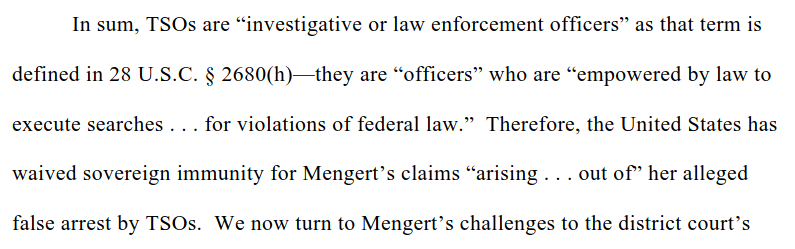
Until this week, I had obtained rulings in 3 other Courts of Appeals holding that TSA screeners are “officers of the United States” who may be sued under this particular law (and two other law firms obtained similar rulings in another pair of appeals courts), but that pesky contra opinion from the Eleventh still remained. On Wednesday, however, my firm obtained victory in Koletas v. United States, 24-10505 (11th Cir. 2025), reversing U.S. District Judge Sheri Polster Chappell in the Middle District of Florida:

As our sister circuits noted, the reasoning in Corbett I is not persuasive for two reasons. First, it did not conduct a textual analysis of the relevant statute, the FTCA. See e.g., Iverson, 973 F.3d at 850 (explaining that the ATSA postdates the FTCA and cannot “silently alter[]” the scope of a statute enacted 30 years prior). Second, as the Third Circuit explained, it is perfectly consistent for TSOs to be classified as both “employees” and “officers,” but not “law enforcement officers.” See Pellegrino, 937 F.3d at 171 (“[T]here is no textual indication that only a specialized ‘law enforcement officer’ in the [ATSA] qualifies as an ‘officer of the United States’ under the [FTCA].”).

Because the government does not meaningfully defend Corbett I’s holding that TSOs are not “officers” under the law enforcement proviso, and because we are persuaded by the plain-meaning analysis conducted by our sister circuits, we conclude that TSOs qualify as “officers” under the proviso.

Notable of the lower court’s ruling was that the prior decision in my long-ago case was not binding precedent because it was an “unpublished” decision of the Eleventh Circuit, and the lower court not only adopted it wholesale, it completely ignored (as in, did not even mention) the other then-four appellate courts to go the other way:

But the district court’s economical dismissal order did not grapple at all with the thorough analyses provided by the Third and Eighth Circuits in the cases cited by Koletas, nor with other then-recently published decisions from the Fourth and Ninth Circuits reaching the same conclusion.

Accordingly, we caution district courts from relying on our unpublished decisions purely because they are our decisions, without carefully evaluating the legal suasion of an unpublished Eleventh Circuit opinion.

It is, of course, too late to go back and re-open my case, but my client here will now have her day in court after having been unlawfully strip searched by TSA screeners in Orlando — a massive win for justice.

The issue of whether TSA screeners may be sued for intentional torts under the Federal Tort Claims Act is now 6-0 in favor of “indeed they may!” in the twelve circuit courts (and, now that the government has lost the one opinion in its favor, I expect this may be the end of the issue). Summary of the law by circui

  • First Circuit – No Decision
  • Second Circuit – No Decision
  • Third Circuit – TSA Lost (Pellegrino, 2019)
  • Fourth Circuit – TSA Lost (Osmon, 2023)
  • Fifth Circuit – No Decision
  • Sixth Circuit – No Decision
  • Seventh Circuit – No Decision
  • Eighth Circuit – TSA Lost (Iverson, 2020)
  • Ninth Circuit – TSA Lost (Leuthauser, 2023)
  • Tenth Circuit – TSA Lost (Mengert, 2024)
  • Eleventh Circuit – TSA Lost (Koletas, 2025)
  • DC Circuit – No Decision

Koletas v. United States – Eleventh Circuit Opinion (.pdf)

Federal Judge: During Unlawful Civil Forfeiture, Government Liable for Seized Property AND False Arrest

“Civil asset forfeiture” is a legal framework that allows the government to take money or other assets that it has probable cause to believe are connected to a crime. Meant to allow the government to drain the assets of drug cartels, the law is now used to take cash wherever a law enforcement officer finds it and then make the owner prove it wasn’t drug money if they want it back.

Frequently, this results in innocent citizens having to hire, and pay for, an attorney to force the government to return their money. They usually do not get their attorney’s fees paid back, and often, the government tries to “settle” the matter by offering a percentage of the money back to avoid a trial, leaving the innocent owner to either take back a fraction of their cash or face the time, expense, and uncertainty of a trial. Further, if the government detained you in the process of stealing your cash and you try to sue for false arrest or an illegal search, they argue that a law immunizing the government when “property was seized for the purpose of forfeiture under any provision of Federal law” (see 28 U.S.C. § 2680(c)(1)) also immunizes them from any misconduct incident to the seizure, including arrest and search.

My firm has been known for pressing back on that, starting in 2021 when we got the return of a full $70,000 taken from a filmmaker traveling with cash and then an additional $15,000 settlement for false arrest. But because that case, and others, ended in settlement, a judge has never determined whether an individual who was detained for a nonsense civil forfeiture could sue for damages beyond the value of the property. Today, U.S. District Judge Margo A. Rocconi in the U.S. District Court for the Central District of California ruled for my client — who runs a legitimate, licensed cryptocurrency exchange and has had DEA agents harass him in airports on multiple occasions despite carrying paperwork proving his legitimacy — allowing him to recover for false arrest despite my firm having already recovered 100% of his seized currency in an earlier proceeding:

“Ultimately, the Court makes the general finding that the detention of goods exception bars Plaintiff’s claims to the extent that they are based on the agent’s seizure of Plaintiff’s cash but does not bar Plaintiff’s claims that they are based on the search of his bags or any temporary seizure of his person”

The court also refused TSA’s backup argument, which is that a brief stop of a traveler who is carrying large amounts of cash is legal because carrying large amounts of cash constitutes reasonable suspicion:

“Here, Plaintiff alleges that TSA noticed his cash and reported the cash, along with his flight itinerary, to the DEA, who stopped him at his arrival destination — seemingly without conducting much further investigation, given that Plaintiff had registered both transactions with the U.S. Department of Treasury. FAC ¶¶ 10–13.44–47. These allegations invite the inference that DEA stopped Plaintiff solely on the basis of the large sum of cash he had in his luggage. To find that Plaintiff has failed to allege that the DEA had no lawful basis to detain him on these facts would essentially require the Court to find that a large sum of cash, without more, can constitute reasonable suspicion. The Court will not take such a leap…”

Now, my client — and everyone else stopped for no reason other than having cash — can actually make himself whole, and the government will be further discouraged from using a “take first, make them justify themselves later” approach. Excellent!

White v. U.S. – Opinion Denying in Part Motion to Dismiss (.pdf)

White v. U.S. – Motion to Dismiss (.pdf)
White v. U.S. – Motion to Dismiss, Opposition (.pdf)
White v. U.S. – Motion to Dismiss, Reply (.pdf)

Our Court System Isn’t Perfect, but Trump’s Disrespect For It Is Not Helping

Respect for the rule of law isn’t generally a partisan issue. Appreciation for career civil servants usually doesn’t come only with an R or a D. And yet, I know, I’m likely to lose a lot of followers of this blog for saying some fairly simple things that, two months ago, would not have been controversial to say:

  1. We shouldn’t fire career prosecutors and law enforcement for political reasons, or force them to use (or refrain from using) their powers for political purposes.
  2. Everyone should obey court orders and refrain from disrespecting judges by calling them “corrupt” or “frauds” just because we don’t like a decision they’ve made.
  3. No one should be denied their rights without due process.

I assume most of us agree with these three points in theory. Yet, far too many of my neighbors will refuse to call out Trump for failing to uphold these basic tenets. Why is this? Why can’t more people say, “I support a lot of Trump’s agenda, and generally support the President, but I wish he’d do a few things differently?” Nobody’s perfect, right? Frankly, I’ve never supported 100% of any politician’s actions, or even 90% of them. But some refuse any criticism of the President. They should reconsider.

As to the first of these points, consider the scandal behind the criminal trial of New York City Mayor Eric Adams. The man knowingly took money from foreign agents through straw donors, and that money resulted in his receipt of matching public funds he wasn’t entitled to. In other words, he not only cheated during the election by taking illegal money, but also literally stole from the taxpayer. There’s little question that he is guilty of this. But because he agreed to change NYC’s immigration policies, the Trump Administration ordered prosecutors to dismiss the corruption case against him. Career prosecutors were outraged that a person they knew was guilty of a crime was being let off for political favors, and at least 7 of them resigned rather than follow the order to file a motion to dismiss. The Deputy Attorney General then publicly excoriated the most senior of them for not following his orders, even though dismissing a case for political gain quite possibly would violate their oath of office. We lost at least 7 good attorneys are are going to let a criminal walk free. Can we agree this is a bad thing? Similar nonsense happened in law enforcement; for example, FBI officials who were tasked with investigating (not volunteered to, but told it is their job to do so) the January 6th riots were fired. These were good people just doing their job. Surely you don’t support this, right?

As to the second, I challenge you to find a response from the White House to a judge that paused a Trump order that does not call the judge “corrupt” or “a radical leftist” or “part of the deep state” or “should be impeached” or similar such language. In normal times, an administration says, “We respectfully disagree with the holding of the court and will consider an appeal.” It is not normal to attack judges like this. And, suffice to say, this administration has produced no evidence that any of these judges — many of whom have been serving for decades — is in any way “corrupt.” This breeds contempt for duly commissioned judges and our justice system as a whole. Like Trump or not, you must admit that he is pushing the boundaries of his constitutional authority, and it should be of no surprise that sometimes he is told by the courts, “No, that’s too far.” That is the system of checks-and-balances we have, and if ultimately Trump can’t even get a U.S. Supreme Court with a 6-3 conservative majority to reverse these judges, it should be crystal clear that it is not the judges, but the President, who is wrong.

As to the third, what we are doing in regards to illegal immigrants is wrong. Not the fact that we’re deporting them: I am sure that most of those expelled by Trump last weekend based on their alleged association with Tren de Aragua were dangerous people who should have been thrown out. But why are we now trying to skip the courts? Do you really want a President to be able to simply say, “This person is a gang member!” and then have the authority to fly them to a foreign prison that is basically a concentration camp? It turns out that at least one of them was probably falsely accused. If you take comfort in the fact that it was only brown people being mistreated, consider that we recently held a Canadian in a squalid jail for a few weeks just because she didn’t have the right paperwork with her when she got to the border. She was forced to lay on freezing cement floors, strip and pee in a cup for a nurse for a pregnancy test, and drink water from a tap attached to a toilet.

The point here is that Trump is not God, nor is he a dictator. He is subject to court orders just like you and me, unless and until they are overturned by a higher court (which, again, is packed with conservative judges, so what is the problem?). If we let Trump dismantle our justice system by firing prosecutors and law enforcement, demeaning and ignoring judges, and acting himself as judge, jury, and executioner, the result will be the destruction of our constitutional system and ample suffering — and in case it matters to you, it will not only be brown people who will suffer. It is my job as an attorney — an officer of the court sworn to uphold the constitution — to speak out when things are wrong in our justice system. And I’m telling you: things are wrong.

TSA Loses on Immunity for Fifth Time: Tenth Circuit Court of Appeals Holds TSA Screeners Can Be Sued Under FTCA

Last week, the U.S. Court of Appeals for the Tenth Circuit was the fifth federal appeals court in a row to hold that TSA screeners are “investigative or law enforcement officers,” a category of federal employees who may be sued for intentional misconduct like battery or false arrest under the Federal Tort Claims Act. The decision was a 2-1 victory in Mengert v. U.S., argued by my firm on behalf of a woman who was strip searched by TSA screeners in Oklahoma who alleged they were confused by a feminine hygiene product she was wearing.


The opinion in this case was unfortunately not all good news, as the court also held that in Oklahoma, one can’t recover for emotional distress claims unless their emotional distress is so severe that it, for example, affects their daily life. This is bad news for those injured in Oklahoma (although attorneys seeking to recover in Oklahoma should consider negligence, battery, and other tort claims that may still be viable), though we will, of course, consider our options to challenge that overly-strict standard for emotional distress.

There are twelve regional federal circuit courts of appeals and each one is precedential only for its own region — so the government can try in each circuit to get a different decision, but it is extremely rare for one circuit to go against a consensus of five. Undeterred, TSA is now pursuing the same issue in the Eleventh Circuit, likely to be heard on oral argument in March, which I’ll be arguing for a fourth client.

Summary of the law by circuit:

  • First Circuit – No Decision
  • Second Circuit – No Decision
  • Third Circuit – TSA Lost (Pellegrino, 2019)
  • Fourth Circuit – TSA Lost (Osmon, 2023)
  • Fifth Circuit – No Decision
  • Sixth Circuit – No Decision
  • Seventh Circuit – No Decision
  • Eighth Circuit – TSA Lost (Iverson, 2020)
  • Ninth Circuit – TSA Lost (Leuthauser, 2023)
  • Tenth Circuit – TSA Lost (Mengert, 2024)
  • Eleventh Circuit – Oral Arguments Likely March 2025 (Koletas)
  • DC Circuit – No Decision

TSA, Having Lost Immunity in Four Courts of Appeals, Tries Again Twice More

TSA loves arguing that it’s exempt from Federal Tort Claims Act (FTCA) lawsuits based on the misconduct of its checkpoint screeners. The text of the FTCA states that it only applies to intentional misconduct when committed by an “officer of the United States who is empowered by law to execute searches, to seize evidence, or to make arrests for violations of Federal law,” and TSA argues that checkpoint screening isn’t really “executing searches.” Given that the FTCA is the only viable way to redress checkpoint abuse in the courts, it’s no wonder that they give serious effort to this strategy despite it requiring… er, linguistical creativity… to say that TSA screeners don’t search.

Every U.S. Court of Appeals to hear the matter and come up with a precedential ruling — four so far — has ruled against them. I argued two of them that were decided last year (Osmon in the Fourth Circuit, Leuthauser in the Ninth) and the Third and Eighth Circuits took the same path in 2019 and 2020, respectively. But, there are twelve federal circuits that hear general appeals and a decision of one of them is only binding within the states covered by that particular circuit, so unless the Supreme Court takes up the matter, TSA is free to give all twelve circuits a try. If TSA wins in one of them, it can use that as a reason to persuade the Supreme Court to hear the case (lawyers call this a “circuit split”).

So try they do. In March, I’ll be doing oral arguments in Mengert v. U.S., on behalf of a woman who was subject to a back-room strip search by TSA screeners (TSA rules categorically prohibit their screeners from conducting strip searches for any reason). TSA lost on the FTCA issue in the lower court and is now raising it in the Tenth Circuit. TSA also tried again in a Florida federal district court in Koletas v. U.S., and prevailed on the FTCA issue in that trial court. That Florida ruling rubber-stamped TSA’s argument without even mentioning the Third, Fourth, Eighth, and Ninth circuit rulings, which is pretty outrageous even for Florida. We filed a notice of appeal to the Eleventh Circuit.

So in summary:

  • First Circuit – No Decision
  • Second Circuit – No Decision
  • Third Circuit – TSA Lost (Pellegrino, 2019)
  • Fourth Circuit – TSA Lost (Osmon, 2023)
  • Fifth Circuit – No Decision
  • Sixth Circuit – No Decision
  • Seventh Circuit – No Decision
  • Eighth Circuit – TSA Lost (Iverson, 2020)
  • Ninth Circuit – TSA Lost (Leuthauser, 2023)
  • Tenth Circuit – Oral Arguments in March 2024 (Mengert)
  • Eleventh Circuit – Oral Arguments Likely Winter 2024 (Koletas)
  • DC Circuit – No Decision

The Electric Zoo 2023 Class Actions

Electric Zoo 2023 StampedeElectric Zoo is a large annual electronic dance music festival held on Randall’s Island in Manhattan. They are no stranger to legal issues, and in fact my firm had sued them in 2019 over allegations that their security was conducting strip searches on attendees. But, matters were made worse when notorious Brooklyn nuisance/nightclub owner Juergen Bildstein purchased the event last year. 
Known for constant overcrowding and general assholery at his Brooklyn Mirage venue — which has resulted in that venue being temporarily shut down by the New York State Liquor Authority, New York Fire Department, New York Police Department, NYC Department of Buildings, and NYC Department of Health & Mental Hygiene (on separate occasions!) — Mr. Bildstein apparently took the same approach to organizing a festival.

The result was disaster: the first day of the three-day festival was cancelled entirely because they did not finish building their stages in time. The second day opened 2 hours late and some encountered lines to enter so lengthy that they never got in. And on the third day, NYPD noticed that they were approximately 7,000 people over their legal capacity mid-way through the day. Ticketed attendees who had not yet entered were denied access until they, predictably, rushed the gates, causing many injuries and a riot-like environment. Those who did manage to get in on either day were treated to unsanitary bathrooms, unfinished stages, and massive lines to leave. So far, Electric Zoo has issued no refunds.

My firm was one of four of which I’m aware that has filed class-action lawsuits against the festival and its organizers for fraud, breach of contract, and the like. Three of these firms, including my own, have joined forces and yesterday filed a consolidated complaint (that is, one complaint to cover all clients of all three firms). In total, we directly represent 16 plaintiffs and have asked the court to certify a class of all ticket holders. The fourth firm seeks to hold the festival liable for racketeering — a bold move and we wish them and their 3 additional plaintiffs well.

All four firms’ cases are being heard together as Brockmole v. EZ Festivals, Case No. 1:23-CV-8106 in the U.S. District Court for the Southern District of New York. The defendants will answer these complaints by next month and the court will set scheduling shortly thereafter.

Brockmole v. EZ Festivals – Consolidated Complaint (.pdf)

Brockmole v. EZ Festivals – Racketeering Complaint (.pdf)

United Faces Class Action Suit for 777-200 Engine Failure — Again

United Airlines has a problem.

Of its approximately 900 airplanes, only 19 of them are original Boeing 777-200s, delivered 23 to 28 years ago with Pratt & Whitney PW4077 engines. In the last 10 years, these 19 planes had at least 11 engine failures or related incidents during takeoff or mid-flight. In 2021, my firm represented the passengers of UA328, when an engine fan blade broke off at high speed due to metal fatigue, causing an explosion. It turned out that the same thing happened to a sister aircraft in 2018, but United failed to conduct metal fatigue tests that would have prevented the 2021 incident. Passengers were treated to an engine fire that pilots could not put out until landing, causing panic and fear of death.

Today, my firm filed suit on behalf of the passengers of United 1158, departing from LAX on a 777-200 on June 21st, 2023. Like the 2021 incident, passengers heard an explosion shortly after takeoff. Moments later, the cabin filled with smoke, and passengers said goodbye to loved ones as the plane attempted an emergency landing. Although this plane landed without physical injury, 260 passengers walked away traumatized, suffering nightmares, flashbacks, and panic attacks. Many who complained were offered a few hundred dollars in United travel vouchers as compensation for this PTSD-inducing incident.

It turns out it was not even the first time this year that this particular airplane had engine failure: on February 4th, 2023, an engine shut down mid-flight.

Another United 777-200 had smoke in the cabin during flights twice, in 2016 and 2017.

Yet another United 777-200 had engine failures during flights twice, in 2016 and 2017.

Two more United 777-200s both had an engine shut down in-flight, in 2015 and 2017.

…and so on.

While planes can and often do land without physical injury when one engine malfunctions, this is an extremely dangerous state for these planes to be in, and it is a matter of time before a catastrophic failure occurs that ends in tragedy. But even absent a fiery crash, Americans should not be forced to wonder whether their plane’s engines can safely make it to their destination, and be subjected to a terrifying experience when they fail.

United should retire these planes immediately. But they won’t until the cost of lawsuits is greater than their profits from using these planes.

Carroll v. United, 23-CV-8236 (C.D. Cal.) – Class Action Complaint (.pdf)

Is It *Really* Impossible To Get A Gun License in NYC? (Part XV — Returning to the Court of Appeals)

This is the fifteenth installment of a series documenting an ordinary New Yorker attempting to exercise his Second Amendment rights: Part I (license application), Part II (application rejected), Part III (the lawsuit), Part IV (appeal filed), Part V (appellate briefing complete), Part VI (N.Y. Appeals Court Not Interested in Ending NYPD Corruption), Part VII (Corruption? You Can’t Prove It!), Part VIII (appeal to N.Y. high court), Part IX (N.Y. Court of Appeals won’t hear), Part X (Federal Lawsuit Filed), Part XI (Federal Court Refuses Challenge), Part XII (U.S. Court of Appeals), Part XIII (No Help from Second Circuit), Part XIV (Supreme Court Strikes Down Proper Cause). 

Total Time Spent So Far: 142 hours
Total Money Spent So Far: $4,102

It’s been more than a year since the U.S. Supreme Court struck down New York’s corrupt “proper cause” requirement, wherein only those whom the licensing officers deemed had a “good reason” to exercise their constitutional right to bear arms were permitted to do so. In anticipation of the ruling, I filed a new application a couple months before the ruling, so in theory, I should have my license by now, right?

Of course not.

In the wake of the Supreme Court’s decision, N.Y. Gov. Kathy Hochul crammed through legislation called the Concealed Carry Improvement Act. In addition to futility, such as declaring Times Square to be a gun-free zone (seems criminals didn’t get the memo), CCIA was designed to make it as difficult as possible to obtain a license. To that effect, it contains three particularly unconstitutional requirements: 1) mandatory disclosure of all social media accounts used in the last three years, 2) four letters of recommendation from others, and 3) 18 hours of training.

The social media requirement is particularly odious: it stands no chance of helping to keep guns from dangerous people, because dangerous people will simply not disclose the social media accounts they use to express their dangerous views. Sure, a licensing officer might find that account anyway, but that was already possible without CCIA. On the flip side, now if you have an OnlyFans, you’re required to let the police look at your body before you can exercise your rights, just as those who may anonymously use social media to discuss medical issues, their sexual orientation, or their fetish preferences must bare themselves to the police department.

The other two requirements fare no better: reference letters require outing one’s self as a (future) gun owner in a city where doing so is, in many scenes, socially unpopular, and re-introduces the same sort of “approval of others to use your rights” requirement the Supreme Court just struck down. And the training requirement serves no purpose other than to discourage applicants: it is the longest training regimen of any state, and there simply is not 18 hours worth of conversation to be had about responsible gun ownership — explaining when deadly force is legal, safe gun storage, and the like simply does not require more than a few hours. I support reasonable pre-licensure training to ensure that everyone who owns a gun understands their responsibilities, but that’s clearly not the intent or effect here.

So, I challenged these three requirements in U.S. District Court last July, and U.S. District Judge Lorna Schofield denied my request to enjoin all three of them. As to the first two, the state argued that they would not apply them to those who applied before CCIA took effect, and therefore I had no standing. Of course, I would be required to follow those requirements on license renewal, but that happening, she ruled, was too far away. That said, at least I have a commitment that my application will be processed without these requirements… for now.

As to the training requirement, the standard set by the Supreme Court for when a gun restriction is lawful is that there must be a tradition of similar laws at the time the Second Amendment was written; a so-called “historical analog.” Obviously, gun licenses didn’t exist at the time, and so the state argued that since militia membership was required, and militia membership required gun training, that this is “analogous” to CCIA’s training requirement.

I’ve appealed to the U.S. Court of Appeals for the Second Circuit, explaining why this is nonsense:

“First, as the government concedes, mandatory militia membership requirements applied only to 1) able-bodied, 2) male, 3) citizens of the state, 4) within a certain age range. … People who were disabled or otherwise not physically able to serve in the militia were not prohibited from carrying concealed weapons or required to partake in supplemental training. Neither were women, nor were those outside of the 30-year age range where service was expected, nor were those who lived in a state without being a citizen thereof. These “exceptions” entirely swallow the analogy, as more than half the population is female and a substantial percentage of the remaining male population would have been physically unfit to serve, a non-citizen, or of an excluded age.”

Beyond that, militia gun training serves the opposite purpose — teaching how to kill people with guns rather than educating to prevent gun deaths — and was entirely unconnected to gun ownership (that is, failure to participate in the militia did not result in disenfranchisement of gun rights). It is simply not an analogous restriction on gun rights.

My appeal is now fully briefed and likely to be scheduled for oral arguments in the fall. In the meantime, the NYPD is slow-walking all license applications, and mine has not even been scheduled for an interview by this time, now 15 months later. Although the tide is turning, at this time, it is still impossible to get a gun license in New York City.

Corbett v. Hochul – Appellant’s Brief (.pdf)

Corbett v. Hochul – Appellee’s Brief (NYC) (.pdf)
Corbett v. Hochul – Appellee’s Brief (NYS) (.pdf)

Corbett v. Hochul – Reply Brief (.pdf)

Ninth Circuit Holds Government Liable for TSA Misconduct at Airport Checkpoints

In a second victory for travelers this year, the U.S. Court of Appeals for the Ninth Circuit held 3-0 that the Federal Tort Claims Act allows lawsuits against the government when TSA screeners violate passengers. Two months ago, the Fourth Circuit held the same, and previously the Third and Eighth Circuits took the same path in 2019 and 2020, respectively.

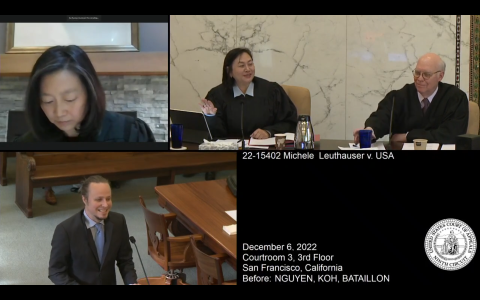
Oral Arguments in Leuthauser

Oral Arguments in Leuthauser in San Francisco, CA


I was pleased to represent Michele Leuthauser in both the district court and appellate court. The court aptly summed up her experience as follows:

Leuthauser was told that she had to submit to a “groin search.” Leuthauser then entered a private room with two TSOs, including Defendant Anita Serrano. Leuthauser was directed to stand on a floor mat with footprints painted on it to show where to place her feet. Leuthauser alleges that TSO Serrano directed her to spread her legs far more widely than the footprints indicated. TSO Serrano then conducted a pat-down during which TSO Serrano slid her hands along the inside of Leuthauser’s thighs, touched her vulva and clitoris with the front of her fingers, and digitally penetrated her vagina.

One would think that under such circumstances, it would be obvious that the screener or her employer would be on the hook for such egregious conduct. But, the government attempts to combine two laws to preclude any lawsuits against anyone. First, the Westfall Act allows the government, when one of its employees gets sued for on-the-job conduct, to say, “sue us instead of the employee.” This would not be a problem — the treasury is more likely to pay a judgment than a random TSA employee anyway — except they next use the Federal Tort Claims Act, which basically says, among other things, “the government can’t be sued for certain conduct.” In this case, it’s assault and battery when committed by anyone other than an “investigative or law enforcement officer.” So the argument is: 1) you have to sue only the government, but 2) the government isn’t liable.

Luckily, now four appellate courts have concluded that TSA screeners are “investigative or law enforcement officers. I wrote more about this when the Fourth Circuit ruling came out in April for those interested in the details, but suffice to say: if your local letter carrier, social security clerk, or receptionist at a VA hospital doesn’t like your attitude and punches you in the face, you may have no recourse, so long as the government protects the employee with the Westfall Act, because they are not “investigative or law enforcement officers.” But the law is now clear: TSA screeners are, and the government may be sued for their intentional (and negligent) misconduct.

Leuthauser v. United States, 22-15402 – Reversed & Remanded (.pdf)

U.S. Court of Appeals Clears Path to Lawsuits Against Abusive TSA Screeners

Osmon DecisionIn 2012, a TSA screener refused to allow me to leave a checkpoint after I told him I wouldn’t consent to having him touch my genitals. He told me I would be forcibly searched, called the police, and spent 45 minutes tearing apart my baggage looking for drugs. TSA screeners, of course, have no authority to conduct a detention, a forcible search, or a search for drugs.

I sued TSA that year — long before I had even started law school — and the U.S. Court of Appeals for the Eleventh Circuit held against me, without allowing oral arguments as is traditional, because, they said, the law under which I sued only applied to “investigative or law enforcement officers” and TSA screeners are not “officers.” This despite their badge reading “U.S. Officer,” their job title being “Transportation Security Officer,” and obviously meeting the statutory definition, which was one “empowered by law to execute searches, to seize evidence, or to make arrests.”

Fast forward a decade, a law degree, and a law license later, and two U.S. Courts of Appeals have held the opposite — and today I’m proud to announce that the Fourth Circuit joins them in a unanimous opinion in Osmon v. United States, 22-2045, a case I argued on behalf of a woman who was sexually assaulted on video, right at a checkpoint, while the TSA screener commented on how short her shorts were:

The government disagrees, insisting the relevant language covers only searches that are part of “criminal law enforcement.” U.S. Br. 21 (quotation marks omitted). Per the government, the law enforcement proviso permits suits for battery only when the officer could perform “a criminal, investigatory search” rather than “an administrative search,” which takes the form of an “inspection” or “screening.” U.S. Br. 26.

The problem with the government’s argument is that it reprises a tactic the Supreme Court has already rejected: “read[ing] into the text additional limitations designed to narrow the scope of the law enforcement proviso.” Millbrook, 569 U.S. at 55. The word “criminal” appears nowhere in the law enforcement proviso—let alone as a modifier of “searches.” See 28 U.S.C. § 2680(h). Here, as elsewhere, we “may not narrow a provision’s reach by inserting words Congress chose to omit.” Lomax v. Ortiz-Marquez, 140 S. Ct. 1721, 1725 (2020).

Having joined the Third Circuit in Pellegrino v. United States, 15-3047 (3rd Cir. 2019, en banc) and Iverson v. United States, (8th Cir. 2020), there are now 15 states where TSA may no longer use the “we’re not officers” defense. Because the Eleventh Circuit did not publish their opinion in my 2012 case, it is non-precedential and lawsuits may proceed in all 35 other states, where TSA will have an uphill battle convincing courts to apply different logic.

Suffice to say, I am ecstatic to open the courthouse doors for all injured by abusive feds, I am thrilled to bring my client closer to getting some justice for this brazen misconduct, and I feel personally vindicated after having been swept out the courthouse door a decade ago by judges who, frankly, did not want to deal with a pro se litigant challenging the government’s status quo. My firm continues to handle cases of checkpoint abuse, and I encourage anyone violated by TSA at the checkpoint to get in touch.

Osmon v. TSA – Reversed & Remanded (.pdf)

Blog at WordPress.com.

Up ↑