TSA: We May Force You to Go Through Body Scanners Because… Well… We Can’t Tell You

tsagropeAt the end of 2015, the TSA snuck in a pre-holiday amendment to their body scanner opt-out policy: that passengers may “generally” opt for a pat-down instead of the body scanner, but the TSA reserves the right to require the body scanner.  I immediately filed suit, asking the U.S. Court of Appeals to reverse this arbitrary change made in the face of 94.0% public opposition to the body scanners and the fact that I made readily apparent in 2012: that the body scanners simply don’t work.

A year later, we finally have the government’s position on the matter.  First, I’m reminded that I’m complaining for no reason:

“AIT screening presents no greater intrusion upon passenger privacy than the walk-through metal detectors previously deployed at airport checkpoints”

…which is why 94% oppose them.

Next, I’m told that I shouldn’t concern myself with the matter, because only “selectees” will lose their right to opt-out:

“[T]he challenged AIT screening policy applies only to individuals who have been issued a boarding pass with an “SSSS” notation indicating that they have been selected for enhanced screening.  This notation generally means that the passenger in question is a ‘selectee.’  Selectees are individuals who are ‘[k]nown or suspected [t]errorists’ or who have been ‘identified as [posing a] higher risk’ to airline security ‘based on intelligence [redacted].’  Additionally, as of July 2016, TSA has instituted a policy under which [redacted] airline passengers are randomly designated as selectees for the purpose of a particular trip.”

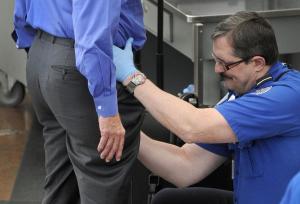
…but that last sentence is, of course, the problem and, frankly, is what we all already know: that you can be Mother Theresa and still end up with a blue glove between your legs because because the TSA has randomly made you a “selectee.”

But, let’s ignore that for a moment.  There’s a more pressing question: Why does the TSA feel that someone with a higher “risk” level (whether because they are a suspected terrorist, or were randomly selected to be treated like one) should be screened by body scanner rather than a pat-down?

“[Redacted].  Covert tests also suggested selectees could [redacted] opting out of AIT screening in favor of a pat-down.”

Ah, that clears it up.  The TSA, allegedly, found some scenario where it’s easier to beat the pat-down than the body scanners, but doesn’t want to tell us what that is.  But, what about the very real scenarios where the body scanners are easier to beat than the pat-down?  That, of course, isn’t discussed at all.  Once again, the TSA blindly chooses these high-tech, high-price, highly-invasive gadgets when very effective alternatives exist.

The case continues as I get an opportunity to file a reply brief.  I’ll also be asking the court to appoint counsel with a security clearance to review the redacted brief and represent my interests, because hiding the rationale for a policy that is being challenged for arbitrariness from the person challenging it doesn’t exactly lend itself to a fair day in court.

Corbett v. TSA – Appellee Brief (Redacted) (.pdf)
 

Briefed: Can the TSA Eliminate the Pat-Down “Opt-Out?”

petSince the nude body scanners were introduced by the TSA as primary screening in Fall 2010, they have always maintained that use of the technology is optional: that if you wanted, they would instead simply molest you using their new “pat-down” rather than use radiation to image your nude body.  Not exactly a pretty choice, but it was some choice nevertheless.

Five years later, after all the dust had settled over the lawsuits by passengers who felt that the TSA’s new screening techniques were unconstitutionally invasive (and down-right stupid considering that despite being the most intrusive search they had ever implemented, they were blatantly ineffective), the TSA doubled-down on their scanners and announced to passengers that they reserve the right not to honor “opt-out” requests in the future.  This new announcement flew in the face of the 94% of the public who formally told the TSA to ditch the scanners, and me being one of that 94%, I immediately filed suit in the U.S. Court of Appeals for the 11th Circuit.  Two other lawsuits were filed by EPIC and CEI, alleging that the TSA improperly disregarded that 94%.

It’s amazing how long these things take to progress.  It’s 7 months into the lawsuit and I just filed my principal argument, the appellant’s brief — a written statement of the entire case.  Those 7 months were filled largely with the TSA bickering about how much information they had to release to me, which resulted in the end with several thousand pages landing on my doorstep.  I’ll be posting those pages, known as the “administrative record,” shortly (scanning thousands of pages is an effort!), along with a few highlights (including, “How Any Terrorist Can Get Pre-Check,” an exposé on why the Pre-Check system is bullshit), but what was most interesting about them is they showed zero basis for their decision to eliminate the opt-out.  As I explain in my brief:

The Administrative Record is illuminative on the reasons for adopting the body scanner and pat-down program as primary screening in 2010 [Ed – Not that they were good reasons, but they were reasons.]. There are many documents that address the effectiveness of the body scanners and provide some evidence of cost/benefit thought process and procedures by which the program is tested. See, e.g., Admin. Rec., Vol. 4, p. 3893 (results of body scanner field testing). However, the elephant in the room is that there is no discussion on the effectiveness of the pat-down component of the program, nor a comparison between how likely a body scanner is to find a dangerous item on a passenger as compared to a pat-down.

Full brief below…

Corbett v. TSA IV – Appellant’s Brief (.pdf)


Civil rights advocacy is expensive!  Want to contribute to the fight against police abuse, TSA assholery, and other civil rights issues? Donate via PayPal, Venmo, Chace QuickPay, Bitcoin, or check

Court Refuses to Hear International Security Interviews Lawsuit; TSA Ramps Up Domestic Version

Last month, the 11th Circuit Court of Appeals abruptly terminated my case against the TSA’s international security interview program, wherein the TSA forces US-flagged airlines to interview their passengers before they return to the U.S.  Their reason?  I asked for an injunction (forcing them to stop or modify the program), and the court ruled that I can’t prove that I will be subject to it again, and therefore I lack standing.  The rationale for this interpretation of standing comes from a case over 30 years ago where the U.S. Supreme Court that ruled that a black man who was choked out by the L.A.P.D., nearly to death, during a traffic stop still could not seek an injunction against the chokehold policy, despite proving that the L.A.P.D. had a widespread practice of chokeholds, that they were regularly deadly, and and that he was a victim of the policy.   Los Angeles v. Lyons, 461 U.S. 95 (1983).

Lyons was a bad ruling, and I’m not certain the court would make the same decision today given its trend against rubber stamping blatant racial discrimination, but importantly, it ruled that while Mr. Lyons could not sue for an injunction, he could indeed sue for money, so I’ll get to renew my case as a request for money damages.  If I win even a trivial amount, the TSA would have to stop the program, because then thousands of passengers daily could sue for that trivial amount.  Even $100 would do, given that about 2 million passengers would be able to sue every moth by my calculations.  So, I shall proceed in that direction.

In the meantime, as I noted before, the case is already won, because it forced the TSA to: 1) publicly disclose the existence of the program, which had been previously described nowhere on the public Internet, and 2) state in open court that it wouldn’t force travelers to participate in the program with a threat of denied boarding, which is what I encountered.  I continue the lawsuit because the TSA needs to direct the airlines to stop the practice of threatening denied boarding, which it has thus far refused (at least publicly) to do.

With that said, I received an e-mail from a woman this weekend who said she was questioned at a gate for a domestic flight:

In Tulsa yesterday, three [uniformed TSA screeners] fanned out among people waiting AT THE GATES and began interrogations.  They asked EVERYONE up and down my concourse, “Are these your bags?  (Yes) Do you have any others? (No) Did you check any?  (No)  Where are you going? (Charlotte) After Chicago, where are you going?  (I’m not going to Chicago, I’m going to Charlotte.) Okay after Charlotte, where are you going?  (Portland)  Portland Oregon or Portland Maine?  (Y’all are scaring me.  Is something going on here?  What’s up?)  We have to talk to everybody.  Portland Oregon or Portland Maine?  (Maine)

[It was American Airlines, the gates near A5, Saturday, August 6, waiting for a 1:40 pm flight to Portland Maine, after a flight to Chicago had taken off from the same gate.]

This is likely an extension of the SPOT program, the largely discredited waste of taxpayer dollars by which the TSA thinks its poorly-trained screeners can pick out terrorists just by looking at and talking with them.  Please remember that you have no obligation to answer their questions, and although there may be additional screening, they cannot deny you boarding for remaining silent.

Corbett v. TSA III – Appeal Dismissed (.pdf)

PS – Delta, you suck.  7 hours of scheduled flying became 14 today because you still use a computer system designed during the Reagan administration.

TSA: Taking Pictures Of Our Dogs Is Illegal!

tsak9
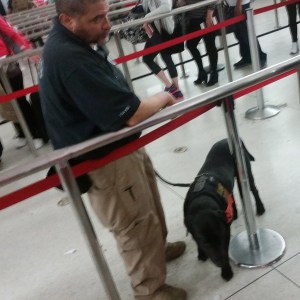
I’m told that this picture is very illegal.  TSA K-9 handler at JFK T1 immediately before ordering me to stop taking pictures.

On Friday, I flew out of New York’s JFK T1 after experiencing what was the longest airport security line I have ever seen. It literally stretched from the zig-zag queue at the center of the terminal to the far end of the terminal, and then around the corner. The TSA, of course, knows that terrorists now target security lines, rather than airplanes, and doesn’t seem to care that they are putting us at risk, but I digress.

After finally reaching the front of the queue, I spotted, for the first time, the TSA’s new experiment with bomb-sniffing dogs. Interested in finally seeing the TSA put a far better solution in place for the detection of non-metallic explosives than the body scanners, I snapped a few pictures, including the one here.

But, of course, the TSA can’t leave well enough alone. “You can’t take pictures!” barks the dog’s handler. I can’t? Well that’s news to me, and I consider myself pretty up-to-date on aviation security law. 🙂 I soon spot an STSO (supervisory transportation security officer — the “3 stripe” blue uniform people) and ask her to clarify, but she tells me she doesn’t have time to talk to me. Eventually, I spot her boss, the TSM (transportation security manager — always wearing a suit), a very friendly South Asian woman who is cheerfully tells me that my First Amendment right to photograph has been suspended:

Jon: Are you the TSM by chance?

TSM: Yes.

Jon: I have a question for you.

TSM: Sure.

Jon: What’s the policy on taking pictures in line?  The person with the K-9 told me I was not allowed to take pictures.

TSM: Yes, that’s a screening process, what he’s doing there, so you’re not allowed to take pictures.

Jon: OK, so that’s a federal regulation?

TSM: Yes.

Jon: Not New York state, that’s a TSA…

TSM: No, not New York state, it’s federal.

Jon: Ok, so if I ask the TSA, because I’m a civil rights advocate, and my job is to sue the TSA, if I ask them, they’re going to tell me that I’m not allowed to take the pictures, and that’s official TSA policy?

TSM: You have to specify what you were doing.

Jon: Taking a picture of a K-9.

TSM: You can’t.

Jon: OK.

TSM: Because that’s a screening process.

Where legal, I generally record my interactions with the TSA, and New York being a 1-party consent state (any party to a conversation may record it), I got an audio recording (.mp3).  (As a side note, a reasonable argument can be made, and some courts have held, that audio or video recording of government officials while working in public is constitutionally protected even in 2-party consent states.)

Why is this a “big deal,” some may ask: Any time the government restricts our ability to take pictures, they are reducing their accountability to the people. Thousands of times per day, law enforcement in this country violates the rights of citizens, but only occasionally is it caught on camera, and only then is it punished (sometimes).  By removing our ability to document their actions, they are insulating themselves from consequences for wrongdoing, and this a free society cannot stand.

I’ve asked the TSA’s Civil Rights Office to comment as to whether this is official TSA policy and await a reply, but expect a new lawsuit to be filed soon either way.

Terrorists Detonate Bombs in Brussels Airport — Before The Security Checkpoint

International media reports today that 2 bombs went off in BRU airport, just outside of Brussels, Belgium, and Islamic State has claimed responsibility.  How did they get these bombs past security?  They didn’t…

Passengers queuing at terminal counters described sudden panic and mayhem as the explosions turned the departure area into a death trap with flames, smoke, flying glass and shrapnel.

This is far from the first time such attacks have happened.  For example, just 5 years ago terrorists bombed DME outside Moscow, Russia, killing 37 people.

As passengers flying from US airports this year have been told to gear up for longer wait times, largely due to the additional time added to screening by body scanners that don’t actually stop threats, they should realize what this means is that the security queues are getting longer.  It sounds an awful lot to me like the TSA is creating a target rather than protecting one.  Would it make less of a terroristic statement for ISIS to blow up a TSA checkpoint with 150 people than to blow up a 737 with 150 people?  Of course not.

This mess brought to the taxpayer at a cost of $8B per year.


Fighting the TSA in court is expensive!  Want to contribute to the fight against TSA assholery? Donate via PayPal, Venmo, Chace QuickPay, Bitcoin, or check

TSA Tries Doing Exactly What I’ve Asked It To Do for 5 Years: Metal Detectors + Dogs

The TSA announced an “exciting” “new” program that it’s trialing in MSP airport in Minnesota:

After a explosives-detection dog sniffs passengers for traces of explosives, travelers can then move through expedited screening like the Precheck program, where they can leave on shoes and light coats, and leave laptops and small containers of liquids in their carry-on bags.

“You’ll see them snaking up and down the line,” Neffenger said of the canine teams. “I’m very excited about getting extra teams here.”

(source)

In other words, passengers that pass a dog skip the body scanner and go through a metal detector.  This is exactly what I’ve been asking the TSA to do since the very beginning, because:

  1. dogDogs are by far cheaper than the body scanners.  A body scanner costs $300,000, functions for less than a decade, and requires significantly more man-hours per
    passenger than a dog, which may cost low-5 figures to train and a couple bucks a day in food.
  2. Dogs are by far tougher to beat than the body scanners.  The fact of the matter is that if you’ve been working with explosives, you likely have traces of it all over your body, and you’re likely not fooling Rover, while in 2012 I proved that beating the body scanners takes no more than a sewing kit.
  3. Dogs are far less invasive than the body scanners.  These dogs are trained to detect explosives only, while a body scanner is set to alert on anything on your body, including medical devices, scars, hygiene products, your baggie of weed, etc. Dogs are a targeted search only for the stuff the TSA should actually be looking for.

Instead of spending nearly $2B by now on technology that people hate because they are slow, invasive, and emit poorly-studied radiation… instead of fighting tons of legal battles… instead of making them perhaps the most hated federal agency on the planet… they could have just done this 5 years ago.

Let’s hope their pilot program goes well and the body scanners are relegated, along with a pat-down option, to those who fail Fido’s nose.

Eleventh Circuit: “Zero Fucks Given.”

Today the Eleventh Circuit Court of Appeals, in considering my case against the constitutionality of the body scanners, denied my motion to transfer, motion to stay the use of body scanners during the petition, and even denied my motion to file electronically — a routine motion that allows a non-lawyer to use the court’s e-filing system, as 3 other federal courts have for me already.

Their reason? Why, they didn’t say.

The court denied all three motions together in a 1 page order that offers no insight at all into their decision.

Perhaps the court thought it would be obvious as to why they denied a motion implicating fundamental constitutional due process rights that required 74 pages of briefs, plus exhibits, from the government and myself. Or perhaps, as I more suspect, the just don’t give a fuck. Just as the U.S. Supreme Court also didn’t care about whether the nude body scanners ever went to trial.

At some point, it gets frustrating when you’ve followed all the rules and still, now 2.5 years and several hundred pages of legal writing later, your issues aren’t even close to being given a fair hearing. My next step is to ask the judges to explain themselves. Should they fail to work out a solution, they will essentially hear my case solely on the evidence as presented by the government — an utter miscarriage of justice.

Corbett v. DHS – Summary Denial of Motions (.pdf)

Delta CEO <3s TSA, Warns of Pocket Knife Terror

The TSA recently decided to relax its rules regarding small (6 cm or smaller) pocket knives, allowing them to be taken past security and into the airplane cabin. After this fleeting moment of common sense from the TSA (as post-9/11, no terrorist would even think of taking on a cabin full of Americans armed only with 2″ knives), Delta CEO Richard Anderson begged TSA Administrator John Pistole to reconsider, in a love letter addressing both parties by first name and gushing that Delta “will always be good partners with the TSA.”

It is truly unclear to me why those in the industry feel the need to ass-kiss with the TSA at all times. They can’t possibly think that the TSA is an effective, well-run organization. Do they fear retribution if they speak out? Or is it simply that they enjoy having a third party take the responsibility (and blame) for aviation security?

Delta, unfortunately, is not the only people who oppose the policy change. Useful idiots on both sides in Congress, such as Chuck Schumer on the left and John McCain on the right, flight attendants and pilots, and Jon “The Skies Are Falling” Adler of the Federal Law Enforcement Officers Association, who cries, with trembling voice and while holding his mommy’s hand, that “if [the new policy] isn’t changed, say a prayer, rub a rabbit’s foot, and get ready to fly the deadly American skies.”

Most of the opposition talks about generic “safety” in the skies, avoiding the unjustifiable proposition that a pocket knife would make the difference between success and failure of a terrorist attack. But, what does this mean? Safety of flight attendants? That of other passengers? If so, then we might as well ban knives on buses, in McDonald’s, and everywhere else, since the people there are just as deserving of safety via governmnet-imposed weapons searches as FAs and airline passengers. The “anything to keep us safer” crowd strikes again, this time taking things even farther than the TSA (perhaps because knife detection doesn’t give the TSA an excuse to buy shiny new toys like nude body scanners).

You may have never expected to read this on this blog, but TSA Out of Our Pants fully supports this change in TSA policy.

One Year Later, State of the TSA

One year ago, I published my video exposing the TSA’s nude body scanners as vulnerable to an extraordinarily simple attack: any metal objects placed on the side of the body are invisible. The TSA mocked, then threatened, then downplayed, but never denied that the $1B of our tax dollars spent on the most invasive search ever directed at the general public in the history of our nation is great at finding TSA screeners with small genitalia but utterly useless against fighting serious threats to aviation security.

Before I published my video, I said to my friends, “This is it — this is the end of the body scanners!” I believed that if the vulnerability I published was publicly exposed, the TSA would be forced to remove the machines. Anyone can use the technique to bring even a firearm through security completely undetected so the TSA would have to get rid of them, I thought. Yet one year later, the scanners are still here (and yes, I tested the exploit on one of the new millimeter wave scanners with ATD, the kind that swirl around your body and “create a [fake] 3-D image”). The TSA is too proud to return to metal detectors and admit that it wasted your money and invaded your privacy for nothing… even if that pride means we are significantly less safe when we fly.

We’ve seen some changes over the last year. We’ve seen one of the two types of scanners removed — the Rapiscan backscatter x-ray devices — and the other upgraded to include “automated threat detection” so that live people (supposedly) never see your nude body. This is a huge win, not only for privacy advocates but for those concerned about being dosed with ionizing radiation by their government. We’ve seen the TSA shrink back from threats of fines and jail for those who don’t want to allow the TSA to “touch their junk” (new non-public policy is simply to ask you to leave). We’re also seeing that court battles, after being tossed over questionable technicalities that the U.S. Supreme Court refused to address, are finally moving towards being heard.

We still have more work to do. The privacy violation, in the form of having every square inch of our bodies analyzed without cause (resulting in countless drug charges but zero terrorism charges), still exists. TSA assholery, from strip searching grannies, to stealing iPads, to traumatizing rape survivors, to making kids cry just for fun, to collaborating with airports to lie in Freedom of Information Act responses, still exists. But we’re getting somewhere, slow as it may be. If you’ve donated, shared links with your friends, or simply opted-out, thank you for your help.

TSA Accidentally Publishes Copy of My Drivers’ License in Brief About Privacy

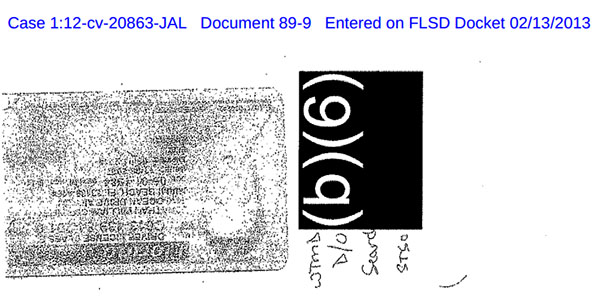
I realized after I made my last post that the TSA, in its brief explaining why its employees deserve privacy in the form of having their names and faces redacted from any documents it releases, accidentally (I would assume) published a copy of my drivers’ license!

While not the cleareset image in the world, in the version you can download from the court, you can zoom in well enough to get most of my name, most of my drivers’ license number, and my date of birth (a violation of Fed. R. Civ. P. Rule 5.2(a)(2)). I’m leaving it up on the blog because I’m always happy to trade a little of my privacy for the sake of exposing the hypocritical foolishness of the TSA. That and you know that if you steal my identity, I’ll track you down. 😉

Blog at WordPress.com.

Up ↑