Fully Briefed: Can TSA Read Your Documents, Threaten False Arrest, Lie About Checkpoint Video?

In August 2011, a TSA supervisor detained me for an hour, threatened me with forcible search and (false) arrest, read through my documents, and, ultimately, ejected me from the airport… all because I wouldn’t let a TSA screener “touch my junk.” Afterwards, I asked for CCTV video of the incident under FOIA, and was lied to about its existence. I filed suit, and last year, a federal judge dismissed that lawsuit, arguing that all of the above was either legal, or that the TSA manager had immunity from damages.

The issue is now fully briefed before the U.S. Court of Appeals for the Eleventh Circuit. A three judge panel will now decide whether there is truly no recourse when someone so egregiously violates your rights (assuming we still have those). Although “fully briefed” means that all parties have said their peace in writing, the TSA has taken the unusual step of requesting oral arguments. I assume this means they are unsure of their case, and it’s a good sign.

Corbett v. TSA – Appellant’s Opening Brief

Corbett v. TSA – Appellee’s Brief (Federal Defendants)
Corbett v. TSA – Appellee’s Brief (Broward County)
Corbett v. TSA – Appellee’s Brief (Broward Sheriff’s Office)

Corbett v. TSA – Appellant’s Reply Brief

Eleventh Circuit Orders Oral Arguments in Case Against Scanners

I received a call just now from a pleasant sounding woman in the clerk’s office of the U.S. Court of Appeals for the Eleventh Circuit. She informed me that oral arguments have been scheduled for June 4th, 2014, at 10:00 PM in the court’s Miami building for my case against the TSA’s nude body scanners and invasive pat-downs.

What does this mean?

Oral arguments are discretionary and not given as a general rule. The fact that they granted them means that they are taking the case seriously and have questions they would like to ask. This is a good thing — it means they have decided not to simply brush my case aside. Both parties will have an additional chance to speak beyond the written briefs, which is decidedly advantageous to me because many of the government’s arguments are difficult to make with a straight face. It’s one thing to talk around the issues when you have weeks to figure out how to phrase things; it’s another when you have a panel of federal judges asking tough questions in person.

The only downside is this means we will have no ruling until, likely, at least July. So, for now, continue to opt out of those scans!


Donate to support the last remaining lawsuit against TSA body scanners!
PayPal or Bitcoin: 15ftA2938sp7Mnsi8U7wYVmEtd4BRbFnkT

“Change We Can Believe In” Donation Drive

ChangeIn October, I posted that I wouldn’t be pursuing an appeal in my case against stop and frisk, which was dismissed on the theory that I couldn’t prove that the 4 plainclothes cops who stopped and frisked me were actually real police officers (they might have been, you know, just ordinary citizens playing a game!). I think the ruling was wrong, but I felt that I couldn’t effectively pursue that appeal in addition to the two actions I have against the TSA, which are more important to me, especially in light of the advances against stop and frisk made by others this year. Each of these cases I take on generate hundreds of pages of complex legal documents, monetary costs, and stress — all totally worth it, by the way.

As a result, the NYPD asked for, and received, a judgment for their costs in arguing the absurd, over my objections and despite their request for costs being after the deadline set by federal rules. They don’t get attorney’s fees, but court reporting fees, copies, etc., resulted in a bill for $820.15.

I’d like to send them this $820.15 in coins, and I’d like your help! If you have a coin jar that you’ve been filling and would like to use it to make a statement, mail it my way. The USPS Small Flat Rate Box would fit well over $100 in coins and costs $5.80 — potentially less than CoinStar would charge you to count them (no worries, I have access to a free coin counter). If you don’t have coins sitting around, I’d be happy to turn your PayPal, Bitcoin, or check donation into pennies, nickles, dimes, and quarters on your behalf. Here’s how:

  • Coins: Mail to Jonathan Corbett, 228 Park Ave. S. #86952, New York, NY 10003
  • PayPal: Donate here!
  • Bitcoin: 15ftA2938sp7Mnsi8U7wYVmEtd4BRbFnkT
  • Check: Make out to Jonathan Corbett and mail to the address above

Once I get the coins together, I shall assemble them into a sculpture that expresses my feelings towards the NYPD and send it their way. I’ll, of course, post a picture. This, my friends, is change that we can believe in! 😀 Thank you in advance for your support and for helping me to not only continue to fight against abusive governments in court, but also to help me make this special message to the NYPD.

Judge in CA: If Secret Information Is Published, It Is Public

If you’ve been following my recent Orwellian saga where the government accidentally published one of my sealed briefs, exposing information embarrassing to the TSA to the public, and then demanded that I stop talking about it despite it having been published to millions, there is some good news out in California.

A federal judge for the Northern District of California was confronted with a similar question in another case you may have heard about: Ibrahim v. DHS — the foreign-born professor who left the U.S. for a few weeks to be never allowed back because she was erroneously placed on the no-fly list (which apparently causes your visa to be revoked). The government in that case was demanding that Sensitive Security Information — the D.H.S. monicker for “stuff it wants to keep secret” — be prohibited from disclosure in open court, even if that SSI was gleaned from a public source. U.S. District Judge William H. Alsup firmly and unambiguously rejected that argument in a ruling delivered orally on Monday:

[I]f the government was contending that the ABC list and its very existence was secret and should be SSI, and the plaintiff was able to prove and wanted to try to prove that there was such a list and could do it from independent sources, the government cannot clamp that down and say: No, you can’t even mention it because that’s SSI, if there is an independent public source for that information.

So in my view, the plaintiff has the right to try to prove its case. And if it can prove its case entirely through publicly available information, even if the same — the same information is within the government designated as SSI, the plaintiff can still use that publicly available evidence if it’s admissible.

Let’s hope the court in my case decides the same. I’ve sent them a copy of Judge Alsup’s ruling to help them. 😀

Excerpt from Ibrahim v. DHS Ruling Re: SSI

Has the TSA Changed Their Pat-Down Procedure?

Perhaps the most insidious component of the TSA’s enhanced pat-down procedure rolled out in October 2010 was the part where TSA screeners were required to “meet resistance” between your legs. That is, they would cup your ankle with their hands and move their hands upward until “something” stopped them. That “something” being your genitals, of course.

The last few pat-downs I’ve had, however, have taken a different approach: instead of starting at the bottom and moving up, they’ve started at the top (front or back of thigh) and moved down. This makes it significantly less likely for them to bump into “sensitive areas,” whether by accident or as part of the procedure.

I tried asking two of the screeners if things had changed (they’re not supposed to say — that’s a secret, you know! — but I figured I’d ask anyway). One of them replied that some screeners do it differently, and that was just how he did it, and the other said it’s been that way for years. So, I’m curious: those of you who have had pat-downs within the last 6 months, did they start from the top or botttom of your legs?

TSA Files Secret Motion in Case Against Scope & Grope

My case against the TSA’s nude body scanners and invasive pat-downs has had an interesting month after court officials accidentally posted one of my sealed briefs — containing secret and embarrassing TSA documents — which was later published by the media. I was then ordered not to talk about the contents of those leaked docs, even though, by now, tens of millions of people have read about them. The TSA then unilaterally declared that it has the right to edit and file my own briefs for me.

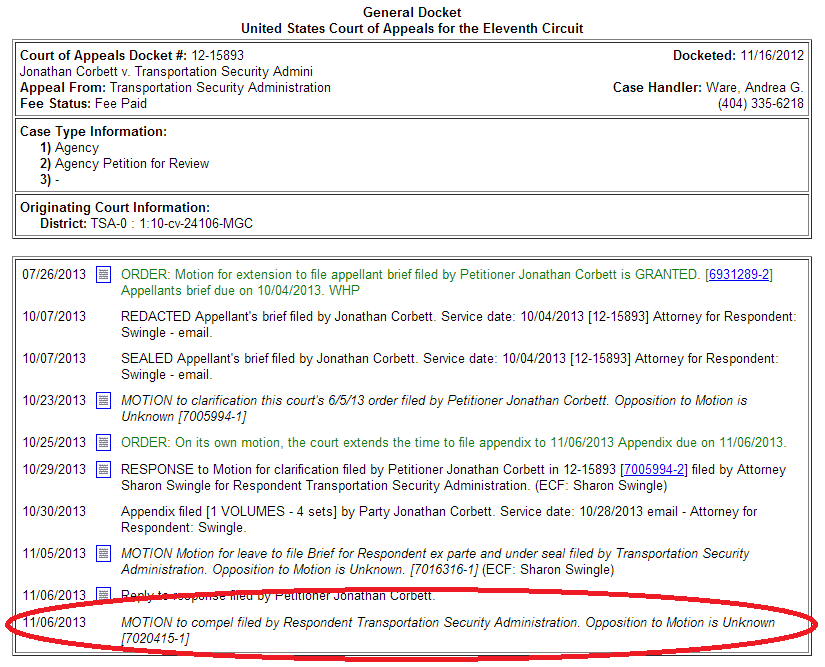
Pending before the court now is another motion filed under seal, listed on the public docket as “MOTION to compel filed by Respondent Transportation Security Administration…”

Motion Under Seal

I have a copy of the motion, but I’m prohibited by court order from publishing it here (and it appears the clerk’s office has learned how not to accidentally post sealed documents). A “motion to compel,” as a general matter, is a request for a court to order someone to do something. Why would the TSA need to do this under seal? I unfortunately can’t answer that question for you yet. What I can say is that I filed my opposition to the motion today and asked the court to unseal the motion in its entirety.

The TSA is not an organization that needs to operate in secrecy. “Security through obscurity” — a security mechanism that requires its operations to be hidden — doesn’t work, because people always find out how things work. It is universally derided in the tech security world, and the same logic applies to physical security. The alternative is to open your security model such that experts all over the world can review it, identify issues, and fix them. That’s the security we need. It’s too bad the TSA doesn’t feel the same way.

Syracuse Airport Installs “Exit Portals” To Lock Travelers Inside Terminal

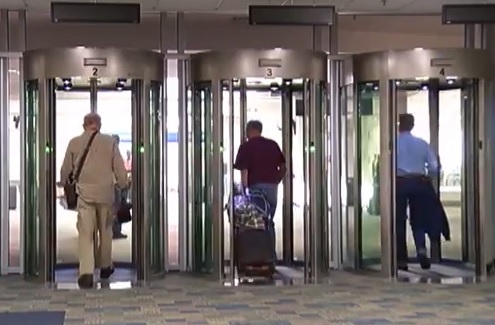
Exit Portal / "Detention Pod" The latest invention for controlling a population in transit: meet the TSA-approved “exit portal,” or, as some call it, the “detention pod.” These little devices are installed at the exits to the secure area of the terminal and use an airlock-like system where you enter the first door, the first door closes, and then the second door opens. Syracuse Airport is the first to give them a try

The airport claims that this is so the exits can’t be used as an entrance, thus saving them the $11/hour that they used to pay to have a security guard make sure no one goes the wrong way. It’s unclear how much the portals cost and how many thousands of hours of a security guard’s salary it cost to buy them. It’s also unclear why they would use these machines instead of a pretty ordinary one-way turnstile or, as some airports already use, entirely unobtrusive sensors that detect when someone is walking in the wrong direction and sound an alarm.

What *is* clear is that these devices represent another opportunity for the TSA to violate the public. Perhaps the TSA sees you walking through the terminal and determines that you’re suspicious or. you know, your credit score wasn’t good enough. They can then lock you inside these machines for “additional screening.” What happens if there is a fire, or another terminal shooting, and people need to exit immediately? Surely there’s an “emergency mode” where the portals simply open, but does it work if the portal controller is on fire?

The TSA comes up with an impressive quantity of bad ideas. Be sure to let Syracuse Airport know that you don’t appreciate their support of this one.

Three Years Later…

Three CandlesMy fight against TSA assholery began 3 years ago with a tiny 5 page complaint filed in a U.S. District Court in Florida, which has now grown into over 1,000 pages of legal filings, 3 trips to the Court of Appeals, one trip to the U.S. Supreme Court, and, of course, embarrassing the TSA in front of the world by showing, on camera, that their nude body scanners don’t work. I’ve been kicked out of three airports, equated with a terrorist by the DoJ, and gagged by the courts. I’ve presented my findings to Congress and to the TSA itself at its Arlington headquarters and testified in front of the legislature of the State of Texas. My work has been at the top of virtually every social sharing site and featured on Drudge Report. And that’s just the TSA — I’ve had even more fun with NYPD stop-and frisk and the NSA scandal.

We’ve seen several small steps towards success. The worst types of nude body scanners (both for the health and privacy conscious) have been removed from airports. The TSA no longer threatens $11,000 fines for those who refuse groping, nor sics the cops on them (mostly). Pat-downs have been modified for seniors and children. Airports across Europe are tossing their scanners aside. The TSA was forced to accept public comment on the nude body scanners. And, most importantly, pretty much everyone is now clued in that the TSA is an utter waste.

I’ve never worked so hard at anything in my life, and it’s because of your support — your encouraging comments, your stories by e-mail, and your generous donations — that I’ve been able to keep going. Thank you again for being here with me, and I look forward to seeing another year of rolling back the TSA.

[Edit — Also, happy 200th post, apparently!]


Donate to support the last remaining lawsuit against TSA body scanners!
PayPal or Bitcoin: 15ftA2938sp7Mnsi8U7wYVmEtd4BRbFnkT

Want to Know Why The TSA Needs to “Touch Your Junk?” Sorry, That’s Classified!

Grumpy Cat with SSIIn 2010, the TSA implemented a radically invasive search program that transformed the agency from a mere inconvenience to the most despised agency in the country. Late that year, the nude body scanners and enhanced pat-down procedures were rolled out as primary screening, ensuring that the TSA would either look at or touch every inch of your body. The pat-down involves a TSA screener literally putting their hands in your pants (they call it a “waistband check”), in the name of your safety.

Is all this really necessary? For what purpose does the TSA require a hand on your genitals? Internal TSA documents leaked by a federal court a couple weeks ago provide some insight on the matter (that I’ve been ordered not to discuss, so you’ll have to click the link to find out why!), but my lawsuit challenging the constitutionality of “scope-and-grope” forces the TSA to explain itself in writing. The time has finally come, and their answer?

Sorry, that’s classified!

The TSA filed on Tuesday a motion to submit their brief — the one that explains why they “must” abuse travelers in airports nation-wide — under seal and ex parte because it will contain information administratively classified as “Sensitive Security Information.” “Under seal” means the public doesn’t get to see it, and “ex parte” means that the other side of the case (me) doesn’t even get to see it. (They were nice enough to offer to send me a redacted copy at some point, which I’m sure will resemble a stack of black construction paper.)

The TSA is, essentially, saying to the public: “Trust us, we need to use scanners to conduct a virtual strip search, touch your body anywhere we like, and anything else we deem necessary, but we can’t tell you why because then the terrorists would win.” At this point, does anyone still believe them?

Corbett v. DHS – Motion to File Under Seal (.pdf)


Donate to support the last remaining lawsuit against TSA body scanners!
PayPal or Bitcoin: 15ftA2938sp7Mnsi8U7wYVmEtd4BRbFnkT

TSA Screener Shot, Killed By Man Who “Wanted To Instill Fear In Their Traitorous Minds”

Last Friday, a man walked into LAX airport on a mission to kill TSA screeners. In the end, 1 screener lost his life, and 3 more were injured before police were able to stop him.

Police reported that documents left by the shooter indicate that his motive was to strike back at an abusive government. Writing an “FU” to DHS Secretary Janet Napolitano, his goal was to “instill fear in their traitorous minds.”

The fact that this man resorted to violence is tragic. But it’s hardly surprising. The TSA has been the poster child for an agency that has spat on the rights of the people: physically strip-searching elderly women, leaving the disabled covered in urine, and using technology to virtually strip search Americans who simply want to get where they are going. They treat the public like cattle, and that a presumably mentally unstable man would eventually snap and decide that violence is the answer is to be expected.

It also highlights a point I’ve made many times before: the TSA, in implementing absurd security theatre that creates massive queues in a gun-free zone, creates the perfect target for a would-be terrorist:

By using procedures that take significantly longer than the prior metal detector search (a few seconds per passenger), the nude body scanners (22 seconds per passenger) and pat-downs (about 3 minutes per passenger) extend the security lines, creating a terrorist’s dream target of hundreds of unarmed travelers plus dozens of unarmed federal officers.

There is no reason for a terrorist to sneak through security when he or she can create just as much mayhem at the checkpoint itself.

The fallen TSA screener is not responsible for the abusive government we have today, regardless of whether you argue that he was supporting the oppression of the people by working for such an agency. The President, his cabinet, and our legislators are to blame, and we can fix that with ballots, not guns.

Blog at WordPress.com.

Up ↑