Jon to Judge: Release the Names of the TSA Screeners Who Harassed Me

A part of my lawsuit from when the TSA detained me in FLL airport in 2011 relates to a Freedom of Information Act request I submitted after the incident, which asks for all documents relating to their illegal detention: incident reports, video, e-mails, etc. After the airport initially lied to me (because they were worried about giving away the “secret” fact that they videotape TSA checkpoints), the airport and TSA have given me most of the documents — with the exception that they took out all the names of all the TSA employees who wrote the documents, and blurred the video so that you can’t see the faces of the screeners. That’s right — the TSA has the right to digitally strip search you, but a video of their faces might violate their privacy.

My brief explains why this is legally wrong, but also why it’s not in the public interest:

The public has an undeniable right to review the actions of its government, and this concept is the very reason for the existence of public records laws like FOIA. As any citizen who has contested a traffic violation has found out, in the context of where a member of the public offers a version of the facts that contradicts a version offered by an employee of the government, all other things equal, courts uniformly adopt the version proffered by the government employee, even in situations where the burden of proof is high. Often times, video evidence is the only means a criminal defendant has in order to dislodge an accusation by a police officer.

But, the public interest of the release of videos of government interaction goes far beyond that of the individual whose liberty or property is on the line. Release of video provides accountability of government officials to the public. When an official knows that his or her actions are being recorded and may be published on the evening news, it is axiomatic that he or she will be more likely to act lawfully and in the public interest.

If there were ever a government agency that could benefit from increased accountability to the public, the Transportation Security Administration is it. In 2012, the TSA has admitted that hundreds of its employees have been caught stealing from members of the public. It admitted to strip-searching grandmothers without lawful authority. It admitted that it hires former clergy accused of sex offenses against children to search children. And, regardless of whether or not such actions are technically legal, it is accused on a daily basis of bullying everyone from grown men to women and children. The TSA is more disdained by Americans than the Internal Revenue Service, a distinction which they have well earned.

Accountability is achieved not by releasing redacted video with blurred faces, but rather by the knowledge that the public – your friends, family, neighbors, letter carrier, Starbucks barista, and anyone else – will judge you if you make a 3-year-old on her way to Disney World cry because you were a power-hungry, arrogant, insensitive, and pathetic individual in the course of your service of the American people. When both the courts and Congress refuse to – or work at a snail’s pace to – leash an out-of-control agency such as the TSA, this is all that we, the people, have left. On the flip side, with the release of video, members of the public who make accusations of mistreatment when they were in fact to blame for an incident will lose their power to malign the agency and its employees.

Defendant TSA is absolutely correct that when the Court releases the full video to Plaintiff, he will publish this video for the world to see. However, if TSA and its employees have done nothing wrong, they should be proud to have that video published, demonstrating their faithful service and that Plaintiff is simply a “troublemaker.” The truth of the matter is that the TSA does not want disclosure of the videos in this case and many others because it knows that while it can argue the legality of its actions in court, it cannot justify its actions to the citizens.

The most awesome part of writing this brief was that the Department of Justice actually did all the research for me. As I was researching case law, I came across the Department of Justice Guide to the Freedom of Information Act, which was written (surprisingly) from an entirely neutral perspective and thoroughly analyzes, with case citations, privacy exemptions to the Freedom of Information Act. Lo and behold, the DoJ opines that “civilian federal employees who are not involved in law enforcement generally have no expectation of privacy regarding their names, titles, grades, salaries, and duty stations as employees…” I couldn’t have said it better myself!

If you want to see what the paperwork looks like when you say “no” to the TSA, check the end of the TSA’s motion (below).

Corbett v. TSA – Motion for Summary Judgment (Broward) (.pdf)
Corbett v. TSA – Motion for Summary Judgment (TSA) (.pdf) (3 MB)
Corbett v. TSA – Motion for Summary Judgment (Corbett) + Opposition to Defendants’ Motions (.pdf)

Federal Magistrate: White People Not Protected Against Discrimination Under Civil Rights Act

My first suit against the NYPD, for stopping & frisking me for being a white guy in a black neighborhood has a motion for summary judgment pending, filed by the city. A motion for summary judgment filed by the defense means basically “under the undisputed facts we know so far, no reasonable jury could find us liable, so please dismiss this action without a trial.” When complicated motions are filed in federal court, typically the U.S. District Judge will have a magistrate judge (basically, an assistant judge) read through it and write up a report on whether or not the motion should be granted. The parties have a chance to explain to the district judge why the magistrate is wrong, if they’d like, before the district judge makes a ruling.

The biggest sticking point in this case is that the city “can’t find” the cops who stopped & frisked me. The magistrate judge recommended that the motion be granted and my case be tossed because — get this — no “reasonable jury [could conclude] that police officers were involved in the alleged stop.” In other words, a jury might believe my story entirely, but since I didn’t get badge numbers and the city “can’t identify” the cops, a reasonable jury would have to find that these people — who stopped me, identified themselves as police, detained me, and searched me — were probably just random troublemakers, not real police. We’ve all heard of the stories of random, non-police groups of men stopping & frisking the citizens just for kicks, right?

But, that’s not even the most absurd part of the report produced by U.S. Magistrate Judge Vera M. Scanlon. Part of my complaint that the judge was analyzing alleged a violation of 42 U.S.C. § 1981, which prohibits racial discrimination: “All persons within the jurisdiction of the United States shall have … equal benefit of all laws and proceedings for the security of persons and property as is enjoyed by white citizens.” In combination with the Fourteenth Amendment to the U.S. Constitution, which guarantees equal protection to all persons regardless of race, this law must either be interpreted a) to protect white persons the same as racial minorities, or b) as unconstitutional and void. “Where a statute is susceptible of two constructions, by one of which grave and doubtful constitutional questions arise and by the other of which such questions are avoided, our duty is to adopt the latter.” Jones v. United States, 529 U.S. 848, 857 (2000).

Judge Scanlon, however, found that to state a claim under § 1981, one must be a member of a minority group, and that this is perfectly constitutionally sound. Or, essentially, that the law is different for white people than it is for racial minorities. I unfortunately don’t get to challenge this part of the report since my most recent amended complaint dropped the § 1981 claim (it was unnecessary since proving that I was stopped illegally is much simpler than proving that I was stopped because of my race). It is, however, disturbing just the same.

Corbett v. City of New York – Report & Recommendation (.pdf)

NYPD Asks Nicely for Judge to Dismiss; Judge Tells City to File a Real Motion

In response to my suit against NYPD street body scanners and the motion for preliminary injunction, the city, a day after its response to the motion for preliminary injunction was due, sent the judge a 4-page letter asking the judge to toss the entire case. Nothing surprising in the argument… basically, “we haven’t done anything yet so there’s nothing to sue for, and this Florida guy doesn’t even live here.” Of course, when the city admits that they’re going to begin testing ASAP, and when the complaint clearly indicates that I travel within the city for several weeks a year, this argument is of limited utility.

What *is* surprising is the city’s response by letter. No formal opposition to the motion for injunction, no formal motion to dismiss, just a 4-page “Yeah, nothing to see here, just toss that aside, k?”

Before I had a chance to finish typing my response to their letter, the judge denied their request to dismiss, offering them 2 weeks to file a real motion. The motion for preliminary injunction remains looming. It is unclear whether the judge plans to wait until the motion to dismiss is received to rule on it, but my bet is that he will.

Corbett v. City of New York II – City’s Letter to Dismiss (.pdf)
Corbett v. City of New York II – File a Real Motion Order (.pdf)

NYPD Fails to Respond to Motion for Injunction

Today marks the two-week anniversary of my latest lawsuit, requesting the federal courts to shut down the NYPD’s plans to scan New Yorkers as they walk down the streets for guns without suspicion at all. The city was simultaneously served the complaint as well as a motion for a temporary restraining order and preliminary injunction*. By local rule, their opposition, if any, is due by midnight tonight. So far, crickets chirp when opening the docket.

What does this mean? Likely the city asking for an extension shortly, which would probably be granted, but may not be: motions for temporary restarining order can be granted ex parte, so technically the judge needn’t have waited for a reply at all. I’ve e-mailed the city’s attorneys in hopes that the new e-mail sound effect on their inbox will wake them from their slumber. It’s nice to see that the city takes this matter as seriously as it does the civil liberties of its citizens.


* What’s the difference between a temporary restraining order and a preliminary injunction, you say? In the federal courts, a temporary restraining order is a short-term injunction that a judge can act on immediately, without waiting for the other party to respond, lasting only until a motion for preliminary injunction can be heard. A preliminary injunction, on the other hand, requires motion practice including time for oppositions and replies, but this type of injunction can last until the merits of the case are decided — potentially for years.

DHS “Office for Civil Rights and Civil Liberties” Admits It Is A Farce

I mean, they didn’t say that explicitly, but you be the judge: the Office for Civil Rights and Civil Liberties of the U.S. Department of Homeland Security was asked to review the policy of DHS’s Customs and Border Patrol regarding conducting suspicionless searches of electronic media (generally, your laptop) at border crossings. This policy means that any time you enter the country, the government feels it has the right to look through all the documents on your hard drive, even if there’s no reason at all to suspect that you might be engaged in criminal activity.

The review concluded that “imposing a requirement that officers have reasonable suspicion in order to conduct a border search of an electronic device would be operationally harmful without concomitant civil rights/civil liberties benefit.”

Do you see a problem here with an office, whose job it is to ensure that an agency respects the civil rights of the people, that does not understand how requiring the government to have a reason before it paws through the photos of your kids and wife (yeah, those photos!), reads through all of your e-mail, and makes sure the music you’re listening to and books you’re reading are not “suspicious,” would have a civil liberties benefit? DHS does this, ostensibly, to prevent the trafficking of child pornography and corporate espionage. I’m no expert on either subject, but it would seem to me that if one were to engage in either crime, wouldn’t they simply upload their contraband to a secure location on the Internet, where they can easily download it at their destination, rather than travel the globe with it sitting on their hard drive?

It seems clear to me that the alleged desired benefit of these searches is unobtainable since they are easier to circumvent than the TSA’s body scanners. It seems clear to me that this is a new technique to spy on the citizens, collect data (“Oh, Mr. Corbett here has files on his hard drive relating to aviation security… let’s put him in a database!”), and chip away at the Fourth Amendment. It seems clear to me that this furthers the government’s, and particularly the Obama administration’s, desire to fellate the copyright industry — from its absurd extrajudicial prosecution of Megaupload, to its attempts to pass SOPA and related laws, to these hard drive searches at borders that have already seen travelers questioned about whether they illegally downloaded songs and movies.

While this battle is fought on the legal front, you can protect your data now: free software such as TrueCrypt can scramble the data on your computer such that, if done right, it cannot be unscrambled without the correct password, even by the government (and, even if the government can decrypt your hard drive, they won’t: to admit that they know how to break the world’s strongest encryption algorithm would be giving away a secret that is worth much more than prosecuting you). As U.S. Courts of Appeals have refused to compel people to provide passwords, for the time being, encryption allows you to force the government to respect your rights.

Update: Judge Who Jailed Teen for Disrespect Famous for Fighting on Floor of Fla. Legislature

[Update to the Update: The Miami-Herald Runs This Story]

[Update to the Update to the Update: Penelope has been freed after apologizing to the court.]

It turns out that the judge from my previous post who deemed it proper to deny a teen girl an attorney for her arraignment, deny her an attorney for future proceedings (“sell your jewelry!”), raise her bond because she had an attitude, and then jail her for 30 days after she lost it and gave him the middle finger, became famous for his lack of ability to control his own temper. Back 15 years ago, Judge Jorge Rodriguez-Chomat made headlines for attacking a fellow legislator on the floor of the Florida House of Representatives. He, of course, was not sent to jail to “learn his lesson.”

It’s interesting that Jorge, who seems to be of Latin descent and speaks with a heavy accent despite being in the U.S. most of his life, seems to have a thing against others of Latin descent. The man he attacked on the House floor was also Latin, and he only flipped out on the teen girl — a Latina — in his court after she said “adios.” This guy seems to have some issues.

Florida Judge Denies Public Defender Because 18-Year-Old Defendant “Could Sell Her Jewelry” To Afford Lawyer

This video of Penelope Soto’s arraignment in front of Miami Circuit Judge Jorge Rodriguez-Chomat for possession of Xanax without a prescription went viral because of her attitude problem and telling the judge to “fuck himself” while giving him the middle finger…

 
But what’s actually incredible about this video is this:

  1. The judge denied her a public defender on the premise that she “could sell her jewelry” in order to pay for a lawyer, despite admitting to income of only $200/week (a little more than $10,000 per year, and below the poverty line, even in Florida).  It isn’t clear exactly how much jewelry she has, but a lawyer may cost per hour more than she makes in a week.  She is clearly unable to afford an attorney, and is entitled to have one appointed to her.
  2. The judge doubled her bail based on her saying, “Adios!”  I’m not really sure why he took offense to this moreso than her general laughing throughout the proceeding, but it doesn’t matter.  A judge is not permitted to set bail based on the defendant’s attitude, but rather only on the bases of ensuring that she returns and preventing harm to the public.
  3. The girl had no attorney for her arraignment.  Why not?  None of this “attitude problem,” which is likely because she was nervous and without her Xanax (a popular anti-anxiety drug), would have been an issue if she had an attorney speaking for her.  The State and County need to step it up here.  Because they wouldn’t pay a public defender something like $20 for the 15 minutes of his salaried time, the taxpayers will now spend closer to $1,000 housing this woman for 30 days.
  4. Beyond the judicial misconduct, WTF is wrong with our war on drugs?  Felony drug charges, $5,000 bond, and a night in jail for possession of medicine?!  They didn’t accuse this woman of dealing — just of mere possession.  Meanwhile, rich people can pay doctors and get all of the pills they want, but this 18 year old, who would be forced to sell her jewelry to pay for a lawyer, can’t, and therefore she pays the price.

This whole system is screwed, and I truly don’t blame this girl for being so nervous that she was unable to control herself.

OT: Credit Cards, Interest Rates, and Unconscionable Contract Terms of @Citi

fuck youProbably few of you know that before I went after abusive government agencies, I used to go after abusive financial companies — my first federal lawsuit was against a collection agency who called non-stop about a bill that I didn’t owe. It’s actually shockingly simple to sue a collection agency since there are pages upon pages of rules they have to follow, and it’s way cheaper for them to deal with the occasional lawsuit than to follow the rules.
I had a credit card with Citi that I was paying off over time until a few months ago, when my automatic payment didn’t go through. No problem, just send another payment, maybe pay a $30 late fee, whatever, right? Of course not. Because of the missed payment, Citi tells me that I now owe them a “penalty APR” of 29.99%, which can’t be reduced even after making up the payment.

Let me put this in perspective for you. Let’s say you owe $5,000. A typical credit card company will ask you to pay, give or take, 3% of your balance or $25, whichever is greater, per month. This would result in a monthly payment of $150. However, in that month, you will have accrued $124.96 in interest, meaning that after paying your $150, your balance owed will go down by only $25.04. Your debt will take you over 6 years to pay and over those 6 years you’ll have paid about $5,800 in interest — more than the amount you borrowed!

This is what is referred to as an “unconscionable contract term” — a part of a contract that is so absurd that no judge will enforce it. And, in fact, some judges have chosen not to enfoce Citi’s usurious interest rates. This common-law concept comes paired with the fact that contracts are supposed to represent a negotiation between the two parties that are signing the contract — but fat chance you can negotiate your credit card terms of service, and so judges therefore must be ever vigilant against the large companies taking advantage of the little guys.

So when Citi collection reps call me and tell me, “Well you agreed to the penalty APR when you signed your cardmember agreement, didn’t you?” I explain the unenforcability of this agreement to them until they get frustrated with me and hang up. I’ve offered them the money in exchange for returning my interest rate back to where it belongs, and they’ve declined. So now I offer them this: come after me for the debt in court, and let’s see what kind of precident we can create regarding unconscionable contract terms and credit card interest rates.

I won’t be taken advantage of by a bank, and I urge you not to be taken advantage of as well. The best way is to never borrow money, but for must of us it’s too late for that, so the next best is to know your rights and refuse to bend over.

[Author Note: Trying something new with the title here. Often times, people tweet my blog entries, and I’m hoping by putting the @Citi that Citi will be bombarded with copies of this post. If you’d like to participate in my experiment, share this on Twitter!]

Broward County Wastes Tax Dollars Delaying Inevitable Appeal

A couple months ago, U.S. District Judge Joan A. Lenard dismissed much of my lawsuit from when I was detained in FLL airport for refusing to let the TSA “touch my junk.” Two of the 21 claims my lawsuit were allowed proceed, and I’d like to appeal the 19 dismissed counts immediately. In order to do that in federal court, I need to have the judge essentialy sign off that those 19 counts are “done.” You might think that it would be obvious that they’re done since they’ve been dismissed, but since the entire lawsuit wasn’t dismissed, that “Rule 54(b) certification” is required.

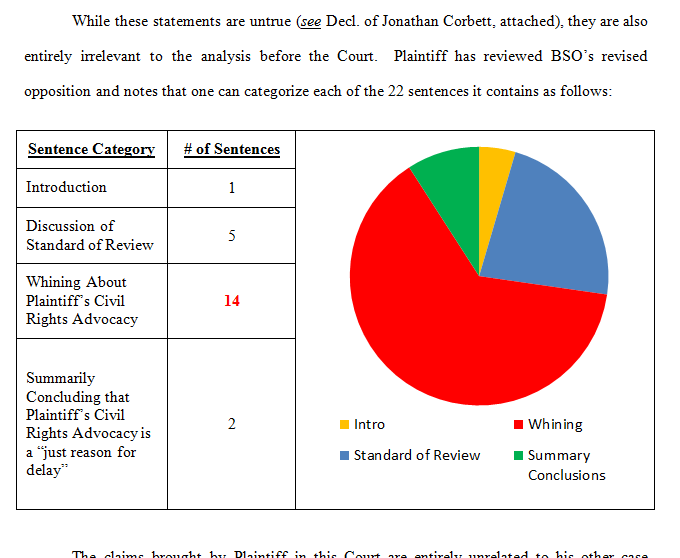
The TSA, surprisingly, had no opposition to this, since as a party who is experienced in being sued, they understand that my appeal is as of right and will happen sooner or later. Broward County and its sheriff, however, wrote to the court to ask that she not certify that judgment is final on those counts, despite the fact that the appeal will happen eventually (after the 2 remaining counts are settled) even if the judge refuses to certify. I have no idea why they want to delay, since as a pro se litigant I have all the time in the world. The reply of the sheriff, however, was particularly hilarious: he spent more than a full page whining about how I travel around suing everyone and therefore the judge shouldn’t certify. Obviously, this is entirely irrelevant and untrue: I’ve gone after the TSA in one district ever.

So, I made this little infographic to help the court to parse the sheriff’s reply:

nowhining

It sucks that tax dollars are being wasted on this futile motion, especially in light of the fact that I have offered to settle for changes to policy instead of money — an offer that was declined.

Blog at WordPress.com.

Up ↑