Miami: Taking Pictures? We’ll Question You.

If this blog interests you, chances are you follow other news sources that have covered attempts by police and other government officials (including, of course, TSA screeners) to crack down on citizens that use their cell phone cameras to record the activity of those government officials. Carlos Miller, a Miami-based photographer and activist, formed Photography is Not a Crime (PINAC) after being detained (now on several occasions) for an even less confrontational reason: capturing photos and video of buildings and transportation hubs. PINAC covers stories of people being denied their First Amendment rights at an astounding frequency: the front page of PINAC has 8 stories from the last 12 days alone.

Carlos’ most recent personal interaction was on Miami’s Metrorail system, where he was pushed down an escalator and arrested by security for no more than taking pictures from the platform while he waited for his train — and this wasn’t even the first time the same security company — “50 State” — arrested him for the same reason!

Being a Miami resident myself, I contacted county officials to express that I no longer felt safe on the county’s public transit as a result of the abuse of this security contracor. (I also contacted state officials to request a review of 50 State’s license to act as a security firm and the individual guards’ licenses to open carry a firearm as a security officer.) After significant back-and-forth and many ignored messages that required follow-up, the last message I received was from Eric Muntan, Chief of the Office of Safety and Security of Miami-Dade Transit:

First and foremost, MDT fully acknowledges that members of the public can take photographs in the common areas of public facilities. Areas within the public view are open to photography, as long as the activities do not present a safety concern for transit operations.

At the conclusion of its investigation of this incident, MDT took numerous administrative actions to effectively address areas which needed enhancements, to include, but not limited to, immediate refresher training for all MDT-contracted security officers regarding the proper interpretation of commercial photography and an individual’s right to photograph common areas of our facilities.

However, given the threats against mass transit systems, both domestic and abroad, and in order to protect the safety of its transit system, its customers and its employees, MDT reserves the right to question individuals taking photographic images at our stations.

However, that stance may not actually be lawful. The police have great leeway to ask questions of nearly anyone (so long as those people are not obligated to answer and are “free to go”). However, they still can’t do so in an arbitrary or capricious manner: they need a reason — however flimsy — to do so. Virtually any reason will do, except a reason that rests upon violating someone’s rights. And, if the county is admitting that it your right to take pictures (which it is), it would seem to me that they would need a reason beyond the mere taking of pictures.

It is nice that Miami is taking at least some steps (retraining, for example) to remedy the problem, but in the end, the problem won’t go away until the mindset is changed: holding a camera should not subject you to any government contact in and of itself.

NYPD: Can’t Sue Us Over Body Scanners Until We Violate You

In my suit against terahertz imaging by the NYPD, their motion to dismiss based primarily on standing is now fully briefed. In it’s final say on the matter, the NYPD argued the following:

Plaintiff Will Have Standing If, And When, The NYPD Implements The Scanners And Plaintiff Is Among The Scanned

In other words, the NYPD argues that the courts may not prevent the NYPD from violating the people — they must wait until they have already violated the people. Luckily for the people, that’s actually not the legal standard. In addition to stepping in once an actual injury has occurred, the courts may step in when an injury is “imminent.” Lujan v. Defenders of Wildlife, 504 U.S. 555, 560, 561 (1992). Additionally, threatened injury is sometimes enough to cause actual injury (for example, a threat to the right to speak freely is often enough to convince a court that people are not speaking because of the threat, and therefore an actual injury exists). The court may or may not decide that my injury is imminent enough (and if he decides against, I can re-open the case as soon as the scanners hit the streets), but it certainly won’t be based upon the NYPD’s deranged interpretation of the cases and controversies clause.

Corbett v. City of New York II – Motion to Dismiss (.pdf)
Corbett v. City of New York II – Motion to Dismiss Opposition (.pdf)
Corbett v. City of New York II – Motion to Dismiss Reply (.pdf)

Texas Debates Anti-TSA Bill, Asks Me to Testify

Today, the House of Representatives of the State of Texas debates H.B. 80 (information, full text), a bill to amend their official oppression statute to criminalize requiring genital touching (even through clothes), as well as the separation of parent and child, during security searches incident to transportation. The bill was introduced by Rep. David Simpson, who invited me to testify on the matter.

While I wasn’t able to make it in person, as I got less than 24 hours notice of the hearing, I put together 10 pages of written testimony that highlights the current problems with the TSA and the solutions offered by H.B. 80. H.B. 80 is more well-crafted than predecessors in the Texas legislature that two years ago prompted the TSA to threaten to declare Texas a “no-fly zone,” including text limiting the scope and declaring severability of the clauses.

It’s important that we support efforts like this, because even if the federal government thwarts the legal effect, they cannot thwart the attention that such measures bring to its abuse. If you live in Texas, contact your representative and let them know you support H.B. 80. Likewise, if you know someone who lives in Texas, please pass the message along.

Testimony of Jonathan Corbett, Texas House of Representaves, April 10th, 2013 (.pdf)

Eleventh Circuit: “Zero Fucks Given.”

Today the Eleventh Circuit Court of Appeals, in considering my case against the constitutionality of the body scanners, denied my motion to transfer, motion to stay the use of body scanners during the petition, and even denied my motion to file electronically — a routine motion that allows a non-lawyer to use the court’s e-filing system, as 3 other federal courts have for me already.

Their reason? Why, they didn’t say.

The court denied all three motions together in a 1 page order that offers no insight at all into their decision.

Perhaps the court thought it would be obvious as to why they denied a motion implicating fundamental constitutional due process rights that required 74 pages of briefs, plus exhibits, from the government and myself. Or perhaps, as I more suspect, the just don’t give a fuck. Just as the U.S. Supreme Court also didn’t care about whether the nude body scanners ever went to trial.

At some point, it gets frustrating when you’ve followed all the rules and still, now 2.5 years and several hundred pages of legal writing later, your issues aren’t even close to being given a fair hearing. My next step is to ask the judges to explain themselves. Should they fail to work out a solution, they will essentially hear my case solely on the evidence as presented by the government — an utter miscarriage of justice.

Corbett v. DHS – Summary Denial of Motions (.pdf)

Fully Briefed: Would Releasing Videos of TSA Screeners at Checkpoints Violate Their Privacy?

Although the question of whether a TSA screener can detain travelers at checkpoints will be decided at a later day by the Eleventh Circuit Court of Appeals, earlier this week I filed the final brief before U.S. District Judge Joan A. Lenard decides the following questions:

  1. Would releasing videos that show the faces of TSA screeners while working at checkpoints violate their privacy?
  2. Would releasing the names of those screeners violate their privacy?
  3. Can a government entity lie, in response to a Freedom of Information Act request, about the existence of a record deemed to be Sensitive Security Information?

Question 1, I think, borders on the absurd.  The idea that a bunch of public servants working in a public place have some sort of right to privacy sufficient to hide any video taken of them is absurd, especially in light of the fact that us “normal citizens” have no such reasonable expectation when we walk around in public.

Question 2 measures only marginally lower on the absurdity scale.  TSA screeners wear name tags and ID badges when working at the checkpoint.   Somehow, the identity of TSA screeners is public while they’re working, but if an incident happens, all the sudden, that information is now private.  Do we have a right to know who we, the taxpayers, have hired to work for us?  Would release of this information increase accountability to the public?

Question 3 also deals with accountability: if the government is allowed to lie about having “secret” records, it can mark any record as “secret” and the public would have no way to challenge that because we’d have no way to prove that a record existed in the first place.  If revealing the existence (or non-existence) of a document would truly harm national security, this is precisely the situation for which a Glomar denial (“we can neither confirm nor deny…”) was invented.  Instead, Broward County chose to lie, and then to double down by defending that lie through summary judgment.

So far, this particular judge has not looked too favorably on my case.  She dismissed 19 out of 21 counts so far (those involving the illegal search and seizure itself), denied a motion for reconsideration without explanation and analysis, and ignored a motion to begin the appeal of the 19 dismissed counts while the 2 remaining counts are pending.  The 19 dismissed counts will make it to the appeals court sooner or later regardless, but for the remaining counts, I am still optimistic that the law is clearly on my side and Judge Lenard will rule in my favor.  There is no time-table for her ruling, but since I don’t feel like she particularly wants my case in her courtroom, I expect that she’ll rule fairly quickly — within a month.

Corbett v. TSA – Motion for Summary Judgment (TSA) (.pdf) (3 MB)
Corbett v. TSA – Motion for Summary Judgment (Broward) (.pdf)

Corbett v. TSA – Opposition to Defendants’ Motions and Cross-Motion for Summary Judgment (Jon) (.pdf)

Corbett v. TSA – Reply & Cross-Motion Opposition (TSA) (.pdf)
Corbett v. TSA – Reply & Cross-Motion Opposition (Broward) (.pdf)

Corbett v. TSA – Reply to TSA’s Opposition (Jon) (.pdf)
Corbett v. TSA – Reply to Broward’s Opposition (Jon) (.pdf)

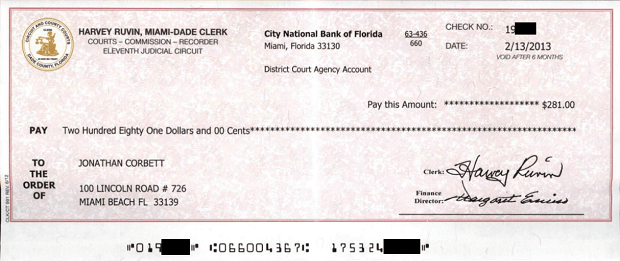
Miami (Finally) Pays Parking Ticket Appeal Costs

ptikcheck

In 2011, I was given an improper parking ticket on South Beach, which naturally I brought to court. However, Hearing Officer Carmen Dominguez was not interested in, well, hearing, and repeatedly made me discontinue relevant lines of cross-examination of the meter wench who cited me. Despite that, I got said meter wench to admit that she did not know the definition of “parking” in Florida, and despite that, Carmen found me guilty. So I appealed, complete with $301 filing fee for an $18 citation, and won.

The circiut court, finding that the meter wench had “a misconception of the statutory definition of park or parking,” shortly thereafter awarded full costs to me. Six months later, I finally have the last of the money due. Success. 😀

Delta CEO <3s TSA, Warns of Pocket Knife Terror

The TSA recently decided to relax its rules regarding small (6 cm or smaller) pocket knives, allowing them to be taken past security and into the airplane cabin. After this fleeting moment of common sense from the TSA (as post-9/11, no terrorist would even think of taking on a cabin full of Americans armed only with 2″ knives), Delta CEO Richard Anderson begged TSA Administrator John Pistole to reconsider, in a love letter addressing both parties by first name and gushing that Delta “will always be good partners with the TSA.”

It is truly unclear to me why those in the industry feel the need to ass-kiss with the TSA at all times. They can’t possibly think that the TSA is an effective, well-run organization. Do they fear retribution if they speak out? Or is it simply that they enjoy having a third party take the responsibility (and blame) for aviation security?

Delta, unfortunately, is not the only people who oppose the policy change. Useful idiots on both sides in Congress, such as Chuck Schumer on the left and John McCain on the right, flight attendants and pilots, and Jon “The Skies Are Falling” Adler of the Federal Law Enforcement Officers Association, who cries, with trembling voice and while holding his mommy’s hand, that “if [the new policy] isn’t changed, say a prayer, rub a rabbit’s foot, and get ready to fly the deadly American skies.”

Most of the opposition talks about generic “safety” in the skies, avoiding the unjustifiable proposition that a pocket knife would make the difference between success and failure of a terrorist attack. But, what does this mean? Safety of flight attendants? That of other passengers? If so, then we might as well ban knives on buses, in McDonald’s, and everywhere else, since the people there are just as deserving of safety via governmnet-imposed weapons searches as FAs and airline passengers. The “anything to keep us safer” crowd strikes again, this time taking things even farther than the TSA (perhaps because knife detection doesn’t give the TSA an excuse to buy shiny new toys like nude body scanners).

You may have never expected to read this on this blog, but TSA Out of Our Pants fully supports this change in TSA policy.

One Year Later, State of the TSA

One year ago, I published my video exposing the TSA’s nude body scanners as vulnerable to an extraordinarily simple attack: any metal objects placed on the side of the body are invisible. The TSA mocked, then threatened, then downplayed, but never denied that the $1B of our tax dollars spent on the most invasive search ever directed at the general public in the history of our nation is great at finding TSA screeners with small genitalia but utterly useless against fighting serious threats to aviation security.

Before I published my video, I said to my friends, “This is it — this is the end of the body scanners!” I believed that if the vulnerability I published was publicly exposed, the TSA would be forced to remove the machines. Anyone can use the technique to bring even a firearm through security completely undetected so the TSA would have to get rid of them, I thought. Yet one year later, the scanners are still here (and yes, I tested the exploit on one of the new millimeter wave scanners with ATD, the kind that swirl around your body and “create a [fake] 3-D image”). The TSA is too proud to return to metal detectors and admit that it wasted your money and invaded your privacy for nothing… even if that pride means we are significantly less safe when we fly.

We’ve seen some changes over the last year. We’ve seen one of the two types of scanners removed — the Rapiscan backscatter x-ray devices — and the other upgraded to include “automated threat detection” so that live people (supposedly) never see your nude body. This is a huge win, not only for privacy advocates but for those concerned about being dosed with ionizing radiation by their government. We’ve seen the TSA shrink back from threats of fines and jail for those who don’t want to allow the TSA to “touch their junk” (new non-public policy is simply to ask you to leave). We’re also seeing that court battles, after being tossed over questionable technicalities that the U.S. Supreme Court refused to address, are finally moving towards being heard.

We still have more work to do. The privacy violation, in the form of having every square inch of our bodies analyzed without cause (resulting in countless drug charges but zero terrorism charges), still exists. TSA assholery, from strip searching grannies, to stealing iPads, to traumatizing rape survivors, to making kids cry just for fun, to collaborating with airports to lie in Freedom of Information Act responses, still exists. But we’re getting somewhere, slow as it may be. If you’ve donated, shared links with your friends, or simply opted-out, thank you for your help.

TSA Accidentally Publishes Copy of My Drivers’ License in Brief About Privacy

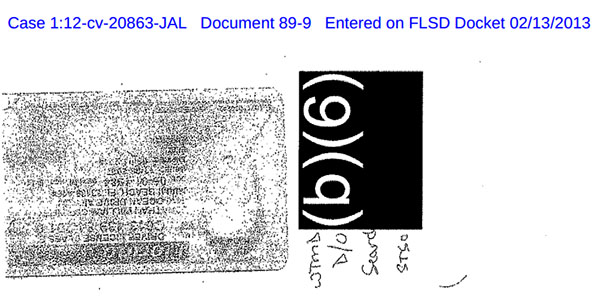
I realized after I made my last post that the TSA, in its brief explaining why its employees deserve privacy in the form of having their names and faces redacted from any documents it releases, accidentally (I would assume) published a copy of my drivers’ license!

While not the cleareset image in the world, in the version you can download from the court, you can zoom in well enough to get most of my name, most of my drivers’ license number, and my date of birth (a violation of Fed. R. Civ. P. Rule 5.2(a)(2)). I’m leaving it up on the blog because I’m always happy to trade a little of my privacy for the sake of exposing the hypocritical foolishness of the TSA. That and you know that if you steal my identity, I’ll track you down. 😉

Blog at WordPress.com.

Up ↑