Some “Light Reading” from the TSA, Some Denied Reading from the NYPD

Corbett v. TSA Administrative RecordMy fight against the TSA’s nude body scanners is approaching the deadline for briefs (in the Court of Appeals, the main briefs are, essentially, the entirety of your case). Pictured here is the “administrative record” as filed by the TSA. Some of it is public record (and will be posted here in full when I have a chance to scan it), other parts are claimed to be secret for various reasons (the release of which will be fought for in court at the appropriate time), and some parts are redacted (as if anything the TSA does would actually dissuade a terrorist). It totals about 1,600 pages (still about 30% shorter than ObamaCare!), and I’ll be asking for a time extension shortly to allow me a full opportunity to comb through each and every page.

My other three suits (illegal detention at FLL, NYPD stop-and-frisk, and NYPD street body scanners) are still awaiting rulings on dispositive motions, as they have been since April. I have no idea why these are going so slowly — the issues presented are hotly debated but not terribly complex.

nofoiaIn other news, I sent the NYPD a public records request a few weeks ago on a matter completely unrelated to my lawsuits (I asked for information regarding how they determine whether to accept or reject pistol permit applications). The NYPD has a “FOIL Unit” that is a part of its “Legal Bureau,” which is where the request was sent. I got back a letter stating that they don’t have the records, but that “NYPD – License Division” may have them. So, essentially, the NYPD asks for records requests to be sent to a specialized department that, obviously, doesn’t have the records in their office and refuses to go and get the records. I’m presently awaiting a callback from Lt. Mantellino to explain why he feels that this run-around is in any way legal.

Eleventh Circuit: Nope. Still No Discovery.

A couple months ago, the Eleventh Circuit denied my motion to transfer my case regarding the constitutionality of the TSA’s nude body scanners to district court for evidentiary hearings. They did so without comment. I followed up by asking them to do the only other thing they can do under their rules to allow me discovery, which is to appoint a “special master” (basically, a discovery judge). The Eleventh Circuit today denied this, again without comment.

The court was nice enough to append this load with a cherry, denying the TSA’s request to make me sign a non-disclosure before receipt of copyrighted materials, and requesting additional briefing on whether the TSA should provide me with SSI and non-classified summaries of classified documents. The last thing the TSA wants to do is hand me SSI, so the mere possibility of that is making someone in Arlington uncomfortable at the moment.

This petition will now continue based only on the record produced by the TSA and what I can attach to my brief as an appendix. This far cry from due process can’t be appealed at the moment, but it is possible that I could raise the issue on appeal if (lol) the Court decides that the nude body scanners are constitutional.

Corbett v. TSA – Order (.pdf)

It’s a little TOO quiet…

It’s now been a full month since I’ve seen the familiar “Activity in Case…” e-mails that the federal court system sends to litigants registered for electronic filing. Considering I have four cases open in four different courts, it’s the first time I’ve had a month of quiet since 2011. This gives me a little time to write my comment for the TSA’s public rulemaking regarding nude body scanners (due by June 24th, 2013 — no legal experience required, just let the TSA know how you feel!) and my appeal that is inevitable regarding (in largest part) U.S. District Judge Joan A. Lenard’s decision that TSA screeners enjoy qualified immunity for unlawful searches even when they know they intentionally continue their search beyond what is necessary to find weapons.

So, here’s where we are right now:

I have this sneaking suspicion that I will shortly be innundated with rulings and legal documents to write. The calm before the storm… 😉

U.S. Attorney Discusses TSA Case with Judges — Without Informing Other Side

My petition to review the constitutionality of the TSA’s nude body scanner programs is presently before three judges of the Eleventh Circuit Court of Appeals, who are trying to figure out how much information the TSA can refuse to provide to me (or require me to keep secret), some of which is clearly non-disclosable (classified information) and others of which are laughable (copyrighted documents, documents stamped “For Official Use Only” — a designation invented by the TSA with no legal significance, etc.).

I received notice today that the government has filed these documents under seal (meaning not publicly) and ex parte (meaning I don’t get a copy) “at the request of the Court.” But, I’ve never seen that request. I’ve never been a party to — or even aware of — discussions where the Court woud have made such a request.

If the Court is going to insist on secret filings, it could at least be up front about it.

Corbett v. DHS – Notice of Lodging (.pdf)

Eleventh Circuit: “Zero Fucks Given.”

Today the Eleventh Circuit Court of Appeals, in considering my case against the constitutionality of the body scanners, denied my motion to transfer, motion to stay the use of body scanners during the petition, and even denied my motion to file electronically — a routine motion that allows a non-lawyer to use the court’s e-filing system, as 3 other federal courts have for me already.

Their reason? Why, they didn’t say.

The court denied all three motions together in a 1 page order that offers no insight at all into their decision.

Perhaps the court thought it would be obvious as to why they denied a motion implicating fundamental constitutional due process rights that required 74 pages of briefs, plus exhibits, from the government and myself. Or perhaps, as I more suspect, the just don’t give a fuck. Just as the U.S. Supreme Court also didn’t care about whether the nude body scanners ever went to trial.

At some point, it gets frustrating when you’ve followed all the rules and still, now 2.5 years and several hundred pages of legal writing later, your issues aren’t even close to being given a fair hearing. My next step is to ask the judges to explain themselves. Should they fail to work out a solution, they will essentially hear my case solely on the evidence as presented by the government — an utter miscarriage of justice.

Corbett v. DHS – Summary Denial of Motions (.pdf)

Fully Briefed: Would Releasing Videos of TSA Screeners at Checkpoints Violate Their Privacy?

Although the question of whether a TSA screener can detain travelers at checkpoints will be decided at a later day by the Eleventh Circuit Court of Appeals, earlier this week I filed the final brief before U.S. District Judge Joan A. Lenard decides the following questions:

  1. Would releasing videos that show the faces of TSA screeners while working at checkpoints violate their privacy?
  2. Would releasing the names of those screeners violate their privacy?
  3. Can a government entity lie, in response to a Freedom of Information Act request, about the existence of a record deemed to be Sensitive Security Information?

Question 1, I think, borders on the absurd.  The idea that a bunch of public servants working in a public place have some sort of right to privacy sufficient to hide any video taken of them is absurd, especially in light of the fact that us “normal citizens” have no such reasonable expectation when we walk around in public.

Question 2 measures only marginally lower on the absurdity scale.  TSA screeners wear name tags and ID badges when working at the checkpoint.   Somehow, the identity of TSA screeners is public while they’re working, but if an incident happens, all the sudden, that information is now private.  Do we have a right to know who we, the taxpayers, have hired to work for us?  Would release of this information increase accountability to the public?

Question 3 also deals with accountability: if the government is allowed to lie about having “secret” records, it can mark any record as “secret” and the public would have no way to challenge that because we’d have no way to prove that a record existed in the first place.  If revealing the existence (or non-existence) of a document would truly harm national security, this is precisely the situation for which a Glomar denial (“we can neither confirm nor deny…”) was invented.  Instead, Broward County chose to lie, and then to double down by defending that lie through summary judgment.

So far, this particular judge has not looked too favorably on my case.  She dismissed 19 out of 21 counts so far (those involving the illegal search and seizure itself), denied a motion for reconsideration without explanation and analysis, and ignored a motion to begin the appeal of the 19 dismissed counts while the 2 remaining counts are pending.  The 19 dismissed counts will make it to the appeals court sooner or later regardless, but for the remaining counts, I am still optimistic that the law is clearly on my side and Judge Lenard will rule in my favor.  There is no time-table for her ruling, but since I don’t feel like she particularly wants my case in her courtroom, I expect that she’ll rule fairly quickly — within a month.

Corbett v. TSA – Motion for Summary Judgment (TSA) (.pdf) (3 MB)
Corbett v. TSA – Motion for Summary Judgment (Broward) (.pdf)

Corbett v. TSA – Opposition to Defendants’ Motions and Cross-Motion for Summary Judgment (Jon) (.pdf)

Corbett v. TSA – Reply & Cross-Motion Opposition (TSA) (.pdf)
Corbett v. TSA – Reply & Cross-Motion Opposition (Broward) (.pdf)

Corbett v. TSA – Reply to TSA’s Opposition (Jon) (.pdf)
Corbett v. TSA – Reply to Broward’s Opposition (Jon) (.pdf)

TSA Accidentally Publishes Copy of My Drivers’ License in Brief About Privacy

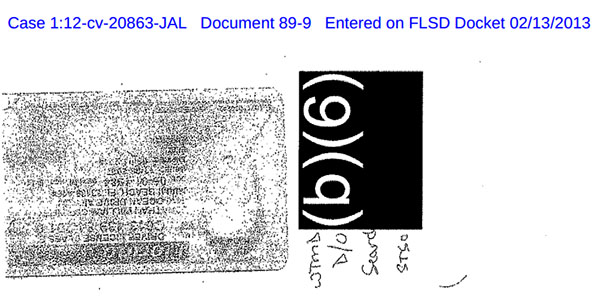
I realized after I made my last post that the TSA, in its brief explaining why its employees deserve privacy in the form of having their names and faces redacted from any documents it releases, accidentally (I would assume) published a copy of my drivers’ license!

While not the cleareset image in the world, in the version you can download from the court, you can zoom in well enough to get most of my name, most of my drivers’ license number, and my date of birth (a violation of Fed. R. Civ. P. Rule 5.2(a)(2)). I’m leaving it up on the blog because I’m always happy to trade a little of my privacy for the sake of exposing the hypocritical foolishness of the TSA. That and you know that if you steal my identity, I’ll track you down. 😉

Jon to Judge: Release the Names of the TSA Screeners Who Harassed Me

A part of my lawsuit from when the TSA detained me in FLL airport in 2011 relates to a Freedom of Information Act request I submitted after the incident, which asks for all documents relating to their illegal detention: incident reports, video, e-mails, etc. After the airport initially lied to me (because they were worried about giving away the “secret” fact that they videotape TSA checkpoints), the airport and TSA have given me most of the documents — with the exception that they took out all the names of all the TSA employees who wrote the documents, and blurred the video so that you can’t see the faces of the screeners. That’s right — the TSA has the right to digitally strip search you, but a video of their faces might violate their privacy.

My brief explains why this is legally wrong, but also why it’s not in the public interest:

The public has an undeniable right to review the actions of its government, and this concept is the very reason for the existence of public records laws like FOIA. As any citizen who has contested a traffic violation has found out, in the context of where a member of the public offers a version of the facts that contradicts a version offered by an employee of the government, all other things equal, courts uniformly adopt the version proffered by the government employee, even in situations where the burden of proof is high. Often times, video evidence is the only means a criminal defendant has in order to dislodge an accusation by a police officer.

But, the public interest of the release of videos of government interaction goes far beyond that of the individual whose liberty or property is on the line. Release of video provides accountability of government officials to the public. When an official knows that his or her actions are being recorded and may be published on the evening news, it is axiomatic that he or she will be more likely to act lawfully and in the public interest.

If there were ever a government agency that could benefit from increased accountability to the public, the Transportation Security Administration is it. In 2012, the TSA has admitted that hundreds of its employees have been caught stealing from members of the public. It admitted to strip-searching grandmothers without lawful authority. It admitted that it hires former clergy accused of sex offenses against children to search children. And, regardless of whether or not such actions are technically legal, it is accused on a daily basis of bullying everyone from grown men to women and children. The TSA is more disdained by Americans than the Internal Revenue Service, a distinction which they have well earned.

Accountability is achieved not by releasing redacted video with blurred faces, but rather by the knowledge that the public – your friends, family, neighbors, letter carrier, Starbucks barista, and anyone else – will judge you if you make a 3-year-old on her way to Disney World cry because you were a power-hungry, arrogant, insensitive, and pathetic individual in the course of your service of the American people. When both the courts and Congress refuse to – or work at a snail’s pace to – leash an out-of-control agency such as the TSA, this is all that we, the people, have left. On the flip side, with the release of video, members of the public who make accusations of mistreatment when they were in fact to blame for an incident will lose their power to malign the agency and its employees.

Defendant TSA is absolutely correct that when the Court releases the full video to Plaintiff, he will publish this video for the world to see. However, if TSA and its employees have done nothing wrong, they should be proud to have that video published, demonstrating their faithful service and that Plaintiff is simply a “troublemaker.” The truth of the matter is that the TSA does not want disclosure of the videos in this case and many others because it knows that while it can argue the legality of its actions in court, it cannot justify its actions to the citizens.

The most awesome part of writing this brief was that the Department of Justice actually did all the research for me. As I was researching case law, I came across the Department of Justice Guide to the Freedom of Information Act, which was written (surprisingly) from an entirely neutral perspective and thoroughly analyzes, with case citations, privacy exemptions to the Freedom of Information Act. Lo and behold, the DoJ opines that “civilian federal employees who are not involved in law enforcement generally have no expectation of privacy regarding their names, titles, grades, salaries, and duty stations as employees…” I couldn’t have said it better myself!

If you want to see what the paperwork looks like when you say “no” to the TSA, check the end of the TSA’s motion (below).

Corbett v. TSA – Motion for Summary Judgment (Broward) (.pdf)
Corbett v. TSA – Motion for Summary Judgment (TSA) (.pdf) (3 MB)
Corbett v. TSA – Motion for Summary Judgment (Corbett) + Opposition to Defendants’ Motions (.pdf)

Broward County Wastes Tax Dollars Delaying Inevitable Appeal

A couple months ago, U.S. District Judge Joan A. Lenard dismissed much of my lawsuit from when I was detained in FLL airport for refusing to let the TSA “touch my junk.” Two of the 21 claims my lawsuit were allowed proceed, and I’d like to appeal the 19 dismissed counts immediately. In order to do that in federal court, I need to have the judge essentialy sign off that those 19 counts are “done.” You might think that it would be obvious that they’re done since they’ve been dismissed, but since the entire lawsuit wasn’t dismissed, that “Rule 54(b) certification” is required.

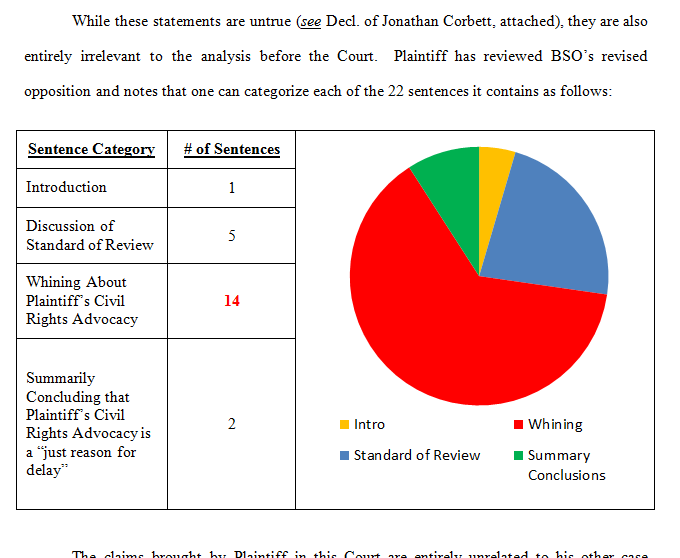
The TSA, surprisingly, had no opposition to this, since as a party who is experienced in being sued, they understand that my appeal is as of right and will happen sooner or later. Broward County and its sheriff, however, wrote to the court to ask that she not certify that judgment is final on those counts, despite the fact that the appeal will happen eventually (after the 2 remaining counts are settled) even if the judge refuses to certify. I have no idea why they want to delay, since as a pro se litigant I have all the time in the world. The reply of the sheriff, however, was particularly hilarious: he spent more than a full page whining about how I travel around suing everyone and therefore the judge shouldn’t certify. Obviously, this is entirely irrelevant and untrue: I’ve gone after the TSA in one district ever.

So, I made this little infographic to help the court to parse the sheriff’s reply:

nowhining

It sucks that tax dollars are being wasted on this futile motion, especially in light of the fact that I have offered to settle for changes to policy instead of money — an offer that was declined.

The TSA Likes It Both Ways

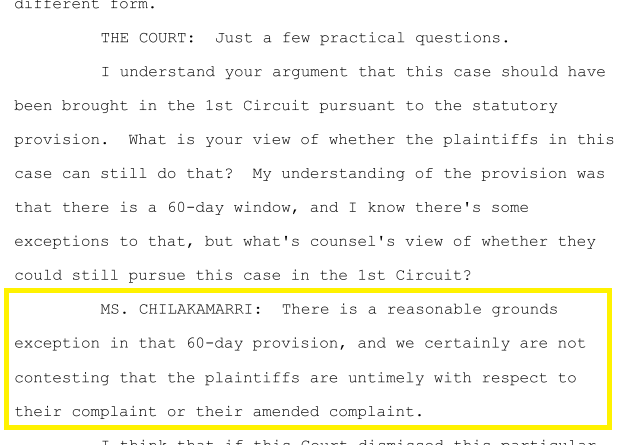
If you’ve been following for a while, you know that my first filing for court review of the TSA’s nude body scanner and genital molestation program was booted for being filed “in the wrong court” (if by “wrong” they mean “in the court that would give me the best opportunity to challenge the TSA’s unconstitutional behavior”). In order to convince the courts to dismiss my case and the several others like it, it had to assure the courts that the other court — the US Court of Appeals — actually would have jurisdiction. This was a problem, since filing in that court has a statutory time limit of 60 days absent “reasonable grounds” for delay.

So, when another plaintiff, who filed virtually the exact same complaint as I did (in large part word-for-word ;)) pointed this out to the judge in their case, the government argued that the “reasonable grounds” clause would clearly cover such a case, and the court need not worry about it:

assholery1

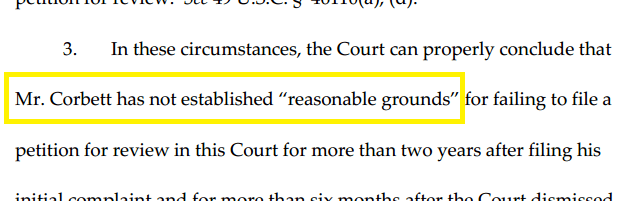
Months later, here we are in that Court of Appeals that the TSA insisted on. And, of course, now the TSA argues that reasonable grounds don’t actually apply:

assholery2

Just another fine example of the Department of Justice’s “Win At All Costs, Fuck Justice” attitude. Luckily, courts are not keen on hypocrites and arguing one thing in front of one court and the opposite in another is barred by the doctrine of judicial estoppel. …in theory, at least. Ruling in favor of the TSA here would mean that “scope & grope” would never be able to be reviewed by any court, ever, which is equivalent to placing the Constitution in the fireplace. Let’s see how the court handles this one!

Blog at WordPress.com.

Up ↑