International Security Interview Program Created for Event That Didn’t Happen

Yesterday I filed my opening brief — the main document that sets out one’s case in the U.S. Court of Appeals — in my case against the TSA’s international security interview program (ISIP).  With the ISIP, the TSA forces airlines that are flying back to the United States to hire security contractors to ask you and everyone else on your flight personal questions.  The idea is that a terrorist wouldn’t be able to keep composed, and refusal to answer their questions seems to mean denied boarding (although the TSA says they don’t strictly require denied boarding).
theadminrecord
The Administrative Record in
Corbett v. TSA, 15-10757

When challenging TSA decisions, the TSA is required to produce all of the documents related to the decision together in a collection known as the “Administrative Record.”  The document is, of course, heavily redacted because the TSA likes to pretend that it has secrets like real federal law enforcement agencies do.  The Administrative Record in this case was strange, though: it didn’t contain a single document that discussed the efficacy of the program, nor one discussing how the program was planned, nor a privacy impact assessment.  It didn’t even explain why the program was created, except for an 8-page declaration submitted by TSA Director of Aviation Michael Keane, created not when the program was, but in response to my lawsuit:

This overseas interview process was instituted [after] an incident that occurred at London’s Heathrow Airport in April 1986. That incident centered around Nezar Nawwaf al-Mansur al-Hindawi, a Jordanian national who had been recruited by Syrian Air Force Intelligence to participate in a plot to destroy an El Al airliner. In furtherance of that plot, Hindawi placed explosives in the bag of his pregnant Irish fiancee, Anne-Marie Murphy, prior to her flight on an El Al aircraft bound for Tel Aviv, Israel. When she attempted to board her flight at Heathrow Airport, however, El Al security officials stopped her and discovered the explosives. A crucial step in the detection of this plot was the fact that El Al officials questioned the passenger about her luggage and its contents.”

Well, that sounds like a reasonable explanation… until you consider two things:

  1. El Al’s program is based on, and works only because it uses, blatant ethnic and religious discrimination.  It is not secret at all that if you are Jewish or Israeli, you are assigned a low risk and cleared quickly, while if you are Muslim or Arabic (or just happen to say the wrong thing), you’ll be strip searched, your bags will be emptied and each article x-rayed individually, and you’ll be seated next to an air marshall.  Its program is so abusive that it demands its security officials be given diplomatic immunity.  Even if we really wanted to model this (and as a free nation, we shouldn’t), El Al’s program only functions when they are able to narrow down the travelers to get the “full treatment” via this discrimination.  It would be impossible to do what they do to Muslims to the entire flight.
  2. The Hindawi plot was not uncovered because of an interview!  Yes, El Al interviewed Ms. Murphy, but according to the Israel Security Agency, the interview went well and aroused no suspicions:

No suspicious signs were revealed during her questioning. The passenger, who gave the impression of being a simple woman, responded in the negative when asked if she had been given anything to bring to Israel. During the questioning she was calm, and revealed no sign of nervousness. In the check of her baggage, suspicious signs came to light…

So let’s get this straight: the TSA has a program modeled after one that blatantly discriminates against people based on their skin and which god they pray to, removed the discrimination (mostly) but still expected the program to function the same way, and justifies it based on an event that didn’t actually happen the way they claim.  And I’m the asshole for refusing to participate.  Got it.

Corbett v. TSA III – Opening Brief (.pdf)

Corbett v. TSA III – Administrative Record, Vol. 1 (.pdf, 14 MB)
Corbett v. TSA III – Administrative Record, Vol. 2 (.pdf, 18 MB)

Five Year Anniversary

It’s tough to imagine it’s been 5 years since this journey started, but a quick look back to post #1 shows that I filed my first lawsuit against the TSA on November 16th, 2010.  There are a few things going on:

  1. Tomorrow I take my first year law school final exams!  Very excited. 🙂
  2. My suit against the TSA’s international security interview program is slowly moving forward, as the TSA has finally (10 months and 2 motions later!) filed the “administrative record” that underlines the bases for their decision to implement the program.  More on that coming soon.
  3. My draft legislation to ensure that the TSA can be held accountable when it oversteps its bounds is almost done, at which point I’m going to work on getting some partners on board to submit the bill to Congress.

Thank you for 5 years of support, guys… it’s been awesome. 🙂

Supreme Court Denies Review of Nude Body Scanner Lawsuit

With your support, I fought the good fight for over 4.5 years.  Today, the U.S. Supreme Court refused to hear my petition for review. This brings my court battle to an end.

We’re not without small victories. In 2012, Congress banned body scanners that require visual inspection by a human TSA screener. This also had the side effect of removing all the scanners that used x-rays, thought to be far more dangerous than the millimeter wave scanners. During this time the TSA’s press has gone from bad to abysmal, with the latest news being that 95% of the time the TSA tests its own screeners’ ability to detect contraband, the screeners fail. And without a doubt, the pressure we’ve put on the TSA has held them back from whatever their next intrusive and expensive new toy would have been.

While the courts have covered their ears, we have 2 other branches of government that can make this better. The next step on my end shall be to make noise towards our legislators. I’ll be working with the right people to make that happen, and it’s my hope to help draft legislation to make the situation better. I’ll also be continuing my lawsuit against the TSA’s international security interview program. Perhaps one more victory to add to the list is that the TSA has turned me into a life-long civil rights advocate, as I finish my first year of law school later this year.

Thank you, again, for all your support. I would have stopped long ago without your constant reminders of how important this is to you all. 🙂


Want to donate to the fight against TSA assholery? PayPal or Bitcoin: 15ftA2938sp7Mnsi8U7wYVmEtd4BRbFnkT

TSA Backtracks on International Security Interview Program, Says Answering Questions Not Mandatory

Last January, I exposed the TSA’s International Security Interview Program, a secret, never before disclosed TSA mandate requiring U.S.-based airlines to question passengers before returning them to the states. I encountered the program before a flight from London to New York, and I filed suit against this unconstitutional restriction on our rights to travel and to remain silent after the TSA confirmed to me by e-mail that failure to comply = denied boarding:

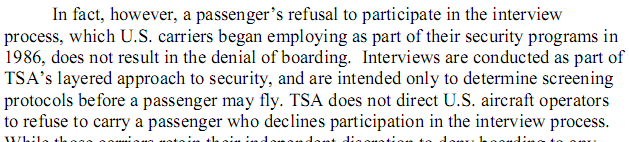
TSA Reply

While often times a first filing by the opposing party is a pleading responsive to the complaint (in District Court) or the filing of an “administrative record” (in the Court of Appeals), the court, on its own, asked the parties to explain whether there was proper jurisdiction, and the first filing by the TSA not only admitted jurisdiction, but confirmed that it mandates airlines have such security programs and that the airline “must refuse to transport” those who don’t comply:

TSA Reply to Jurisdictional Question

Perhaps realizing that this policy is entirely indefensible, a couple weeks later, without prompting from me or the court, it sent the court a letter to “clarify” any “confusing” statements it made to the court in the previous filing:

backpedal

Well now, that’s better. But what does happen if you refuse? That question is entirely unanswered, but it seems clear that the TSA previously had a policy of forcing denial of boarding, and has backpedaled on it now that it has been exposed. A huge win.

So, I made the TSA the following settlement offer: detail what compliance passengers are required to give, detail what happens if they refuse, and specifically say that boarding will not be denied. Do this in a public bulletin that you post on your Web site. So far they’ve not responded to my offer, made last week. They probably need time to re-write their policies. 🙂

Corbett v. TSA – Original Jurisdictional Question Reply by TSA (.pdf)
Corbett v. TSA – Backpedaling by TSA (.pdf)

TSA Admits International Security Interview Program After Corbett Lawsuit …Plus Secret TSA Document!

For the first time, the TSA has publicly acknowledged its “international security interview program” — a program where U.S. citizens traveling from foreign countries are questioned by security contractors before being allowed to board planes home — in a court filing in response to my lawsuit against the program:

The petition for review challenges the lawfulness of an international security interview program, pursuant to which airlines flying to the United States pose certain questions to passengers before permitting them to board.

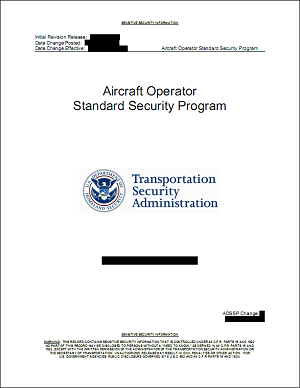
As relevant here, TSA has issued an “Aircraft Operator Standard Security Program (AOSSP)” that incorporates TSA-approved screening protocols. See http://www.tsa.gov/stakeholders/commercial-airlines (last accessed Mar. 26, 2015). The AOSSP is designated as Sensitive Security Information under 49 C.F.R. Part 1520, and has not been publicly released. However, it is correct that, as the petition for review contends, the AOSSP sets out the requirements for air carrier screening of passengers at foreign airports before those passengers are admitted to the secure area of the aircraft and transported to the United States.

To have implemented an entirely new screening program in complete secret with passengers having no notice of a requirement to comply is absurd. To have the contents of that program be a requirement that you talk about your travel plans or face being unable to return to your home country is unconstitutional.

Shhh... this is a secret!!
Shhh… this is a secret!!
How did they get away with this? By ordering the airlines to do their dirty work for them, and then marking the order as “Sensitive Security Information” (SSI), which means the airlines aren’t allowed to talk about it. This Aircraft Operator Standard Security Program (AOSSP) they speak of is a lengthy document containing security rules that airlines are required to follow but are prohibited from sharing.

However, unlike other pieces of SSI (such as the document that implemented the nude body scanners), this document not kept internal to TSA; rather it is distributed to every U.S.-flagged airline with planes over a certain size. The TSA isn’t exactly known for keeping its secrets by itself, but factor in the now thousands of employees and contractors who have access to the AOSSP, and I was fairly easily (and legally, on my end at least) able to obtain a version of it (although it would be nice if someone leaked the latest one to me 🙂 ).

I believe the public has an interest in seeing at least portions of the AOSSP, as it effectively restricts their personal rights, and it does so without notice or meaningful opportunity for review. I gave the TSA first notice of the leak of their information (as I’ve always done, including when I published my video beating the nude body scanners and when I learned that the 11th Circuit had leaked secret documents in my case), and I may in the past, present, or future disclose what I’ve uncovered to attorneys for relevant civil rights organizations. For now, I won’t be disclosing the document or how I obtained it to allow the TSA time to plug their leak, as I believe some information that should legitimately be secret for security reasons was obtainable by me and would be obtainable by others should I disclose the method and/or the contents. (Note: The document was not sent to me by a source in confidence — if it were, I would protect the source to my greatest ability.) I do wish the government would stop relying on security through obscurity and start implementing real, non-invasive, community-reviewed security measures to keep us safe.

In the meantime, I will continue to fight against secret TSA policies that continue to erode our rights.


Want to donate to the fight against TSA assholery? PayPal or Bitcoin: 15ftA2938sp7Mnsi8U7wYVmEtd4BRbFnkT

U.S. Supreme Court Denies Review, Allows TSA To Read Your Personal Documents At Checkpoint

THe U.S. Supreme Court today denied one of my two pending petitions before it. This petition asked the court to review the 11th CIrcuit’s ruling that the TSA’s warrantless checkpoint searches are not limited to weapons or explosives, but can include virtually anything, including your personal documents. Love letters, photographs, business proposals, etc., are all fair game, and it leaves the door wide open to searches of electronic devices, such as your cell phone and laptop. (Note that this petition does not cover the nude body scanners — that petition is still pending.)

The original case comes from 2012, when the TSA decided that it wanted to tear apart my belongings because I had the audacity to refuse to let them touch my genitals at one of their checkpoints. They spent half an hour going through the little pockets inside my pants, flipping through (and reading) pages from books that I had, looking at the names on all the plastic cards they found, and generally looking not for something dangerous, but rather for something illegal, such that they could teach me a lesson about bending over and complying. In the end, they found nothing, and kicked me out of the airport. As icing on the cake, they conspired with the airport authority to lie when I filed Freedom of Information Act requests about the incident.

Other than that their intent was to teach me a lesson, none of the above facts are disputed by the TSA. Instead, they argued that all of the above was totally acceptable (.pdf). And, it worked. The district court dismissed all claims, and the Court of Appeals refused to reverse.

One must ask how much of the Fourth Amendment is left when it is “reasonable” for the government to demand to read your papers simply because you want to travel? Does that remind you of another oppressive regime of the last century? It very much does to me.

Where to from here? If the courts think that current law allows the TSA to conduct these invasive searches that have no real correlation to transportation safety, then the law needs to change. I’ll be waiting for the Supreme Court to rule on the nude body scanner petition first, and then will work on promoting new legislation to fix what the courts should have.

The Final Appeal: Nude Body Scanners Petition Filed in Supreme Court

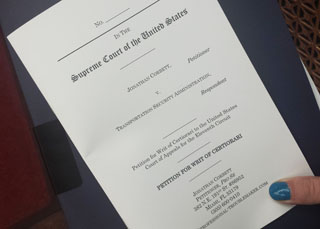
TSA Case Back to Supreme CourtI started this blog about 4.5 years ago with a simple, 5-page complaint stating that imaging my body as a condition of flying violates my rights. The case was filed in a U.S. District Court, then went to a U.S. Court of Appeals, then denied a U.S. Supreme Court review, then back to the Court of Appeals, and now, back to the Supreme Court. If they refuse to hear my case, litigation around the body scanners is over: my case can’t proceed and a challenge from anyone else would be time-barred. If they accept it, it will be a few more years before anything is final, as we work through the Supreme Court arguments process and then (hopefully) end up back in the Court of Appeals. In the meantime, of course, the government is free to continue to abuse our rights.

The petition is fairly simple and really brings up only two issues:

  1. The government had successfully argued that since things bounced around between courts as described above, by the time my case finally got to the right place, it was too late to hear the claim. One should not lose their right to challenge the constitutionality of government policies simply because there was a dispute as to the court to hear the claim, especially since in this case, the policy was issued in secret and therefore there was no way to determine the proper court in advance.
  2. The courts below never allowed me any opportunity for discovery, or any other fact-gathering process, and so they basically decided the case based on the government’s cherry-picked reasons as to why the body scanners are necessary and effective. This one-sided process doesn’t meet due process requirements.

Let’s see if the high court wants to accomplish something!

Corbett v. TSA – Petition for Certiorari

Corbett Sues TSA Over International Security Interview Program

Last month I wrote about an experience I had in December where, before flying from London to New York, I was required to answer questions by an airline security contractor who would then put a “sticker” on my passport to indicate that I had been cleared. Having someone look at my passport and put a sticker on it was nothing new: I assume many airlines would want to make sure that a passenger has the appropriate travel documents to fly to their destination because the airline may be liable for fines if they transport inadmissible passengers. What was new was that the questions asked had nothing to do with my documents or my flight, but were personal questions: Why was I traveling? How long had I been away? etc.

What I encountered in Heathrow was rather reminiscent of the TSA’s “Screening of Passengers by Observation Techniques” (SPOT) program it had run domestically. SPOT was premised on the idea that terrorists probably look visibly nervous and can be identified by talking to them. The program wasted nearly a billion dollars before the Government Accountability Office reported that there was no evidence that the program had any efficacy whatsoever. But, passengers could refuse to participate in SPOT and still be allowed to fly, while the security contractor in London told me that I was required to comply. So I wrote to American Airlines, the airline who hired the contractors, and got a reply:

AA Reply

Ah, so these contractors aren’t merely placed there by the airline, they are “controlled by DHS/TSA.” I was not surprised, despite being in a foreign country. So let’s ask TSA what happens if they get a call from an airline stating that someone has declined to participate in these security interviews:

TSA Reply

To recap, the airline and government is admitting here that there is a program to interview travelers as a condition of flying. I had never heard of such a thing before. Did I have my head in the sand?

Try a Google search. I challenge you to find a single article, announcement, press release, warning, or other indication that the ability to come home would be contingent on telling the TSA why you wanted to travel, written before I published my story last month. There’s nothing, and that’s because, as the TSA also admitted, the program is conducted entirely in secret, using the pseudo-classification of Sensitive Security Information (SSI).

U.S. citizens have the right to re-enter their home country. We also have the right to remain silent when interacting with government officials. The TSA has secretly tried to trick us into picking only one of those two rights. I instead pick both, as well as my right to petition my government for redress, and have filed suit today against the TSA. I’ve asked four federal judges to rule that the program is an unconstitutional violation of our Fifth Amendment rights and to enjoin the TSA from forcing airlines to hire interrogators to sit outside international gates.

Four federal judges, you ask? The TSA was given special rules for jurisdiction over challenges to certain types of TSA decisions known as “orders.” Orders are challenged in front of 3-judge panels of the Court of Appeals, whereas any other TSA assholery is challenged in front of a U.S. District Court judge. Since the international security interview program is a secret, it can’t be determined whether it qualifies as an “order” or not, and if you accidentally file in the wrong court, you’ll be out of time to file in the others. So, my petition was filed simultaneously in the district court covering the airport where I was flying to (the Eastern District of New York) and the appellate court in my home district (Eleventh Circuit Court of Appeals). Double filing fees and double paperwork means that the TSA can’t evade review by claiming that the program is, or is not, an “order” depending on what suits their mood.

Corbett v. TSA III – District Court Complaint (.pdf)
Corbett v. TSA III – Court of Appeals Petition (.pdf)


Donate to support the last remaining lawsuit against TSA body scanners!
PayPal or Bitcoin: 15ftA2938sp7Mnsi8U7wYVmEtd4BRbFnkT

Secret TSA “International Security Interviews” — Thoughts on a Lawsuit?

It’s not often that I learn something completely new about TSA policies, but I was definitely caught off-guard last month when I was told at London Heathrow that I was required to answer some questions in order to board my flight to New York by airline security contractors. Half asleep from a day and a half of flying prior, I encountered the first in the AAdminal’s Club, who I, at first, paid no attention to, but when questions changed from, “Where are you flying?” to “Was your trip for personal or business purposes,” and “Where were you since you left America,” I asked if the questions were necessary, and was told yes. I refused, was referred to an AAdmiral’s club employee, and was allowed on my way.

ictsstickerThe purpose of having this security guy in a lounge turned out to be “convenience.” As I got to my gate, I learned that some passengers had “stickers” on the back of their passports, meaning they had completed one of these so-called “security interviews,” and if I had complied in the lounge, I would have had a sticker. So, being stickerless, another security contractor starts interviewing me, this time asking only 2 questions: where I was flying, and how long I’d be staying there. I gave him a funny look, and he said, “Oh, you live there,” put a sticker on my passport, and let me through.

I immediately complained to AA via e-mail (before I was even in the air), and the next day I had a response that the security interviews in London were TSA-mandated. I asked them to clarify what the procedures were and what happens if a passenger refuses, and was told the procedures were Sensitive Security Information (SSI) and I should contact the TSA. So, I did.

Today, a few weeks later, the reply from the TSA is that security interviews are required as a part of the airline’s TSA-approved security program, that they are indeed SSI, and that failure to comply would result in being denied boarding.

I’m leaning towards filing suit against this policy. Here’s why:

  1. First, it should be clarified that this is *NOT* a border search, a search by Customs & Border Patrol (or their internationl equivalent), or an airline/airport security procedure (the TSA’s phrasing it as the airline’s security program neglects the fact that they forced them to adopt such a program). This is the TSA forcing you to answer questions before you can return. It turns out that not even CBP can force you to answer your questions, if you’re a U.S. citizen.
  2. As an American, I have several rights that cannot be exercised together as a result of this policy. The right to remain silent, the right to travel, and the right to be re-admitted to my homeland are all clearly defined. The TSA is now basically saying, “pick two.” (But, I choose all three, thanks.)
  3. This program is entirely secret. Google for “international security interviews TSA” and see what you get. It’s all about domestic stuff relating to Pre-Check and trusted traveler programs. The contents of this program, as admitted by the TSA and airline, are SSI, have never been disclosed to the public, and even surprised a frequent international traveler and TSA troublemaker like myself. (I’ve had the “sticker” before, but I had never thought anything of it because they had never asked anything more than was printed on my boarding pass.)
  4. My flight was returning home to my family on Christmas day. If the second interviewer had asked the same questions as the first, I would have again refused and been denied the ability to see my family on a holiday because of a secret interview of which I had no notice of a requirement to comply. I don’t want that to happen to me or anyone else in the future. I shouldn’t have to guess whether “none-of-your-business” type questions will be forced on me as a condition of traveling internationally.
  5. Finally, this has to be one of the most useless security measures ever. Like the TSA’s somewhat-abandoned SPOT program, all one need do to defeat it is calmly lie — or print out a sticker in advance.

So, what do you guys think? Is a lawsuit in order here? I’d also love to hear any interesting stories if you’ve been through one of these interviews.

Open Letter to Chief Justice John Roberts

My Supreme Court petition has been re-filed after correcting the “insufficiently thick covers” complained of by the clerk’s office. I also wrote a letter to the Chief Justice to politely remind him that it’s 2015 and that the Supreme Court is behind all other federal courts, save for the Foreign Intelligence Surveillance Court (FISC) as I wrote about on My NSA Records, regarding modernizing filings and public access to court documents. Stuff like “accept electronic filings,” and “if paper filings are necessary, 8.5″ x 11″ paper should be acceptable.”

The Supreme Court should be an example to all other courts of the right way to accept filings, and instead is the most obscure. Let’s hope that John has a moment to read my letter.

Open Letter to Chief Justice Requesting Supreme Court Rules Change (.pdf)
Corbett v. TSA – Petition for Certiorari (Updated) (.pdf)

Blog at WordPress.com.

Up ↑