Public Comments on TSA Body Scanners Counted: 94.0% Opposed

Before making a “substantive change” to regulations affecting the public, the TSA, like all government agencies, is required to engage in “notice and comment rulemaking.”  The basic idea is that before a rule gets made, the agency should publish the proposed change and their reasons for proposing it and allow the public to provide feedback. The agency then reviews the feedback, responds to it, and decides whether or not to proceed with the proposed rule.

The TSA failed to do this before implementing the rule establishing the body scanners as primary screening in 2010, but was ordered to do so post hoc by the U.S. Court of Appeals for the D.C. Circuit, and did so in 2013.  Over 5,500 people took the opportunity to tell the TSA how they felt.

While a quick look made it clear that the overwhelming majority was opposed to the scanners, there was no way to get a count of exactly how many were in favor and how many were opposed.  So, I personally reviewed the 5,578 comments sent in and found as follows:chart

Opposed to the Rule: 5,129 92.0%
In Favor of the Rule (Implants): 115 2.1%
In Favor of the Rule (Other): 214 3.8%
No Position: 120 2.2%
Total: 5,578 100.0%


When all was counted and the comments that took no stance were removed, 5,129 people (94.0%) asked the TSA to discontinue its program of scanning and molesting the public, while 329 (6.0%) were in favor of continuing.  It should also be noted that of the 329 in favor, 115 specifically mentioned that they were in favor because they or a family member has a metal implant in their body (such as a hip replacement, or a pacemaker) that could not pass through a metal detector and that they liked the body scanners simply because they were tired of being patted down by blue-gloved security personnel.

Of those opposed to scanning, the following were the most common reasons given (percentages approximate): invasion of privacy (~34%), violation of rights/unconstitutional (~31%), health risks (~23%), ineffectiveness for security (~12%), cost/benefit analysis (~11%), concern for effects on children (~5%), and a distinct group that requested the TSA to be completely disbanded, defunded, and/or privatized (~2%).

Of those in favor of scanning, the following were the most common reasons given (percentages approximate): artificial implant (~35%), feel safer (~29%), efficient (~7%), effective (~6%), “not a big deal” (~2%), too many “whiners”/”cry babies” (~2%).  Many did not give a distinct reason, simply saying they support whatever is chosen or necessary.  A large percentage also qualified their support on one or more conditions (“if it’s effective…,” “if it’s safe…”).

So, TSA, the public has spoken, and the consensus is clear: body scanners should not be used as primary screening, and if they are to serve any purpose, that purpose should be completely optional screening for those who cannot go through a metal detector and would prefer it to a pat-down.

For complete transparency, I’ve created and hereby publish a full report, indicating which comments were counted as for/against and discussing the methodology, which can be downloaded here:

TSA AIT Comment Index (.pdf)

To view any of the comments, take the following URL:

http://www.regulations.gov/#!documentDetail;D=TSA-2013-0004-XXXX

…and replace the XXXX at the end with the 4 digit comment number from the index.


Fighting the TSA in court is expensive!  Want to contribute to the fight against TSA assholery? Donate via PayPal, Venmo, Chace QuickPay, Bitcoin, or check

TSA Tries to Force Wheelchair Passenger to Stand for Body Scanner

The TSA announcement on December 18th, 2015, that the body scanners would “sometimes” be mandatory was phrased like this:

While passengers may generally decline AIT screening in favor of physical screening, TSA may direct mandatory AIT screening for some passengers.

…which, as someone experienced in translating TSA-speak, I assumed to mean, “We will force you through the scanners whenever the hell we want, especially if we don’t like you on that day.”  But, there were then early rumors that by “some passengers” the TSA was referring only to those on the “selectee list” — an FBI-managed list, much like the no-fly list, that identifies passengers who may fly but only with additional screening.

Those early rumors have been thoroughly dispelled now that reports of actual travelers at the airports are coming in.  Last week, one of our readers reported that despite being PreCheck, she was forced towards the body scanners, only receiving a reprieve by informing them that she is pregnant.  And then, a couple days ago, the TSA attempted to make a passenger in a wheelchair, who was neither PreCheck nor selectee, stand for a scan:

“If you’re able to stand up, you will go through there [the body scanner], you cannot refuse screening.”

~~TSA Supervisory Transportation Security Officer Abdi, SEA Airport, 12/31/2015

Unfortunately, the passenger in the wheelchair is Sai, another civil rights advocate who litigates against the TSA, and Sai caught it all on video:

While, after summoning the highest ranking TSA official in the airport and going through lengthy waits and arguments, Sai eventually was allowed through with the “opt-out” procedure, it seems perfect clear that the TSA is caught in a lie once again: its intent was not that “passengers may generally” opt-out, but rather its intent was that as many be forced through these machines as possible.  To do so to someone who is partially disabled and has difficulty standing on his own for long periods of time is absolutely disgraceful, yet not surprising from this agency.

If you have post-Christmas opt-out stories, please share them with us.


Fighting the TSA in court is expensive!  Want to contribute to the fight against TSA assholery? PayPal or Bitcoin: 15ftA2938sp7Mnsi8U7wYVmEtd4BRbFnkT 🙂

TSA Forces PreCheck Passenger To Scanner, Denies Opt-Out

One of our readers, Tara, reports as follows:

“Apparently those of us with TSA Pre-Check are now going to be subject to random compulsory body scans. Yesterday I was flagged while going through the metal detector for Pre-Check in Akron, Ohio. The agent handed me a laminated green sheet and told me I was randomly selected for additional screening and needed to go through the full body screening machine.  When I tried to opt-out I was told that was ‘no longer an option for those with TSA Pre-Check.’”

The TSA originally said that “passengers may generally decline AIT screening in favor of physical screening” but “TSA may direct mandatory AIT screening for some passengers.”  Initial reports were that the policy would affect only selectee list passengers.  But it took them less than 2 weeks to start applying it to whomever they so choose, including passengers who have gone through fingerprinting, a background check, and payment of fees in order to get PreCheck.


Fighting the TSA in court is expensive!  Want to contribute to the fight against TSA assholery? PayPal or Bitcoin: 15ftA2938sp7Mnsi8U7wYVmEtd4BRbFnkT 🙂

Corbett Sues TSA Over New Policy to Refuse Opt-Outs

Last Friday, the TSA snuck out a document updating the “privacy policy” for the nude body scanners.  On Tuesday, reports started coming in on the change, including right here.  Professional Troublemakers don’t delay, and today, 6 days after the low-key disclosure, I’m happy to announce that I’ve sued the TSA, asking for a preliminary injunction followed by a permanent ban on refusing opt-outs.  But, being Christmas Eve and all, I was sure to make service of the lawsuit festive for the TSA…

20151224_005759

Expertly wrapped in holiday cheer, the TSA shall receive on Friday a petition that asks the U.S. Court of Appeals for the 11th Circuit to consider: 1) whether the body scanner program is constitutional when the option to opt-out is removed, and 2) whether the TSA must engage in “notice & comment rulemaking” before making such a change.  You all may remember that in 2013, the TSA “invited” (after being forced to by the Court of Appeals as a result of EPIC’s lawsuit) the public to submit comments regarding the nude body scanner program.  Over 5,500 of us replied, and well over 95% of the comments were in opposition.  The TSA still hasn’t responded to those comments, but yet feels that it can remove the opt-out procedure without again asking the public or considering our feelings regarding the scanners even with the opt-out option.

In short, TSA, I hope you have a Merry Christmas spent thinking about how you’ve been naughty this year — and every year.

Corbett v. TSA IV – Petition (.pdf)

Corbett v. TSA IV – Motion for PI with Exhibits (.pdf)


Fighting the TSA in court is expensive!  Want to contribute to the fight against TSA assholery? PayPal 🙂

TSA To Make Nude Body Scanners Mandatory — No Right to Opt-Out!

Time and time again, the TSA had argued in lawsuits against the nude body scanners that part of why they fall on the “constitutional side” of the Fourth Amendment is that they are optional.

On Friday, the day all government assholery is disclosed, the TSA published a notice that they are updating the Privacy Impact Assessment relating to the nude body scanners as follows:

TSA is updating the AIT PIA to reflect a change to the operating protocol regarding the ability of individuals to opt opt-out of AIT screening in favor of physical screening. While passengers may generally decline AIT screening in favor of physical screening, TSA may direct mandatory AIT screening for some passengers.

That’s right — the TSA now claims it “reserves the right” to force passengers through the body scanners.

Actually, I think of this as good news.  You see, my last lawsuit was thrown out because it didn’t make it to the right court within 60 days of the release of the scanners.  By changing things around, they’ve now reset the 60 day timer AND adjusted the constitutional balance, meaning my petition will finally get heard.

International Security Interview Program Created for Event That Didn’t Happen

Yesterday I filed my opening brief — the main document that sets out one’s case in the U.S. Court of Appeals — in my case against the TSA’s international security interview program (ISIP).  With the ISIP, the TSA forces airlines that are flying back to the United States to hire security contractors to ask you and everyone else on your flight personal questions.  The idea is that a terrorist wouldn’t be able to keep composed, and refusal to answer their questions seems to mean denied boarding (although the TSA says they don’t strictly require denied boarding).

theadminrecord
The Administrative Record in
Corbett v. TSA, 15-10757

When challenging TSA decisions, the TSA is required to produce all of the documents related to the decision together in a collection known as the “Administrative Record.”  The document is, of course, heavily redacted because the TSA likes to pretend that it has secrets like real federal law enforcement agencies do.  The Administrative Record in this case was strange, though: it didn’t contain a single document that discussed the efficacy of the program, nor one discussing how the program was planned, nor a privacy impact assessment.  It didn’t even explain why the program was created, except for an 8-page declaration submitted by TSA Director of Aviation Michael Keane, created not when the program was, but in response to my lawsuit:

This overseas interview process was instituted [after] an incident that occurred at London’s Heathrow Airport in April 1986. That incident centered around Nezar Nawwaf al-Mansur al-Hindawi, a Jordanian national who had been recruited by Syrian Air Force Intelligence to participate in a plot to destroy an El Al airliner. In furtherance of that plot, Hindawi placed explosives in the bag of his pregnant Irish fiancee, Anne-Marie Murphy, prior to her flight on an El Al aircraft bound for Tel Aviv, Israel. When she attempted to board her flight at Heathrow Airport, however, El Al security officials stopped her and discovered the explosives. A crucial step in the detection of this plot was the fact that El Al officials questioned the passenger about her luggage and its contents.”

Well, that sounds like a reasonable explanation… until you consider two things:

  1. El Al’s program is based on, and works only because it uses, blatant ethnic and religious discrimination.  It is not secret at all that if you are Jewish or Israeli, you are assigned a low risk and cleared quickly, while if you are Muslim or Arabic (or just happen to say the wrong thing), you’ll be strip searched, your bags will be emptied and each article x-rayed individually, and you’ll be seated next to an air marshall.  Its program is so abusive that it demands its security officials be given diplomatic immunity.  Even if we really wanted to model this (and as a free nation, we shouldn’t), El Al’s program only functions when they are able to narrow down the travelers to get the “full treatment” via this discrimination.  It would be impossible to do what they do to Muslims to the entire flight.
  2. The Hindawi plot was not uncovered because of an interview!  Yes, El Al interviewed Ms. Murphy, but according to the Israel Security Agency, the interview went well and aroused no suspicions:

No suspicious signs were revealed during her questioning. The passenger, who gave the impression of being a simple woman, responded in the negative when asked if she had been given anything to bring to Israel. During the questioning she was calm, and revealed no sign of nervousness. In the check of her baggage, suspicious signs came to light…

So let’s get this straight: the TSA has a program modeled after one that blatantly discriminates against people based on their skin and which god they pray to, removed the discrimination (mostly) but still expected the program to function the same way, and justifies it based on an event that didn’t actually happen the way they claim.  And I’m the asshole for refusing to participate.  Got it.

Corbett v. TSA III – Opening Brief (.pdf)

Corbett v. TSA III – Administrative Record, Vol. 1 (.pdf, 14 MB)
Corbett v. TSA III – Administrative Record, Vol. 2 (.pdf, 18 MB)

Five Year Anniversary

It’s tough to imagine it’s been 5 years since this journey started, but a quick look back to post #1 shows that I filed my first lawsuit against the TSA on November 16th, 2010.  There are a few things going on:

  1. Tomorrow I take my first year law school final exams!  Very excited. 🙂
  2. My suit against the TSA’s international security interview program is slowly moving forward, as the TSA has finally (10 months and 2 motions later!) filed the “administrative record” that underlines the bases for their decision to implement the program.  More on that coming soon.
  3. My draft legislation to ensure that the TSA can be held accountable when it oversteps its bounds is almost done, at which point I’m going to work on getting some partners on board to submit the bill to Congress.

Thank you for 5 years of support, guys… it’s been awesome. 🙂

Speaking Tomorrow at 2015 Airport Security Symposium & Conference

If you happen to be in the DC area tomorrow, I’ll be speaking tomorrow on the subject of “TSA Accountability” at the 2015 Airport Security Symposium & Conference, held by the National Association of Airline Passengers. For a very modest registration fee, you can meet myself, Rep. John Mica, Former AK Rep. Sharon Cissna, and many, many others who have been working since at least 2010 to protect your rights at the airport. The NAAP also accepts donations if you’d like to support from afar.

I’ll be publishing my presentation afterwards.

An Act To Hold the TSA Accountable

In 5 years of suing the TSA, I’ve personally encountered an enormous quantity of roadblocks, and I’ve read countless cases that others have put forth that have been similarly shut down without ever reaching the real merits of the case.  Although I’m busily preparing for law school finals at the moment, I’m also slowly making progress on drafting legislation to allow people who are abused by the TSA to successfully litigate by removing those roadblocks.  Some of these changes include:

  • Modifying standards for immunity (sovereign, qualified, etc.)
  • Making sure litigants are entitled to discovery
  • Filling gaps in the Freedom of Information Act and Privacy Act that allow the TSA to evade transparency requirements
  • Ensuring that the TSA cannot hide behind claims of secrecy without review of the courts
  • Holding the TSA accountable for the rampant baggage theft that occurs daily

If you have any ideas that you’d like to suggest, whether on what should be in the bill, how to best present the bill to Congress, or even just a clever name for the bill, please get in touch. 🙂  Remember, this bill is about fixing procedural problems, not disbanding the TSA, removing the body scanners, etc.

Sometimes I’m a Trusted Traveler, Other Times I May Be a Terrorist

The TSA’s ability to predict which travelers are terrorists and which are not is apparently so good that not only can they identify which people are possibly terrorists, but they can also predict whether those people are in a “terrorist mood” before a particular flight, or are feeling rather non-mass murder-y that day. Much like rhythm-method birth control, being able to pick out “safe days” vs. “unsafe days” allows minimal inconvenience for all parties.

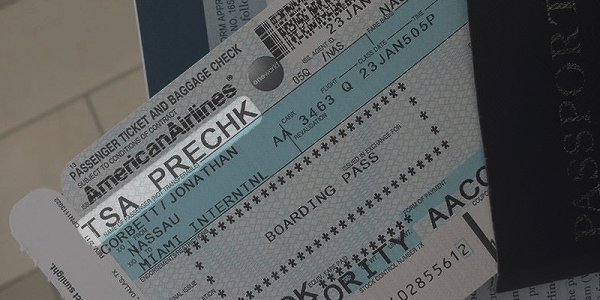
For example, on January 23rd, I was definitely not in touch with my inner jihadi, and so the TSA assigned me Pre-Check status…

Ticket with TSA Pre-Check Endorsement

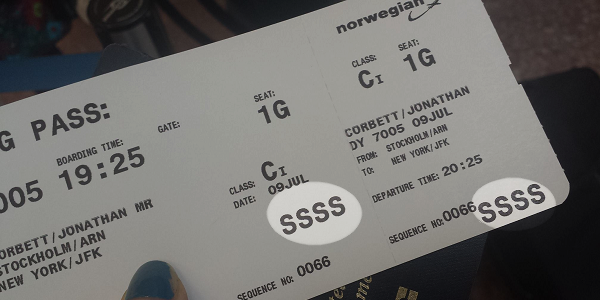
This morning when I woke up, I didn’t even realize that I was feeling like causing some trouble. But luckily, the TSA did, and so they assigned me “selectee” status to dissuade me from bringing any bombs on board…

Ticket with “Selectee” Indicator

If you’re not familiar, the infamous “SSSS” stands for Secondary Security Screening Selection, and is applied to travelers that are on the “Selectee List” (kinda like the “No Fly” list, except they let you fly after petting your genitals before every flight), travelers who trigger an algorithm by doing such things as buying a one-way flight in cash on the day of departure (because Al Qaida can’t afford a round-trip ticket), or at random. It’s unclear why SSSS was assigned to me today or what effect this has for a boarding pass issued at an international airport, as Stockholm didn’t seem keen to treat me any differently, but I for one can’t wait to see what harassment I get when I land in New York.

Obviously I’m being facetious in suggesting that the TSA has the technology to determine which days a dangerous individual might decide to do something bad (and, for the dense within DHS, any suggestion that on some days I might be a terrorist or consider carrying bombs on a plane is also sarcasm). If on some days we’re saying people are trusted enough that they don’t have to take off their shoes, don’t have to take electronics out for separate x-raying, don’t have to go through a body scanner, and are screened using a metal detector calibrated to be less sensitive than usual, but on other days require the most vigorous of security screening, is the system not completely broken?

As far as keeping us secure, it is certainly broken. But is the Pre-Check system really designed to keep us secure, or is it simply to funnel rich people — that is, people with the most influence over the political process — through easier security such that they may continue treating the 99% like cattle without political repercussions?

Blog at WordPress.com.

Up ↑