NYPD Shoots at Unarmed Man, Hits Bystanders, Charges Man With the Shooting

You can’t make this stuff up.

The New York Times reports that last September, NYPD officers in Times Square came across a mentally disturbed man. When the man reached into his pocket, the cops assumed he was going for a gun (despite it being impossible for the man to have a gun, since guns are illegal in NYC!) and shot at him 3 times. All three shots missed, and two of them hit bystanders. The man was subdued with a Taser and found to have no weapons at all.

Yesterday, it was announced that the man was indicted for assaulting the two bystanders on the theory that he was responsible for the cops being “forced” to shoot at him and injure other people.

The Assistant District Attorney responsible for this assholery is Shannon Lucey. If you’d like to express your outrage, the DA’s office has joined the 21st century and accepts e-mails. No, just kidding, you’ll have to call them (preferably with a rotary phone).

Federal Judge: Suit to Stop NYPD Street Body Scanners Must Wait

nypdscanOn January 28th of this year, I filed the first and only lawsuit against the NYPD’s testing and planned implementation of “street body scanners” — terahertz imaging devices designed to allow cops to peer under the clothes of unsuspecting passersby on the street for guns. In addition to highlighting New York’s longstanding disrespect for the Second Amendment by assuming that anyone bearing arms must be doing so illegally, this tool plainly ignores the Fourth Amendment’s requirement, made clear in Terry v. Ohio, that searches must have cause. By checking underneath the clothing of the public at random, the NYPD proposes to conduct the most widespread and general search ever demanded (outside of the airport checkpoint, of course).

U.S. District Judge Paul G. Gardephe ruled today, however, that the suit must wait because the immanency and effects of the NYPD’s proposed scanner use are, at this time, uncertain and speculative. This issue touches a gray area where, on the one hand, courts are allowed to protect the people from imminent loss of liberty, they must balance this against the constitutional requirement that only a live controversy may be reviewed.

The facts of this matter are that: 1) the NYPD has paid millions of dollars to fund the development of these devices, 2) the NYPD has procured at least one of these devices, and 3) NYPD Commissioner Kelly has stated his intent to begin use of the devices as soon as possible.

I think reasonable people could disagree as to whether this constitutes a situation where a constitutional injury is imminent, and it is, of course, no surprise that any benefit of the doubt be sent the government’s way by a federal judge. As of now, I don’t plan on appealing this ruling, but instead watching for the first sign that the NYPD has brought these machines into public, at which point I will move to re-open the case. Let the NYPD be on notice: if you start to scan the public, you will be sued on Day 1.

Corbett v. City of New York II – Dismissed (.pdf)

A Reminder That Stop-And-Frisk Is Wrong Even If Applied Equally to All Races

You’ve probably seen in the news that last week, a federal judge ruled that the NYPD’s stop-and-frisk program is unconstitutional. Naturally, I couldn’t agree more. Seven out of eight people stopped under this program were found to be doing absolutely nothing unlawful. And, while the legal justification for stop-and-frisk is officer safety (that is, to find a gun on someone before they use it against the cop making the stop), not to search for general evidence of criminality (for example, to find drugs), 79 out of 80 stopped were not found to have a weapon. That is to say that the police were wrong in their motive for a stop 98.75% of the time.

I see a lot of focus in the media regarding this program being unconstitutional because it was disproportionately applied to racial minorities. This is true, and despite Bloomberg and Kelly’s claims that the inequality is due to the fact that more crime happens in “neighborhoods of color,” studies have shown that 1) even after accounting for the fact that black neighborhoods have more crime than white neighborhoods, the program is *still* disproportional based on race, and 2) blacks who live in white neighborhoods were more likely to be stopped than their white neighbors.

However, I feel like the intense focus on the NYPD’s racism, despite being well-deserved, masks the fact that even if the NYPD were to cure itself of its xenophobia and apply stop-and-frisk equally among all races, the NYPD’s behavior is still unconstitutional, as the judge also ruled. In order to stop someone, an officer must have reasonable suspicion that the person is committing a crime. In order to frisk someone (assuming the officer does not have enough evidence to make an arrest), he must have reason to believe that the person is armed and dangerous (officer safety, remember?). However, far, far too often, the officers have neither of these. Common “reasons” listed on stop-and-frisk paperwork for the searches include “furtive movements,” presence in a “high-crime area,” “suspicious bulge,” and other nonsense that is not indicative of crime or guns, but, quite simply, allows officers to search whomever they want (a bulge can be anything, presence in a bad neighborhood doesn’t indicate you’re committing a crime, and frankly but with respect to those intelligent NYPD officers who do take their job seriously, I would love to see a study done on how many NYPD officers even know what the word “furtive” means). The number of lives Bloomberg and Kelly opine have been saved are also no justification. Those numbers are about as verifiable as the NSA’s count of terrorists stopped by domestic spying or the TSA’s assertion that touching your junk prevents airplanes from being blown out of the sky, and they are also entirely irrelevant: unconstitutional practices are still unconstitutional even if they save lives. The police have an obligation to protect society and do so without trampling our liberties. These two prongs are neither mutually exclusive nor optional.

As one of the ~60,000 caucasian victims of NYPD stop-and frisk in 2011, I would hate to see reforms center around how to apply this unconstitutional, ineffective practice equally. It shouldn’t be applied at all, absent what the U.S. Supreme Court set out in Terry v. Ohio: reasonable suspicion that a crime has been committed, and specific reasons to think that the particular individual poses a threat to the officer’s safety unless the search were conducted.

Judge Finds Systemic Stop-and-Frisk Abuse, Orders NYPD Officers to Wear Cameras, Change Policy

In a resounding blow to NYPD’s stop-and-frisk, United States District Judge Shira A. Scheindlin has found that the NYPD has committed widespread, systemic abuse of the rights of the people by detaining and searching them without reasonable suspicion.

I skimmed through as much of the 237 page decision as possible before writing, and Judge Scheindlin means business. She appointed an independent monitor to guide the city through adjusting its policies and training to ensure that these violations do not continue, and even went as far as ordering:

… the NYPD to institute a pilot project in which bodyworn cameras will be worn for a one-year period by officers on patrol in one precinct per borough — specifically the precinct with the highest number of stops during 2012.

Very much looking forward to the implementation of the judge’s orders

City v. Floyd – Opinion (.pdf) (the Court’s finding that the NYPD broke the law)
City v. Floyd – Order (the Court’s remedy for the NYPD’s lawbreaking)

Armed Off-Duty NYPD Officer Drinking Shots in Bar, On-Duty Cops Say Perfectly Legal

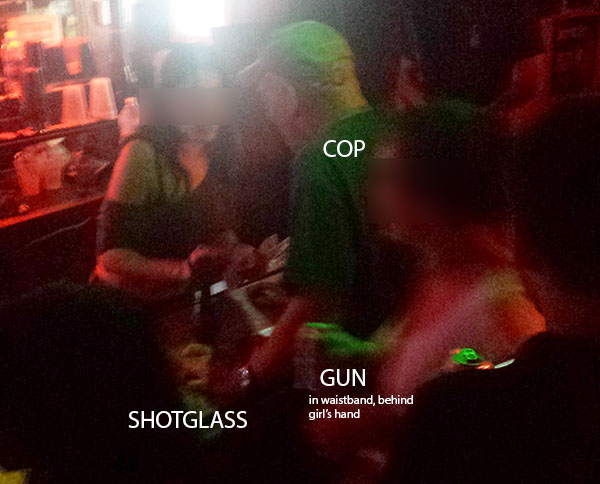
Armed NYPD Officer Drinking[Update – NYPD IA has told me that their initial investigation has led them to believe that this was a New York State Trooper, not an NYPD officer. This does not change the nature of my concerns, but I feel it is appropriate to place the blame on the proper party.]

Last night, I was in an East Village bar when I noticed that a man was walking around with a full-sized semi-automatic handgun sticking out of his waistband. The man was wearing shorts and a t-shirt and made no attempt to hide his weapon. I assumed he was a cop based on the way he looked (style of dress, hair, posture) and the fact that the staff seemed unalarmed — not to mention the fact that citizens sure are sure as hell not allowed to open-carry, let alone concealed carry, in NYC. I wasn’t going to say anything until the guy started downing shots.

In Florida, it’s certainly illegal for a cop to pound shots in a bar while open-carrying, and I figured in New York City, which has the strictest gun laws in the country, the same would be true. I placed a 911 call, and the operator seemed unclear as to why I was calling. She brought Internal Affairs on the line, who took the call seriously and asked her to dispatch a supervisor from the local precinct, which was 0.2 miles away. Five minutes later, still no cops, so I called the local precinct directly to ask if they had sent anyone. The operator transfers me to another cop who pretends not to be able to hear me and says, “You better find some better reception before you call back this number.” Finally, almost 10 minutes later, four officers (but no supervisor) show up and basically tell me that there is no legal issue with having a cop, open-carrying a firearm, in a bar, drinking alcohol.

Needless to say, I’ll be following up with IA and the NYPD’s Civilian Complaint Review Board, and I’m not ruling out legal action. The definition of civil assault is “an act that causes a ‘reasonable apprehension’ of immediate harm or offensive contact to the victim’s person.” Would a reasonable person have an apprehension of harm based merely on the presence of a man openly carrying a firearm while doing shots? Let me know what you think in the comments.

Some “Light Reading” from the TSA, Some Denied Reading from the NYPD

Corbett v. TSA Administrative RecordMy fight against the TSA’s nude body scanners is approaching the deadline for briefs (in the Court of Appeals, the main briefs are, essentially, the entirety of your case). Pictured here is the “administrative record” as filed by the TSA. Some of it is public record (and will be posted here in full when I have a chance to scan it), other parts are claimed to be secret for various reasons (the release of which will be fought for in court at the appropriate time), and some parts are redacted (as if anything the TSA does would actually dissuade a terrorist). It totals about 1,600 pages (still about 30% shorter than ObamaCare!), and I’ll be asking for a time extension shortly to allow me a full opportunity to comb through each and every page.

My other three suits (illegal detention at FLL, NYPD stop-and-frisk, and NYPD street body scanners) are still awaiting rulings on dispositive motions, as they have been since April. I have no idea why these are going so slowly — the issues presented are hotly debated but not terribly complex.

nofoiaIn other news, I sent the NYPD a public records request a few weeks ago on a matter completely unrelated to my lawsuits (I asked for information regarding how they determine whether to accept or reject pistol permit applications). The NYPD has a “FOIL Unit” that is a part of its “Legal Bureau,” which is where the request was sent. I got back a letter stating that they don’t have the records, but that “NYPD – License Division” may have them. So, essentially, the NYPD asks for records requests to be sent to a specialized department that, obviously, doesn’t have the records in their office and refuses to go and get the records. I’m presently awaiting a callback from Lt. Mantellino to explain why he feels that this run-around is in any way legal.

It’s a little TOO quiet…

It’s now been a full month since I’ve seen the familiar “Activity in Case…” e-mails that the federal court system sends to litigants registered for electronic filing. Considering I have four cases open in four different courts, it’s the first time I’ve had a month of quiet since 2011. This gives me a little time to write my comment for the TSA’s public rulemaking regarding nude body scanners (due by June 24th, 2013 — no legal experience required, just let the TSA know how you feel!) and my appeal that is inevitable regarding (in largest part) U.S. District Judge Joan A. Lenard’s decision that TSA screeners enjoy qualified immunity for unlawful searches even when they know they intentionally continue their search beyond what is necessary to find weapons.

So, here’s where we are right now:

I have this sneaking suspicion that I will shortly be innundated with rulings and legal documents to write. The calm before the storm… 😉

NYPD: Can’t Sue Us Over Body Scanners Until We Violate You

In my suit against terahertz imaging by the NYPD, their motion to dismiss based primarily on standing is now fully briefed. In it’s final say on the matter, the NYPD argued the following:

Plaintiff Will Have Standing If, And When, The NYPD Implements The Scanners And Plaintiff Is Among The Scanned

In other words, the NYPD argues that the courts may not prevent the NYPD from violating the people — they must wait until they have already violated the people. Luckily for the people, that’s actually not the legal standard. In addition to stepping in once an actual injury has occurred, the courts may step in when an injury is “imminent.” Lujan v. Defenders of Wildlife, 504 U.S. 555, 560, 561 (1992). Additionally, threatened injury is sometimes enough to cause actual injury (for example, a threat to the right to speak freely is often enough to convince a court that people are not speaking because of the threat, and therefore an actual injury exists). The court may or may not decide that my injury is imminent enough (and if he decides against, I can re-open the case as soon as the scanners hit the streets), but it certainly won’t be based upon the NYPD’s deranged interpretation of the cases and controversies clause.

Corbett v. City of New York II – Motion to Dismiss (.pdf)
Corbett v. City of New York II – Motion to Dismiss Opposition (.pdf)
Corbett v. City of New York II – Motion to Dismiss Reply (.pdf)

Federal Magistrate: White People Not Protected Against Discrimination Under Civil Rights Act

My first suit against the NYPD, for stopping & frisking me for being a white guy in a black neighborhood has a motion for summary judgment pending, filed by the city. A motion for summary judgment filed by the defense means basically “under the undisputed facts we know so far, no reasonable jury could find us liable, so please dismiss this action without a trial.” When complicated motions are filed in federal court, typically the U.S. District Judge will have a magistrate judge (basically, an assistant judge) read through it and write up a report on whether or not the motion should be granted. The parties have a chance to explain to the district judge why the magistrate is wrong, if they’d like, before the district judge makes a ruling.

The biggest sticking point in this case is that the city “can’t find” the cops who stopped & frisked me. The magistrate judge recommended that the motion be granted and my case be tossed because — get this — no “reasonable jury [could conclude] that police officers were involved in the alleged stop.” In other words, a jury might believe my story entirely, but since I didn’t get badge numbers and the city “can’t identify” the cops, a reasonable jury would have to find that these people — who stopped me, identified themselves as police, detained me, and searched me — were probably just random troublemakers, not real police. We’ve all heard of the stories of random, non-police groups of men stopping & frisking the citizens just for kicks, right?

But, that’s not even the most absurd part of the report produced by U.S. Magistrate Judge Vera M. Scanlon. Part of my complaint that the judge was analyzing alleged a violation of 42 U.S.C. § 1981, which prohibits racial discrimination: “All persons within the jurisdiction of the United States shall have … equal benefit of all laws and proceedings for the security of persons and property as is enjoyed by white citizens.” In combination with the Fourteenth Amendment to the U.S. Constitution, which guarantees equal protection to all persons regardless of race, this law must either be interpreted a) to protect white persons the same as racial minorities, or b) as unconstitutional and void. “Where a statute is susceptible of two constructions, by one of which grave and doubtful constitutional questions arise and by the other of which such questions are avoided, our duty is to adopt the latter.” Jones v. United States, 529 U.S. 848, 857 (2000).

Judge Scanlon, however, found that to state a claim under § 1981, one must be a member of a minority group, and that this is perfectly constitutionally sound. Or, essentially, that the law is different for white people than it is for racial minorities. I unfortunately don’t get to challenge this part of the report since my most recent amended complaint dropped the § 1981 claim (it was unnecessary since proving that I was stopped illegally is much simpler than proving that I was stopped because of my race). It is, however, disturbing just the same.

Corbett v. City of New York – Report & Recommendation (.pdf)

NYPD Asks Nicely for Judge to Dismiss; Judge Tells City to File a Real Motion

In response to my suit against NYPD street body scanners and the motion for preliminary injunction, the city, a day after its response to the motion for preliminary injunction was due, sent the judge a 4-page letter asking the judge to toss the entire case. Nothing surprising in the argument… basically, “we haven’t done anything yet so there’s nothing to sue for, and this Florida guy doesn’t even live here.” Of course, when the city admits that they’re going to begin testing ASAP, and when the complaint clearly indicates that I travel within the city for several weeks a year, this argument is of limited utility.

What *is* surprising is the city’s response by letter. No formal opposition to the motion for injunction, no formal motion to dismiss, just a 4-page “Yeah, nothing to see here, just toss that aside, k?”

Before I had a chance to finish typing my response to their letter, the judge denied their request to dismiss, offering them 2 weeks to file a real motion. The motion for preliminary injunction remains looming. It is unclear whether the judge plans to wait until the motion to dismiss is received to rule on it, but my bet is that he will.

Corbett v. City of New York II – City’s Letter to Dismiss (.pdf)
Corbett v. City of New York II – File a Real Motion Order (.pdf)

Blog at WordPress.com.

Up ↑