Federal Judge: Suit to Stop NYPD Street Body Scanners Must Wait

nypdscanOn January 28th of this year, I filed the first and only lawsuit against the NYPD’s testing and planned implementation of “street body scanners” — terahertz imaging devices designed to allow cops to peer under the clothes of unsuspecting passersby on the street for guns. In addition to highlighting New York’s longstanding disrespect for the Second Amendment by assuming that anyone bearing arms must be doing so illegally, this tool plainly ignores the Fourth Amendment’s requirement, made clear in Terry v. Ohio, that searches must have cause. By checking underneath the clothing of the public at random, the NYPD proposes to conduct the most widespread and general search ever demanded (outside of the airport checkpoint, of course).

U.S. District Judge Paul G. Gardephe ruled today, however, that the suit must wait because the immanency and effects of the NYPD’s proposed scanner use are, at this time, uncertain and speculative. This issue touches a gray area where, on the one hand, courts are allowed to protect the people from imminent loss of liberty, they must balance this against the constitutional requirement that only a live controversy may be reviewed.

The facts of this matter are that: 1) the NYPD has paid millions of dollars to fund the development of these devices, 2) the NYPD has procured at least one of these devices, and 3) NYPD Commissioner Kelly has stated his intent to begin use of the devices as soon as possible.

I think reasonable people could disagree as to whether this constitutes a situation where a constitutional injury is imminent, and it is, of course, no surprise that any benefit of the doubt be sent the government’s way by a federal judge. As of now, I don’t plan on appealing this ruling, but instead watching for the first sign that the NYPD has brought these machines into public, at which point I will move to re-open the case. Let the NYPD be on notice: if you start to scan the public, you will be sued on Day 1.
Corbett v. City of New York II – Dismissed (.pdf)

Sen. Dianne Feinstein: Add People to No-Fly List Based on Tips from Family

feinsteinI’m still going through the mounds of administrative record before me, some of which are documents that have been published many times, others of which seem to be brand new, and this one stood out as epicly stupid. It should be no surprise that it was authored by Sen. Dianne Feinsten (D-CA), the nation’s biggest supporter of NSA spying, worst enemy of second amendment rights, and general crazy old lady.

The TSA’s “no-fly list” is a database of individuals who may not board a flight on any U.S. airline or any foreign airline heading to America. If you get stuck on it while overseas, you will literally need to fly to Mexico and walk home to the U.S. A federal court just recently ruled that being on the no-fly list is a deprivation of a constitutional right, which should be common sense but the Department of Justice vehemently argued otherwise.

To get on this list, you get nominated by a government agency (the FBI, for example), and if there is sufficient evidence (in the eyes of a bureaucrat) that you are a threat to aviation security, you are added. Once you are added, without notice, you simply won’t be handed a boarding pass at the airport anymore. The government will never confirm or deny your inclusion on the list, and the appeals process is a nightmare.

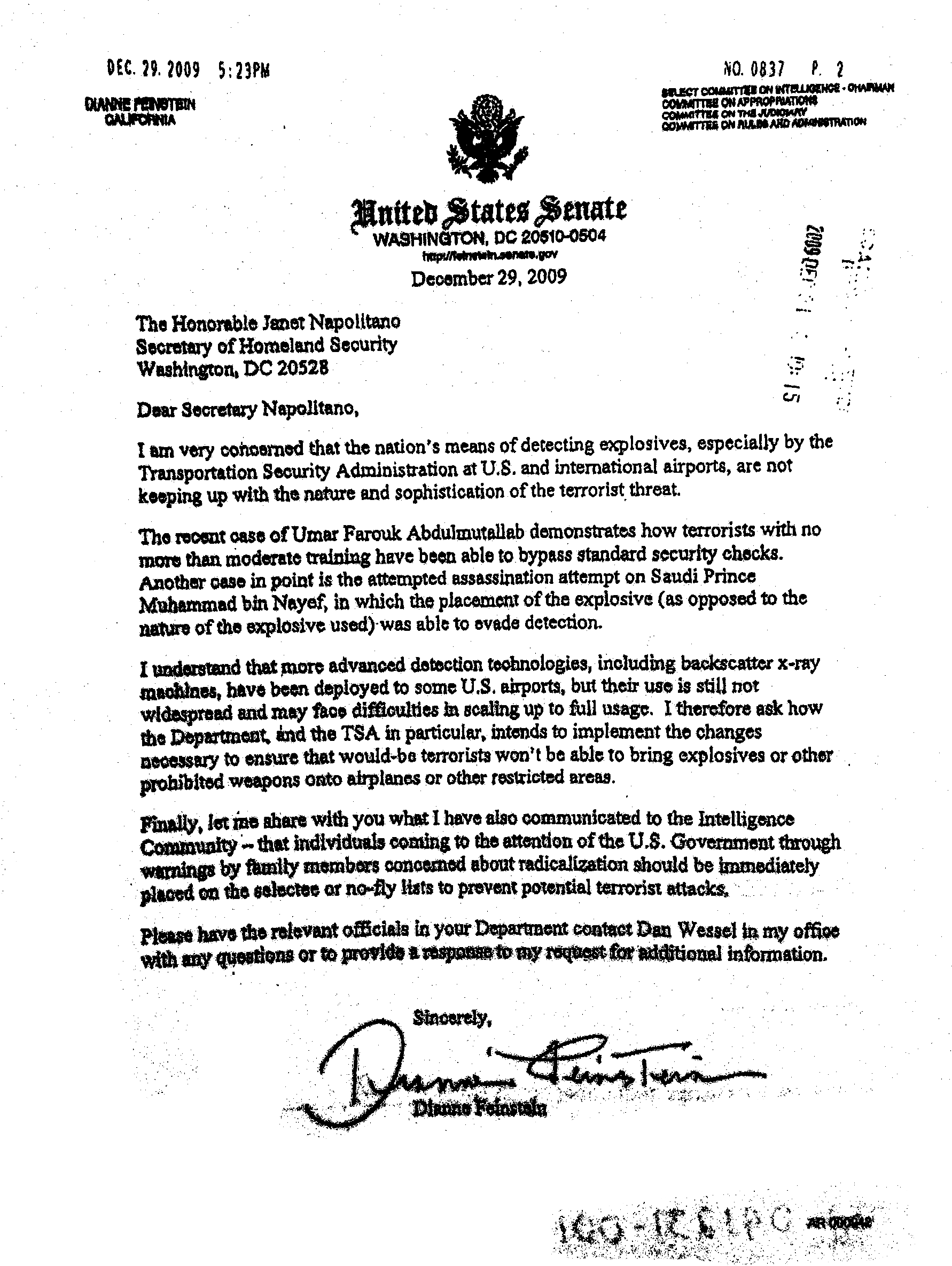
In this classic letter from 2009, Sen. Feinstein suggests that the process for getting on the list of people who can never travel by air again is way too difficult, and instead, we should simply accept tips from the public and start putting people on the list right away:

Finally, let me share with you what I have also communicated to the Intelligence Community — that individuals coming to the attention of the U.S. Government through warnings by family members concerned about radicalization should be immediately placed on the selectee or no-fly lists to prevent potential terrorist attacks.

Letter from Sen. Dianne Feinsten to DHS Secretary Janet Napolitano, Dec. 29, 2009

Apparently, Sen. Feinstein yearns to bring back the good old days of McCarthyism. Would you Cali people please take care of this??

Notice of Appeal Filed, + What is This “Mootness” Stuff?

Notice of Appeal I filed the Notice of Appeal today of U.S. District Judge Joan A. Lenard’s decision to allow the TSA to detain travelers, threaten them with false arrest, read through documents that they are traveling with, and lie in FOIA responses.

The next step (other than some housekeeping paperwork) is to write an appellate brief, which, IIRC is due in 40 days. This brief sets out the entire basis for the appeal, and typically ends up being quite lengthy. Since 19 of the 21 counts were dismissed 6 months ago, I’ve been able to get a head start on most of the brief. 🙂

Additionally, there’s been some commentary here and elsewhere on the Internets that Judge Lenard’s decision notes that my FOIA claim is “moot.” That is, my FOIA claim requested a copy of checkpoint video, and since I now have the video, even though they initially lied to me about it, there’s nothing more to be done.

Mootness is a doctrine that stems from the constitutional requirement that only “cases and controversies” may be heard by the federal courts. The idea is that if there’s no remedy the court can take to make it better, the court should not be wasting its time. But, there is an exception to the mootness doctrine for illegal actions that are “capable of repetition, yet evading review.” In other words, a live controversy still exists if the government can continue to do the illegal thing and always claim it would be moot.

In this instance, it is clear that the exception applies. FOIA would be meaningless if governments could simply lie and then, if caught, just say, “ok, you got me” and hand over the documents. I argued this exception passionately, and my argument was entirely ignored by this judge, as were many of my arguments for the 20 other dismissed charges.

Plaintiff seeks declaratory relief to ensure that Broward County cannot continue to invent its own rules for public records responses. Broward County argues that the issue is moot because Plaintiff currently knows the truth. However, without declaratory judgment, Broward County may continue to lie in public records responses and then, only if caught, release itself from liability by telling the truth. As Broward County‟s unlawful behavior is capable of repetition, yet evading review, mootness is inapplicable here. See Roe v. Wade, 410 U.S. 113 (1973). It should be noted that in the State of Florida, knowingly refusing to comply with a public records request is a criminal matter. See Fla. Stat. 119.02. It is in the public interest, as well as the interest of state officials, to put officials on notice that federal law does not create a basis for lying in a public records response because of an SSI designation.

Plaint. Opp. to Deft. Broward County’s Mot. for Summary Judgment, D.E. 95, p. 13 (Feb 27. 2013) (pdf)

I do think that the appellate court will overturn her ruling of mootness, as well as restore many (or all) of the remaining dismissed counts. Looking forward to this one.

Court: Federal Law Allows Lying in TSA-Related FOIA Requests

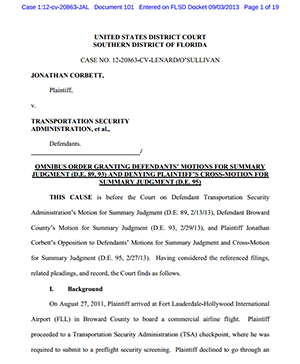
disscoverMoments ago, the remaining claims in my lawsuit stemming from being illegally detained at FLL airport and then lied to about the existence of CCTV video of the incident, were dismissed.

The questions before the court were as follows:

  1. Can the TSA (or local governments as directed by the TSA) lie in response to a FOIA request?
    Sure, no problem! Even the NSA responds that they “can’t confirm or deny the existence” of classified things for which admitting or denying existence would (allegedly, of course) damage national security. But the TSA? U.S. District Judge Joan A. Lenard granted the TSA the special privilege of not needing to go that route, rubber-stamping the decision of the TSA and the airport authority to write to me that no CCTV footage of the incident existed when, in fact, it did. This footage is non-classified and its existence is admitted by over a dozen visible camera domes and even signage that the area is being recorded. Beyond that, the TSA regularly releases checkpoint video when it doesn’t show them doing something wrong (for example, here’s CCTV of me beating their body scanners). But if it shows evidence of misconduct? Just go ahead and lie.
  2. Can the TSA hide the names and faces of its public-facing employees (and any local law enforcement coming to their aid) who are accused of misconduct?
    You bet! Despite the fact that they all wore name tags and I could have legally taken photos of them, Judge Lenard feels that the public servants who illegally searched and detained me deserve “privacy,” and upheld the TSA’s decision to redact their names from every document sent to me and to blur the entirety of every video sent to me. This is the same TSA that cares so much about privacy that they “accidentally” published a copy of my driver’s license in court filings.
  3. Can the TSA frustrate court review of whether or not a document is releasable under FOIA simply by “ordering” it secret?
    Why not?! Judge Lenard ruled that once a document is labeled “Sensitive Security Information” (which the TSA does by merely waiving a magic wand and writing “SSI” on the cover of a document) the U.S. District Court loses its power to review that determination, and the U.S. Court of Appeals is the proper forum. But wait, the Court of Appeals doesn’t evaluate FOIA claims, so now, in order to get a document you want, you must petition 2 courts and pay over $800 in filing fees alone. Yes, clearly this is how Congress intended public records laws — designed to allow transparency in government — to work.

On top of this recent heap of fail, Judge Lenard had previously tossed the bulk of my lawsuit — 19 out of 21 charges — and then refused to allow me to appeal those 19 charges until she contemplated these two remaining charges. She then took 6 months to write this 19-page opinion. Her decision today, therefore, is not much of a surprise to me, since Judge Lenard seems to be more inclined to rubber-stamp government thuggery, through convoluted, ill-supported, and needlessly delayed rulings, rather than to dispense justice. I will be filing a notice of appeal this week, sending this case to the U.S. Court of Appeals for the 11th Circuit, and I am strongly tempted to file a complaint of judicial misconduct based on her purposeful delay of my case and the sheer absurdity of some of her arguments. But, appeal first, misconduct complaint later.

Corbett v. TSA – Full Dismissal (.pdf)

Donate to help fund the appeal?
…or via Bitcoin: 15ftA2938sp7Mnsi8U7wYVmEtd4BRbFnkT

A Reminder That Stop-And-Frisk Is Wrong Even If Applied Equally to All Races

You’ve probably seen in the news that last week, a federal judge ruled that the NYPD’s stop-and-frisk program is unconstitutional. Naturally, I couldn’t agree more. Seven out of eight people stopped under this program were found to be doing absolutely nothing unlawful. And, while the legal justification for stop-and-frisk is officer safety (that is, to find a gun on someone before they use it against the cop making the stop), not to search for general evidence of criminality (for example, to find drugs), 79 out of 80 stopped were not found to have a weapon. That is to say that the police were wrong in their motive for a stop 98.75% of the time.

I see a lot of focus in the media regarding this program being unconstitutional because it was disproportionately applied to racial minorities. This is true, and despite Bloomberg and Kelly’s claims that the inequality is due to the fact that more crime happens in “neighborhoods of color,” studies have shown that 1) even after accounting for the fact that black neighborhoods have more crime than white neighborhoods, the program is *still* disproportional based on race, and 2) blacks who live in white neighborhoods were more likely to be stopped than their white neighbors.

However, I feel like the intense focus on the NYPD’s racism, despite being well-deserved, masks the fact that even if the NYPD were to cure itself of its xenophobia and apply stop-and-frisk equally among all races, the NYPD’s behavior is still unconstitutional, as the judge also ruled. In order to stop someone, an officer must have reasonable suspicion that the person is committing a crime. In order to frisk someone (assuming the officer does not have enough evidence to make an arrest), he must have reason to believe that the person is armed and dangerous (officer safety, remember?). However, far, far too often, the officers have neither of these. Common “reasons” listed on stop-and-frisk paperwork for the searches include “furtive movements,” presence in a “high-crime area,” “suspicious bulge,” and other nonsense that is not indicative of crime or guns, but, quite simply, allows officers to search whomever they want (a bulge can be anything, presence in a bad neighborhood doesn’t indicate you’re committing a crime, and frankly but with respect to those intelligent NYPD officers who do take their job seriously, I would love to see a study done on how many NYPD officers even know what the word “furtive” means). The number of lives Bloomberg and Kelly opine have been saved are also no justification. Those numbers are about as verifiable as the NSA’s count of terrorists stopped by domestic spying or the TSA’s assertion that touching your junk prevents airplanes from being blown out of the sky, and they are also entirely irrelevant: unconstitutional practices are still unconstitutional even if they save lives. The police have an obligation to protect society and do so without trampling our liberties. These two prongs are neither mutually exclusive nor optional.

As one of the ~60,000 caucasian victims of NYPD stop-and frisk in 2011, I would hate to see reforms center around how to apply this unconstitutional, ineffective practice equally. It shouldn’t be applied at all, absent what the U.S. Supreme Court set out in Terry v. Ohio: reasonable suspicion that a crime has been committed, and specific reasons to think that the particular individual poses a threat to the officer’s safety unless the search were conducted.

Judge Finds Systemic Stop-and-Frisk Abuse, Orders NYPD Officers to Wear Cameras, Change Policy

In a resounding blow to NYPD’s stop-and-frisk, United States District Judge Shira A. Scheindlin has found that the NYPD has committed widespread, systemic abuse of the rights of the people by detaining and searching them without reasonable suspicion.

I skimmed through as much of the 237 page decision as possible before writing, and Judge Scheindlin means business. She appointed an independent monitor to guide the city through adjusting its policies and training to ensure that these violations do not continue, and even went as far as ordering:

… the NYPD to institute a pilot project in which bodyworn cameras will be worn for a one-year period by officers on patrol in one precinct per borough — specifically the precinct with the highest number of stops during 2012.

Very much looking forward to the implementation of the judge’s orders

City v. Floyd – Opinion (.pdf) (the Court’s finding that the NYPD broke the law)
City v. Floyd – Order (the Court’s remedy for the NYPD’s lawbreaking)

Went Through @TSA ‘s Body Scanner While Pregnant? The Radiation Reached Your Uterus

The TSA has been as steadfast about their nude body scanners being safe as the Obama administration has been that “we don’t have a domestic spying program.” The TSA, in fact, has been so “confident” in their scanners’ safety that they have proclaimed them safe even for infants and pregnant women:

Advanced imaging technology screening is safe for passengers, including pregnant women and children. One backscatter technology scan produces the same exposure as approximately two minutes of flying on an airplane. Advanced imaging technology is optional for all passengers.

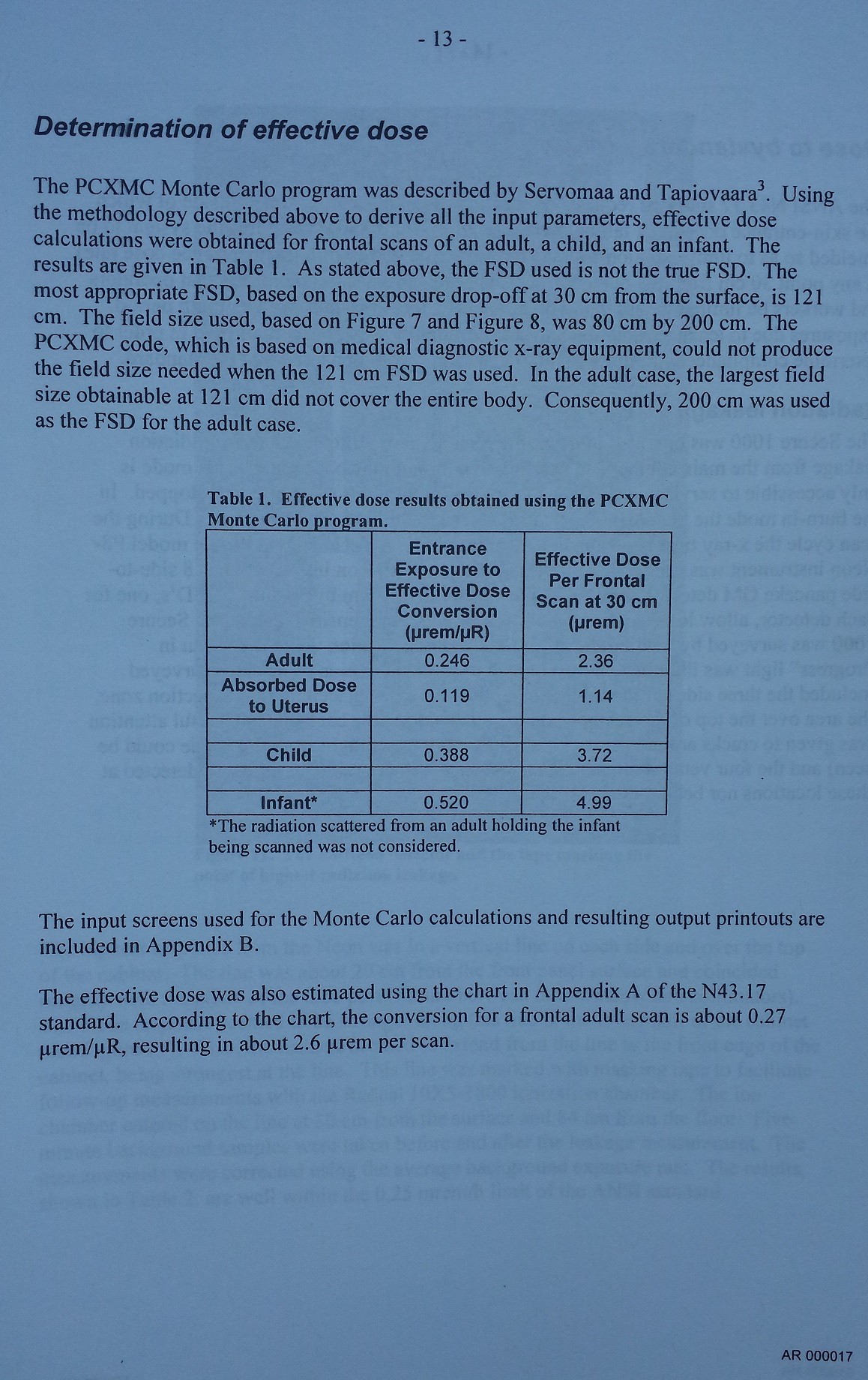
Nude Body Scanner Dose to BabiesHowever, the TSA’s assertion is about as true as the Obama administration’s statements on NSA spying. While reading through the administrative record for my lawsuit, the last remaining challenge in the U.S. Court of Appeals for the constitutionality of the nude body scanners, I came across a table, produced by the FDA at the TSA’s request, showing that children are dosed at more than 1.5x the rate of adults, an infant in your arms gets more than 2x the dose, and your unborn child still receives almost 50% of the radiation that you receive.

This study, produced in 2006 by government scientist Dr. Frank Cerra, was available to the TSA three years before they deployed the body scanners as primary screening, and four years before TSA spokeshole Blogger Bob wrote the passage quoted above. But yet, these records, though released to me as “public records,” are really nowhere to be found for an interested member of the public. I will be publishing the ~1,600 pages of administrative record I received shortly (or as much so as I am allowed to by the Court), but this is, yet again, a systemic culture of hiding the facts. Perhaps the radiation dose received by your unborn baby is not high enough to worry about, but don’t you have the right to know about it in advance?

Former TSA Administrator: End Intrusive Pat Downs, Liquid Ban, Knife Ban (@KipHawley)

It seems that once they get out of office, some politicians have a change of heart. No longer surrounded by the pressures of running the show, they can make better judgments. Take, for example, former TSA Administrator Kip Hawley, who writes the following:

TSA needs to make these changes right now to take on the root causes of its public and security issues. It needs to clean up the mind numbing, overly complicated checkpoint “standard operating procedure,” which no longer matches our security needs and allow officers to act. What needs to be changed:

• The intrusive pat-down needs to be discontinued in favor of a lighter technique supplemented with available technologies.

• The “prohibited items” list needs to be radically reduced to ban only real security threats such as explosives and toxins. As far as carrying knives, the FAA should make it a serious federal offense to intimidate a member of the flight crew or another passenger with a blade — and then TSA can remove blades from the prohibited list. Blades represent virtually no threat to the aircraft at this point. And the baggie rule should be dropped. Current technology allows threat liquids to be detected when they are taken out of the carry-on and scanned in a bin.

Well, isn’t that something. Mr. Hawley, if you’d like change, I invite you to assist with my lawsuit against the scanners and the groping by filing an affidavit stating that in your professional opinion, the pat-downs are intrusive and unnecessary. Your work as TSA administrator set the stage for the assholery we see now, and here is a real chance to fix it.

NSA Database Only for Terrorists? Hardly. Database Used for Years to Track Drug Suspects

Breaking this morning is a story that the DEA uses the databases of other law enforcement agencies, including the NSA’s vast phone and Web databases, to identify potential criminals. Then, when they find someone, they’ll look for a way to search the person without giving away that they used those databases, which they’ve coined “parallel construction.”

Parallel construction is a euphemism made up by the government for conducting an unlawful search and then unlawfully concealing that fact from both the courts and defense attorneys, in violation of the Fourth, Fifth, and Sixth Amendments to the U.S. Constitution, various federal statutes (perjury being the most significant), and the rules of every court. When an illegal search is conducted, it cannot be “made right” by using the bad info and figuring out another way to nab the guy. It’s called using the “fruit of the poisonous tree” and it has been dismissed by every court for about 80 years.

The government will always start its illegal searches with those repulsed by society — terrorists, child pornographers, drug cartel members — and slowly work its way back to “garden variety” criminals. The courts will say, “well, we made it legal for the terrorists, why not for the guy who failed to use his turn signal?” If we don’t stand up for everyone’s rights — even the rights of the most despicable — the rights will be gone for all, and we’ll have deserved it for so easily giving them away. Or instead, we can demand now that the government catch everyone — even terrorists — using investigations that follow the law, followed by a trial that affords them full due process, and only then followed by a jail cell that they justly deserve.

Armed Off-Duty NYPD Officer Drinking Shots in Bar, On-Duty Cops Say Perfectly Legal

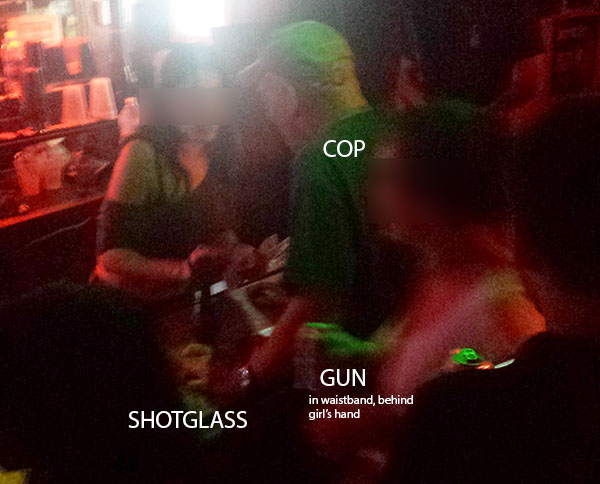
Armed NYPD Officer Drinking[Update – NYPD IA has told me that their initial investigation has led them to believe that this was a New York State Trooper, not an NYPD officer. This does not change the nature of my concerns, but I feel it is appropriate to place the blame on the proper party.]

Last night, I was in an East Village bar when I noticed that a man was walking around with a full-sized semi-automatic handgun sticking out of his waistband. The man was wearing shorts and a t-shirt and made no attempt to hide his weapon. I assumed he was a cop based on the way he looked (style of dress, hair, posture) and the fact that the staff seemed unalarmed — not to mention the fact that citizens sure are sure as hell not allowed to open-carry, let alone concealed carry, in NYC. I wasn’t going to say anything until the guy started downing shots.

In Florida, it’s certainly illegal for a cop to pound shots in a bar while open-carrying, and I figured in New York City, which has the strictest gun laws in the country, the same would be true. I placed a 911 call, and the operator seemed unclear as to why I was calling. She brought Internal Affairs on the line, who took the call seriously and asked her to dispatch a supervisor from the local precinct, which was 0.2 miles away. Five minutes later, still no cops, so I called the local precinct directly to ask if they had sent anyone. The operator transfers me to another cop who pretends not to be able to hear me and says, “You better find some better reception before you call back this number.” Finally, almost 10 minutes later, four officers (but no supervisor) show up and basically tell me that there is no legal issue with having a cop, open-carrying a firearm, in a bar, drinking alcohol.

Needless to say, I’ll be following up with IA and the NYPD’s Civilian Complaint Review Board, and I’m not ruling out legal action. The definition of civil assault is “an act that causes a ‘reasonable apprehension’ of immediate harm or offensive contact to the victim’s person.” Would a reasonable person have an apprehension of harm based merely on the presence of a man openly carrying a firearm while doing shots? Let me know what you think in the comments.

Blog at WordPress.com.

Up ↑