Turkish President Orders Body Guards to Beat Up American Protesters In DC: This Is Why We Don’t Allow Thugs Into the White House

fuck_erdoganWith all of the scandals going on in D.C. surrounding the President, it can be hard to focus on a few people being assaulted.  But the 9 people injured, one seriously, near the White House in a brawl started by Turkish President Recep Tayyip Erdoğan deserves attention for two reasons.

First, Erdoğan is a thug and should not have been invited to the White House.  He is well-known for arresting and beating up protesters in his own country.  He is well-known for misogyny, stating that women are not equal to men and their role in society is “motherhood.”  And he is well-known for media censorship, not just in his own country, but going so far as to sue in a German court against a man who published a satirical poem disfavorable to him (poem below!).  You would think given that, when he was in the political minority, he was imprisoned for reciting a poem of his own, he would have aspired not to do the same, but I digress.  This is not who we should be hosting, as he does not share the value common to those who enjoy living in a free society.

Second, a recently released analysis of video of the brawl shows that Erdoğan himself ordered the assault.  His personal bodyguard can be heard to say, “he says attack,” immediately after speaking with Erdoğan.  His guards than rush to violence against a small group of protesters, allegedly from a political party that Erdoğan cutely labels “terrorists.”

Think about that for a second: a foreign head-of-state just ordered an attack on Americans on American soil.

We can’t prosecute these men because they have diplomatic immunity, but we can certainly expel the Turkish Ambassador, as Sen. John McCain has suggested (note that I don’t join in Sen. McCain’s depiction of Turkey as a “third world” country).  That would be a good start.  The State Department is investigating.

And, you know, not inviting thugs to the White House.


Defamation Poem, by Jan Böhmermann (translated)

Stupid as fuck, cowardly and uptight,
Is Erdogan, the president,
His gob smells of bad döner,
Even a pig’s fart smells better,
He’s the man who hits girls,
While wearing a rubber mask,
But goat-fucking he likes the best,
And having minorities repressed,

Kicking Kurds,
Beating Christians,
While watching kiddie porn,
And even at night, instead of sleep,
It’s time for fellatio with a hundred sheep,

Yep, Erdogan is definitely
The president with a tiny dick,
Every Turk will tell you all,
The stupid fool has wrinkly balls,
From Ankara to Istanbul,
They all know the man is gay,
Perverted, louse-infested, a zoophile,
Recep Fritzl Priklopil

Head as empty as his balls,
Of every gang-bang party he’s the star,
Till his cock burns when he has a piss,
That’s Recep Erdogan,
The Turkish president.

Fully Briefed: Can TSA Refuse Body Scanner Opt-Outs?

This blog began in 2010 to document my lawsuit against the beginning of the TSA’s body scanner program.  From that time until 2015, the body scanner was “optional” for all passengers — so long as you didn’t mind being molested by a blue-gloved screener during their “full-body pat-downs.”  This was part of the reason that no court has struck down these body scanners as unconstitutional: because, they say, passengers are consenting to use them (even though that “consent” is coerced by offering the alternatives of “let us touch your junk” or “don’t fly”).  But, at the end of 2015, the TSA announced that they would reserve the right to refuse to allow these body scanner “opt-outs” at their discretion, and I immediately filed suit.

There are two really interesting issues in this case that I hope may cause a wrinkle for the TSA:

  1. The original body scanner rule in 2010 was issued without “notice-and-comment rulemaking,” a procedure required by Congress whereby agencies that make rules first have to ask the public for input.  The U.S. Court of Appeals for the D.C. circuit ruled that the TSA violated this procedure and, although normally that would require them to stop enforcing the rule (i.e., stop using the body scanners), the Court, fearful that the body scanners actually protect us, simply ordered the TSA to take comment after the fact.  The new body scanner rule limiting opt-outs was also issued without public comment, and I’ve asked the court to, this time, put some teeth into forcing the TSA to actually follow procedure before issuing a rule.
  2. The TSA is arguing that it needs to be able to force some passengers through the body scanner because, they allege, it is more secure than a full-body pat-down.  But, this is objectively untrue.  Besides the fact that I proved the scanners to be beatable in 2012, think about this: if one alerts a body scanner, the result is… a pat-down of the area of the body that generated the alert!  How could this possibly be more secure than a full-body pat-down that would have touched that area of the body and more?  The function of the body scanners is to narrow down those people who do not need to be patted down to save time, not to make a pat-down more secure.  Body scanners don’t find weapons — pat-downs do.

tsa_is_absurd

This case lives in the U.S. Court of Appeals for the Eleventh Circuit, and the procedure for cases there is a written brief filed by the person filing the case, an opposing brief filed by the other side, and then a reply brief again by the filer, after which the court may rule on the case.  Yesterday I submitted my reply brief after nearly a year and a half of delay, and so, the case is now “fully briefed,” meaning the judges can decide it at any point (or can ask for the parties to argue in-person, or can ask for more evidence, or, basically, whatever they want).  Realistically, I expect it more likely that they will decide without in-person arguments, probably towards the end of the summer.  I’m not holding my breath — the game is rigged, and the TSA gets almost complete control over what evidence the court sees, some of which I don’t even get to see (wouldn’t want the public to see things like how often their testing shows the body scanners miss a weapon, because that would be, well, embarrassing).

Corbett v. TSA IV – Reply Brief (.pdf)

Corbett v. TSA IV – Appellee Brief (Redacted) (.pdf)

Corbett v. TSA IV – Opening Brief (article)

U.S. Customs Initiates New Officers Using “Rape Table”

The younger generation is fond of the phrase, “I can’t even,” to describe situations that are beyond the scope of normalcy.

U.S Customs & Border Patrol agents an Newark-Liberty International Airport, a stone’s throw from Manhattan, have been accused of initiating new officers — male and female — with a “hazing ritual” that they call the “rape table.”  A new officer subject to the “rape table” is led into a secure room where the lights are turned off and they are held down and groped and humped by their senior officers.

These are the people we’re supposed to be ok with searching our digital items without a warrant.  Who can detain you for up to 8 hours without giving you a reason, a phone call, or an attorney.  The people who are supposed to be busy, you know, keeping our borders secure.  Who also think the “rape table” is ok.

I.  Can’t.  Even.

What Donald Trump Has Done to U.S. Department of Justice is Shameful

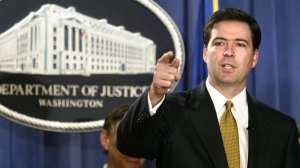
comeyThe U.S. Department of Justice is opposing counsel in about half of the cases I litigate; needless to say, I am no apologist for them.  At the same time as being frustrated by their, for example, analogizing my legal arguments to those of a terrorist, doing their best to keep evidence out of the courts, and even obtaining a special gag order just for me, I respect that they serve an important role in seeing that justice is served in our country.  Unlike the TSA, which should be disbanded rather than corrected, the DoJ should be an institution in which we continually place intelligent, loyal, and non-partisan civil servants.

Instead, Donald Trump has done the following:

  1. Appointed then Deputy Attorney General Sally Yates as Acting Attorney General, and then fired her 10 days later.  The Attorney General is the highest position in the DoJ, which encompasses not only the U.S. Attorney’s Office, which we usually associate with them, but also a host of sub-agencies, including the FBI, DEA, and many others.  Why did he fire her?  According to him, it was because she refused to defend his Muslim Ban on the grounds that the Executive Order was indefensible (virtually every federal judge to hear the matter has agreed).  As the nation’s top attorney, she is obligated to uphold the law and cannot defend law that she believes is unconstitutional.  But, it’s also interesting to note that she was fired on the same day that she, correctly, informed the President that his National Security Advisor Michael Flynn was compromised by Russia and Turkey.
  2. Fired Legendary U.S. Attorney Preet Bharara.  If there was one high official in the DoJ who deserved respect, it was Mr. Bharara, U.S. Attorney for the Southern District of New York.  His district contained Wall Street, and he was well-known for aggressively prosecuting financial crimes including the likes of Bernie Madoff.  But, he was also well-known for fighting public corruption and taking down many a politician in New York, and some speculated he “could be reviewing a range of potential improper activity emanating from Trump Tower and the Trump campaign.”  Trump never offered a reason for firing Mr. Bharara.
  3. Fired FBI Director James Comey.  Being overseas at the moment, I was shocked to wake up this morning to read that Trump has fired the head of the FBI (which, as mentioned, is a sub-agency of the Dept. of Justice).  Officially, Trump’s position was that Comey was fired for mis-handling the Clinton e-mail scandal by stating last July that she would not likely be prosecuted.  This begs the question, though: why now?  In a bizzare 1-page termination notice, Trump takes time time to note his “appreciation” that Comey has “informed” him repeatedly that he is not under investigation.  But the fact remains, of course, that the FBI is actively investigating Russian influence on the election.  It is also worthy of note that U.S. Attorney Jeff Sessions officially gave Trump the recommendation to fire Comey.  Mr. Sessions, after public and Congressional outcry, had recused himself from the Russia investigation… yet now fired the person who was in charge of it.

To be perfectly blunt, it seems to me, based on this pattern of firings, to be far more plausible that Trump has fired these people for not just political reasons, but in order to prevent the exposure of anything from poor decision making (e.g., accidentally hiring a foreign agent to lead the country’s intelligence community) to lying to secretly working with foreign nations.  And, were I Donald Trump and had I nothing to hide, I would certainly at least be aware of the public perception I would be creating by firing these career administrators.

To any extent that Donald Trump has “drained the swamp,” he has either replaced it with new swamp or failed to replace it at all, leaving a hole in our nation’s ability to function.  People like Preet Bharara are not easily replaceable, and Trump should have been begging him to stay rather than asking him to leave.

What Trump has done to the DoJ is shameful.   And, it should go without saying that a special prosecutor needs to be appointed to continue any investigation that Comey was up to before he was fired, because whether or not there’s anything to uncover, the administration of justice requires impartiality beyond what Trump’s team has afforded us so far.

How the California Bar Actually Grades the First Year Law Students’ Exam

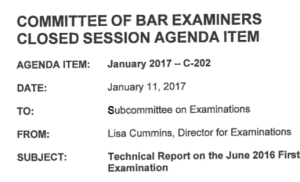
fylsx-real-gradingI’ve made a few posts discussing California’s First Year Law Students’ Exam (the “FYLSX”), noting that I failed my first attempt by a fraction of a percent when the Bar applied a grading formula different from that which was advertised, and then, using the knowledge gained of their altered grading scheme, passed on my second try so spectacularly that the Bar published one of my essays as an example of how to write their exam.  I also briefly mentioned that I — as I’m known to do — filed suit to ask a judge to effectively require them to grade like they say they will and be more transparent about the exam and how they grade it.

The particular dispute was that they advertised that the multiple-choice section and the essay section of the exam would be “converted to the same 400-point scale” in order to “give[] these sections equal weight.”  When I received my score report from the first exam, I noticed that the scaling formula used by the bar resulted in it being impossible to score more than about 362 points even if every question was answered correctly, and likewise, it was possible to score far more than 400 points on the essays.

The attorney for the Bar assigned to the case disclosed additional documents, formerly considered to be secret and until now never disclosed to law students, to me yesterday that all but flatly admit that not only were the sections not weighted equally, but they also didn’t use a 400-point scale!  See if you can follow this tortured grading system they describe, because it took me several reads to figure it out:

Multiple-choice raw scores (i.e., number of items answered correctly) were equated to the June 1998, 2011, and October 2013 exams using 21 items that were common to each of these exams.  The equating formula was as follows:

Multiple Choice Scale = (3.4092 x raw multiple-choice score) + 21.6267

The candidates’ raw total essay scores were scaled to a score distribution that had the same mean and standard deviation as their multiple choice scores using the following formula:

Essay Scale = (2.3536 x raw essay total score) + -442.389

A candidate’s total score was the sum of that candidates’ multiple choice and essay scores.

What I gather from this is that 21 of the 100 multiple choice questions were repeats of previous years, and based on how well students did on those 21 questions, their grade on the entire 100 questions was curved.  Then, they calculated the average multiple choice score and the standard deviation, and curved the essay scores such that the average student gets the same score on that section as the multiple choice, and the score distribution was normalized to the same standard deviation.

From this it is clear:

  1. This has nothing to do with a 400-point scale per section.  The number 400 does not even appear in this internal document regarding their grading scheme.  The scale is created simply by comparing this group’s scores to previous scores and trying to curve it accordingly.  You’ll notice that if you plug in “100” as your raw multiple-choice score (a perfect 100 out of 100 questions) into the formula provided, the maximum score attainable is 362.5467.  Not 400.
  2. The sections do not have “equal weight.”  Saying that the average test taker got the same score on both their multiple-choice and their essay questions is not the same thing as saying “half your grade comes from multiple-choice, and half from the essays.”  Whether the essays count more or less than the multiple-choice section depends entirely on how well the other students do on their exams.  This is not equality, it is normalization.

So, for those taking the June 2017 exam, know this: on both exams I sat for, the essays counted far more than the multiple-choice.  You should therefore be spending far more time studying how to write a good essay than how to select A, B, C, or D correctly, unless your multiple-choice practice exams are turning out abysmally (for more study tips, see my previous post).  Hopefully by the October 2017 exam, a judge will have “persuaded” them to abandon this system.

London Metro Police Caught Spying on E-mails of Journalists and Protestors

jenny_jonesWhile many people have little problem allowing governments vast snooping privileges when investigating “terrorists,” it’s been called out again and again that governments are incapable of showing any such restraint.  Many of the headlines are dominated by the U.S. and our struggles with high-tech abuse from organizations like the NSA, but government assholery isn’t an American-specific problem: last week, London Metro Police were exposed as “hacking” the emails of various journalists and protestors.

We know this information thanks to Jenny Jones, a Green Party representative who exposed the existence of this unit in an article in The Guardian. She became privy to this information thanks to a letter written to her from a whistleblower with inside knowledge about the unit.

The letter she received basically reveals that the police have been illegally accessing the email accounts of individuals for many years.  The letter claims that London police asked the police in India to get the passwords for them, and in turn, Indian police hired various hackers to do it for them. Once these hackers got the passwords, they were sent back to the Indian police, who then sent them to London police. This has been going on for years, and the whistleblower claimed that the unit had no respect for the law and didn’t have any regard for the personal privacy of individuals.

Consider the absurdity of there existing a secret unit in a local police department that has the ability to do such hacking (or sometimes, apparently, outsource the hacking to India).  U.K. law apparently allows such spying only to combat terrorism or a major crime, which probably means it should be taken outside of the hands of municipal cops.  Yet the NYPD here in the U.S. also considers its job to include international terrorism, to the point of having thousands of cops who work in locations other than New York city.

It is still very early in the “investigation,” so it is yet to be seen if exposing the matter will result in change. But, if these allegations prove to be accurate, it will be a serious blow to the reputation of the police force and another reminder that handing over keys to the government is a bad idea, even if they allege they will only use those keys when absolutely necessary — because time and time again, all governments everywhere have shown this to be a fantasy.

United Airlines Reports Man For Suspected Child Trafficking Because His Skin is Darker Than Daughter’s

Osvaldo Maciel
Obviously, Osvaldo Maciel might be a child trafficker, as he’s male, Mexican, and with a child, muses United Airlines flight attendants.

It was a tough choice between the title above and, “United Airlines Hits Bottom, Digs.”  A week after losing close to a billion dollars in share value after forcing a ticketed, seated passenger to get off a plane such that one of their own staff could take his seat, via police who caused enough injury to require hospitalization in the process, and 2 weeks after they denied 2 middle school girls boarding under a sexist dress code policy they apply to family members of United employees, you might think that United would be on their best behavior.

“Hold my beer,” United CEO Oscar Munoz can metaphorically (if not literally) be heard shouting across the terminal.

Earlier this week, a New York mom reported that she was required to go to the U.S. Customs & Border Patrol office at Newark Airport to pick up her husband and young daughter, on vacation in Mexico for a week, because a passenger presenting no reason other than the daughter’s skin color was lighter than the father’s told a United flight attendant that she found the pair to be suspicious, and United, apparently agreeing, had federal law enforcement meet the plane.  Mom is of Irish descent, and dad, Mexican, and this by itself is enough to get dragged off the flight upon arrival, assuming you were allowed to fly in your own seat in the first place:

After our 3-year-old snoozed on her father’s lap for most of the flight, the plane landed. He texted me to tell me they had arrived. When the plane taxied to the gate, however, a number of officers from the Port Authority and Customs and Border Patrol boarded the plane, approached my husband and instructed him to grab his carry-ons and follow them. He and our daughter were escorted out of the plane before anyone else could get off.

The passenger who shared her “concern” with the flight attendants had been sitting next to my husband. According to him, she had been friendly throughout the flight, but my husband noticed her strange obsession with our daughter, sometimes throwing her body over his to try to engage my daughter.

As compensation for this “re-accommodation,” as surely Mr. Munoz would call it, United offered the family a $100 travel voucher.

I think what is even more surprising to me is that the commentary on even the strongly left-leaning Huffington Post, who appears to have broke the story, contained a plethora of comments defending the actions of the passenger, flight attendants, and CBP, because it’s always “better to be safe than sorry” (just as they would assuredly dismiss the TSA touching your genitals with “anything to keep us safer”).  (Click the little thought bubble on the left to read)

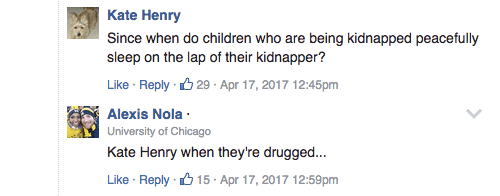
Alexis Nola, for example, is a fan of “see something, say something…”

alexis-nola-lookscount

…and pay no mind to the fact that she was sitting peacefully with her father for the whole flight, because she may have been too drugged to express her situation, even though she could walk on and off the plane…

alexis-nola-drugged

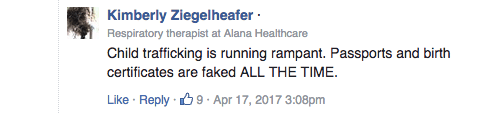
Kimberly Ziegelheafer wants us to know that child trafficking is “running rampant” and, apparently, stopping every adult/child pair who does not look alike (er, let’s be real here, it’s only a father/child pair who would encounter this form of discrimination), dragging them into the back room of a CBP office, and not releasing them until someone female alleges that she is the mother and all is well…

kimberly-zeigelheafer-allthetime

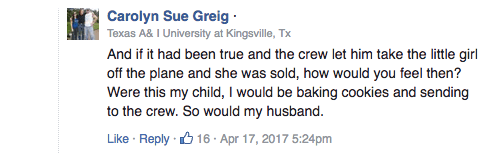
Carolyn Sue Greig alleges she would have baked cookies for these assholes, had it been her husband and child…

carolyn-sue-greig-howwouldyoufeel

But I assume the white woman from Texas with 2 first names has probably never experienced discrimination in her life and does not understand that yes, this is a big deal.  There are millions of children in this country with step-parents who look nothing like their child, and they don’t deserve to be dragged off of flights.  It’s traumatizing to the child and, frankly, to the adult as well.  It also doesn’t take more than a cursory search of the Internet to find that fathers alone with child are regularly given extra scrutiny, whether it’s at the playground or, apparently, simply traveling home.

United Airlines had no business reporting this incident to the police absent the suspecting passenger being able to articulate some reason for her suspicion beyond the color of their skin (the same goes for Muslim-looking men who are dragged off of planes after purely imagined suspicious behavior).  This family is owed much more than a $100 voucher, and I, for one, hope to see Mr. Munoz given the boot after another billion gets wiped off their market cap.

NYPD Finally Ditches Mobile Body Scanner Plans

NYPD T-Ray ScannerLike the TSA, the NYPD enjoys collecting high-tech toys, and announced in 2012 that they too would be joining the body scanner game. In 2013 they published their recent acquisition of a van-mounted body scanner that can penetrate your clothing from across the street to see what you’ve got.  Upon hearing of this, I immediately sued the NYPD, seeking an injunction against their use.  A federal judge ruled that my suit was too early because I couldn’t yet show they were going to use it illegally.

So, I’ve been patiently waiting for the NYPD to go and use one of their vans in public to file a motion to re-open the case.  But, it appears the NYPD got the message: the scanners have been “collecting dust” and the NYPD announced that they have abandoned all plans to ever use it.  Why?

But civil libertarians raised privacy concerns and worried whether other items might be mistaken for a gun, leading to bad arrests.

The NYPD said that after an internal review, it was decided the machine would cause more problems than it was worth.

The Daily News was nice enough to call me for a quote, and I’ll definitely be considering this announcement a victory!

California Bar Posts My Essay as Example of How to Write Exam Answer

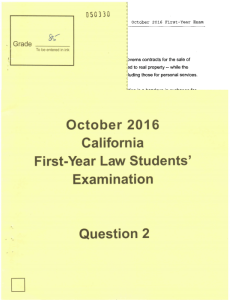
fylsx_q2I was pretty excited to be tipped off by one of my law school professors that the California Bar’s “Selected Answers” for the last administration of the First Year Law Students’ Exam were posted and that one of them looked familiar.

Each sitting of the exam, every student writes 4 essays, and out of the thousands written they picked mine for “Selected Answer A” to Question 2 of the October 2016 exam.

Pretty cool considering I’m presently suing the bar over the way they arbitrarily weight the essay sections and multiple-choice sections of the exam differently, despite promising that they don’t, and then refused to provide documents when confronted with a public records request (original post, new amended complaint).  It’s also amazing how 85 out of 100 was apparently the best score on this exam question, further highlighting the absurdity of their grading.  Hopefully I’ll be able to bring some transparency to their grading process so that law students can get an accurate idea of what to study and how their knowledge will be measured.

Nonetheless, I’m glad they like my writing! 🙂

United Airlines Fiasco: Was It “Legal?”

United GestapoMost have heard by now of the blunder by United Airlines in forcibly removing a man who had paid for a ticket and already taken his seat on the airplane so that they could instead accommodate some of their own employees.  The man was injured when airport police apparently dropped him in the process, and the video taken by other passengers went viral.  To add some gasoline to the fire, the CEO of United tweeted to “apologize for having to re-accommodate” the man, proving that the company obviously misses the point.  This all comes two weeks after the airline was lambasted in the media for its sexist dress code when they denied boarding to two young girls in leggings (this time before the passengers entered the aircraft).

But, the question that I’ve received at least a dozen times in the past 48 hours is: Was what United did legal?  Relatedly, was the man doing something illegal?  Will he win in a lawsuit?

Let’s find out…

Could United legally remove him from the flight?

The answer to this question is “certainly yes.”  Here’s why.

When you are given permission to enter upon the property of another, legally you are given what is called a “license.”  The biggest difference between a “license” to use property and having, say, a lease giving you the right to exclusive possession of the property for a period of time, is that the license is freely revocable at all times, regardless of whether the licensee and licensor have a contract that says otherwise.

Why?  Because we are dealing with two different areas of law here.  Property law governs the ownership of property and the rights and responsibilities of property owners.  The above rule about revocability of licenses comes from property law.  Contract law, on the other hand, generally allows any party to breach their contract duties at any time, under penalty of having to pay damages to the non-breaching party (see also: “efficient breach” theory).

So, the question of whether the contract of carriage allowed United to remove this man is entirely irrelevant as to whether they had the power to do so.  Either way, United could legally oblige him to leave the aircraft because they are “allowed” to breach any contract they may have had with him, but if he had a contract allowing him to stay, he gets to ask for money.

Was the man doing something illegal?

A friend of mine, who is usually quite on top of things, pointed out that federal law requires compliance with crewmember instructions.  Or, at least, that’s what that pre-flight announcement says, if you aren’t busy blasting music through your headphones during the process.

Yes, but, no…

14 C.F.R. § 91.11 – Prohibition on interference with crewmembers.

No person may assault, threaten, intimidate, or interfere with a crewmember in the performance of the crewmember’s duties aboard an aircraft being operated.

While some kinds of defiance may qualify as interference, the duty only attaches while the aircraft is “being operated.”  Before the doors close, not so much.

It is possible he could be charged under some state law for trespassing or resisting the officers, since as discussed above, legally he was obligated to leave, and therefore the officers had the lawful right to use reasonable force to remove him.  It is also possible that he lacked the intent required to be charged, since he believed he had the right to be here — a review of the law of the relevant state would be required and is outside of the scope of things that I care about, and thus this blog.  But, these would be petty misdemeanors, rather than a federal felony, and I do believe the police are now sufficiently embarrassed as to their inability to safely move one man 20 feet without sending him to the hospital that he will face no charges.

Will he win in a lawsuit?

Against whom?  For what?

The police?

In order to win against the police, since the officers were lawfully entitled to remove him, he would need to prove that the force they used was unreasonable.  That is, there was a safer way to do it, and a reasonable police officer under these circumstances would have done so.  This is regardless of whether he sues in battery (where “reasonableness” will be a defense) or in negligence (where lack of reasonableness will be an element of the tort).

This is a question for the jury, so I’ll leave it to you guys.  Watch the video with the fact that the police did have the right to eject him in the back of your mind.  Your verdict of liable or not liable depends on whether the police did the best they could given a non-compliant passenger, or whether the means by which they ejected him was unreasonable.

The airline?

The more interesting one.  The “for what” part of the question definitely matters.

  • For breach of contract?  Well, he paid for them to take him to another city, and they didn’t do so; therefore, United certainly owes him for the flight.  However, how much they owe him turns on whether he was “denied boarding” or not.  The reason is that federal law directly covers “denied boarding,” allows an airline to do it regardless of contract law, and provides a fixed payment schedule for how much the airline will owe the passenger for having done so.  Four hundred percent of the fare, to a maximum of $1,350, to be exact.  The question is whether asking someone already on the plane to leave is “denying them boarding.”  I fear the answer will probably be that it is, as the intent of the law was to cover refused transport without any reason to think that the Federal Aviation Administration intended to distinguish between refusal issued before or after the person passes the gate agent.  But, if not, United Airlines will be liable in contract for all foreseeable damages.  This includes not just the cost of the ticket, but a missed hotel reservation in his destination, missed work in the morning, alternate transportation (to the extent that it is more expensive), etc.  It does not include the police breaking his face — it is not “foreseeable” (although not really surprising either).
  • For his physical injuries?  United won’t be liable in contract for his physical injuries, but how about in tort under battery or negligence theories?  Were the people who took the man off the plane United employees or even contractors, yes, they might be liable for the battery or any negligence.  But, reports are that these were airport police, and as United does not have any control of how the police do their job, they do not have any liability.
  • For anything else?  It’s time to get creative here.  I think this man’s best chance of tort recovery is negligent infliction of emotional distress.  NIED requires two elements that are fairly obvious: 1) negligence, and 2) emotional distress.  Let’s assume he can prove the second, as his face was broken on video that was now seen around the world, and he can probably show that he was traumatized by the event.  Was United in any way negligent?  Well, would a reasonable airline have made sure that they were not oversold before boarding passengers?  Would a reasonable airline have found another way to deal with the situation?  Was emotional distress a foreseeable possibility?  These are the tough questions that any lawyer for this man will have to prove in court.  Luckily, United will be anxious to settle with this man after watching their stock value plummet $800,000,000 on Monday, and so this case will probably never make it to the clerk’s office, let alone a judge and jury.

The tl;dr version is that United was probably, mostly, in the legal right.  But, something need not be legally wrong to be morally wrong, or to be a good reason not to do business with someone, or to make you the butt of every joke on the Internet.  United cost itself a lot of money for doing something that its customers don’t like and then pretending that it was no big deal, and this loss will be far greater than anything the man can hope to win in court.

Blog at WordPress.com.

Up ↑