TSA Loses Immunity in Eleventh Circuit, Doing Away With Only Appellate Decision in Its Favor

Well over a decade ago, the U.S. Court of Appeals for the Eleventh Circuit tossed aside a case I filed as a young, pro se litigant, without oral arguments, on the basis that TSA screeners aren’t “officers of the United States” and therefore can’t be sued under laws that hold such officers accountable. This decision, along with the sting of being denied justice over a brief false arrest by TSA, was one of the most motivating factors for enrolling in law school, which I did months later.

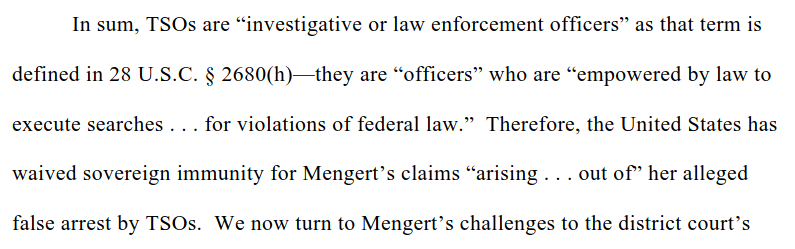
Until this week, I had obtained rulings in 3 other Courts of Appeals holding that TSA screeners are “officers of the United States” who may be sued under this particular law (and two other law firms obtained similar rulings in another pair of appeals courts), but that pesky contra opinion from the Eleventh still remained. On Wednesday, however, my firm obtained victory in Koletas v. United States, 24-10505 (11th Cir. 2025), reversing U.S. District Judge Sheri Polster Chappell in the Middle District of Florida:

As our sister circuits noted, the reasoning in Corbett I is not persuasive for two reasons. First, it did not conduct a textual analysis of the relevant statute, the FTCA. See e.g., Iverson, 973 F.3d at 850 (explaining that the ATSA postdates the FTCA and cannot “silently alter[]” the scope of a statute enacted 30 years prior). Second, as the Third Circuit explained, it is perfectly consistent for TSOs to be classified as both “employees” and “officers,” but not “law enforcement officers.” See Pellegrino, 937 F.3d at 171 (“[T]here is no textual indication that only a specialized ‘law enforcement officer’ in the [ATSA] qualifies as an ‘officer of the United States’ under the [FTCA].”).

Because the government does not meaningfully defend Corbett I’s holding that TSOs are not “officers” under the law enforcement proviso, and because we are persuaded by the plain-meaning analysis conducted by our sister circuits, we conclude that TSOs qualify as “officers” under the proviso.

Notable of the lower court’s ruling was that the prior decision in my long-ago case was not binding precedent because it was an “unpublished” decision of the Eleventh Circuit, and the lower court not only adopted it wholesale, it completely ignored (as in, did not even mention) the other then-four appellate courts to go the other way:

But the district court’s economical dismissal order did not grapple at all with the thorough analyses provided by the Third and Eighth Circuits in the cases cited by Koletas, nor with other then-recently published decisions from the Fourth and Ninth Circuits reaching the same conclusion.

Accordingly, we caution district courts from relying on our unpublished decisions purely because they are our decisions, without carefully evaluating the legal suasion of an unpublished Eleventh Circuit opinion.

It is, of course, too late to go back and re-open my case, but my client here will now have her day in court after having been unlawfully strip searched by TSA screeners in Orlando — a massive win for justice.

The issue of whether TSA screeners may be sued for intentional torts under the Federal Tort Claims Act is now 6-0 in favor of “indeed they may!” in the twelve circuit courts (and, now that the government has lost the one opinion in its favor, I expect this may be the end of the issue). Summary of the law by circui

  • First Circuit – No Decision
  • Second Circuit – No Decision
  • Third Circuit – TSA Lost (Pellegrino, 2019)
  • Fourth Circuit – TSA Lost (Osmon, 2023)
  • Fifth Circuit – No Decision
  • Sixth Circuit – No Decision
  • Seventh Circuit – No Decision
  • Eighth Circuit – TSA Lost (Iverson, 2020)
  • Ninth Circuit – TSA Lost (Leuthauser, 2023)
  • Tenth Circuit – TSA Lost (Mengert, 2024)
  • Eleventh Circuit – TSA Lost (Koletas, 2025)
  • DC Circuit – No Decision

Koletas v. United States – Eleventh Circuit Opinion (.pdf)

TSA Loses on Immunity for Fifth Time: Tenth Circuit Court of Appeals Holds TSA Screeners Can Be Sued Under FTCA

Last week, the U.S. Court of Appeals for the Tenth Circuit was the fifth federal appeals court in a row to hold that TSA screeners are “investigative or law enforcement officers,” a category of federal employees who may be sued for intentional misconduct like battery or false arrest under the Federal Tort Claims Act. The decision was a 2-1 victory in Mengert v. U.S., argued by my firm on behalf of a woman who was strip searched by TSA screeners in Oklahoma who alleged they were confused by a feminine hygiene product she was wearing.


The opinion in this case was unfortunately not all good news, as the court also held that in Oklahoma, one can’t recover for emotional distress claims unless their emotional distress is so severe that it, for example, affects their daily life. This is bad news for those injured in Oklahoma (although attorneys seeking to recover in Oklahoma should consider negligence, battery, and other tort claims that may still be viable), though we will, of course, consider our options to challenge that overly-strict standard for emotional distress.

There are twelve regional federal circuit courts of appeals and each one is precedential only for its own region — so the government can try in each circuit to get a different decision, but it is extremely rare for one circuit to go against a consensus of five. Undeterred, TSA is now pursuing the same issue in the Eleventh Circuit, likely to be heard on oral argument in March, which I’ll be arguing for a fourth client.

Summary of the law by circuit:

  • First Circuit – No Decision
  • Second Circuit – No Decision
  • Third Circuit – TSA Lost (Pellegrino, 2019)
  • Fourth Circuit – TSA Lost (Osmon, 2023)
  • Fifth Circuit – No Decision
  • Sixth Circuit – No Decision
  • Seventh Circuit – No Decision
  • Eighth Circuit – TSA Lost (Iverson, 2020)
  • Ninth Circuit – TSA Lost (Leuthauser, 2023)
  • Tenth Circuit – TSA Lost (Mengert, 2024)
  • Eleventh Circuit – Oral Arguments Likely March 2025 (Koletas)
  • DC Circuit – No Decision

TSA, Having Lost Immunity in Four Courts of Appeals, Tries Again Twice More

TSA loves arguing that it’s exempt from Federal Tort Claims Act (FTCA) lawsuits based on the misconduct of its checkpoint screeners. The text of the FTCA states that it only applies to intentional misconduct when committed by an “officer of the United States who is empowered by law to execute searches, to seize evidence, or to make arrests for violations of Federal law,” and TSA argues that checkpoint screening isn’t really “executing searches.” Given that the FTCA is the only viable way to redress checkpoint abuse in the courts, it’s no wonder that they give serious effort to this strategy despite it requiring… er, linguistical creativity… to say that TSA screeners don’t search.

Every U.S. Court of Appeals to hear the matter and come up with a precedential ruling — four so far — has ruled against them. I argued two of them that were decided last year (Osmon in the Fourth Circuit, Leuthauser in the Ninth) and the Third and Eighth Circuits took the same path in 2019 and 2020, respectively. But, there are twelve federal circuits that hear general appeals and a decision of one of them is only binding within the states covered by that particular circuit, so unless the Supreme Court takes up the matter, TSA is free to give all twelve circuits a try. If TSA wins in one of them, it can use that as a reason to persuade the Supreme Court to hear the case (lawyers call this a “circuit split”).

So try they do. In March, I’ll be doing oral arguments in Mengert v. U.S., on behalf of a woman who was subject to a back-room strip search by TSA screeners (TSA rules categorically prohibit their screeners from conducting strip searches for any reason). TSA lost on the FTCA issue in the lower court and is now raising it in the Tenth Circuit. TSA also tried again in a Florida federal district court in Koletas v. U.S., and prevailed on the FTCA issue in that trial court. That Florida ruling rubber-stamped TSA’s argument without even mentioning the Third, Fourth, Eighth, and Ninth circuit rulings, which is pretty outrageous even for Florida. We filed a notice of appeal to the Eleventh Circuit.

So in summary:

  • First Circuit – No Decision
  • Second Circuit – No Decision
  • Third Circuit – TSA Lost (Pellegrino, 2019)
  • Fourth Circuit – TSA Lost (Osmon, 2023)
  • Fifth Circuit – No Decision
  • Sixth Circuit – No Decision
  • Seventh Circuit – No Decision
  • Eighth Circuit – TSA Lost (Iverson, 2020)
  • Ninth Circuit – TSA Lost (Leuthauser, 2023)
  • Tenth Circuit – Oral Arguments in March 2024 (Mengert)
  • Eleventh Circuit – Oral Arguments Likely Winter 2024 (Koletas)
  • DC Circuit – No Decision

U.S. Court of Appeals Clears Path to Lawsuits Against Abusive TSA Screeners

Osmon DecisionIn 2012, a TSA screener refused to allow me to leave a checkpoint after I told him I wouldn’t consent to having him touch my genitals. He told me I would be forcibly searched, called the police, and spent 45 minutes tearing apart my baggage looking for drugs. TSA screeners, of course, have no authority to conduct a detention, a forcible search, or a search for drugs.
I sued TSA that year — long before I had even started law school — and the U.S. Court of Appeals for the Eleventh Circuit held against me, without allowing oral arguments as is traditional, because, they said, the law under which I sued only applied to “investigative or law enforcement officers” and TSA screeners are not “officers.” This despite their badge reading “U.S. Officer,” their job title being “Transportation Security Officer,” and obviously meeting the statutory definition, which was one “empowered by law to execute searches, to seize evidence, or to make arrests.”

Fast forward a decade, a law degree, and a law license later, and two U.S. Courts of Appeals have held the opposite — and today I’m proud to announce that the Fourth Circuit joins them in a unanimous opinion in Osmon v. United States, 22-2045, a case I argued on behalf of a woman who was sexually assaulted on video, right at a checkpoint, while the TSA screener commented on how short her shorts were:

The government disagrees, insisting the relevant language covers only searches that are part of “criminal law enforcement.” U.S. Br. 21 (quotation marks omitted). Per the government, the law enforcement proviso permits suits for battery only when the officer could perform “a criminal, investigatory search” rather than “an administrative search,” which takes the form of an “inspection” or “screening.” U.S. Br. 26.

The problem with the government’s argument is that it reprises a tactic the Supreme Court has already rejected: “read[ing] into the text additional limitations designed to narrow the scope of the law enforcement proviso.” Millbrook, 569 U.S. at 55. The word “criminal” appears nowhere in the law enforcement proviso—let alone as a modifier of “searches.” See 28 U.S.C. § 2680(h). Here, as elsewhere, we “may not narrow a provision’s reach by inserting words Congress chose to omit.” Lomax v. Ortiz-Marquez, 140 S. Ct. 1721, 1725 (2020).

Having joined the Third Circuit in Pellegrino v. United States, 15-3047 (3rd Cir. 2019, en banc) and Iverson v. United States, (8th Cir. 2020), there are now 15 states where TSA may no longer use the “we’re not officers” defense. Because the Eleventh Circuit did not publish their opinion in my 2012 case, it is non-precedential and lawsuits may proceed in all 35 other states, where TSA will have an uphill battle convincing courts to apply different logic.

Suffice to say, I am ecstatic to open the courthouse doors for all injured by abusive feds, I am thrilled to bring my client closer to getting some justice for this brazen misconduct, and I feel personally vindicated after having been swept out the courthouse door a decade ago by judges who, frankly, did not want to deal with a pro se litigant challenging the government’s status quo. My firm continues to handle cases of checkpoint abuse, and I encourage anyone violated by TSA at the checkpoint to get in touch.

Osmon v. TSA – Reversed & Remanded (.pdf)

Court of Appeals: TSA May Force Travelers to Aggravate Medical Conditions During Search

I fight civil rights cases, which necessitates asking the government (courts) to tell the government (executive) that they can’t do something. It’s always an uphill battle, and not every case gets justice for those who encounter government abuse. But this decision left me equal parts depressed and angry.

Rohan Ramsingh is a disabled veteran. In addition to physical injuries incurred during his service to our country, he has PTSD that would be triggered by certain parts of TSA’s pat down procedure. His PTSD is documented and treated by the VA.

When he went through a TSA checkpoint just before the pandemic and TSA asked him to undergo a pat-down, he respectfully advised them of his medical limitations. Instead of finding an alternate method of screening (as is frequently done for casts or otherwise medically-inaccessible areas of the body) or simply saying, “We can’t clear you today, sorry,” they called police to try to force him to submit, and when police declined to play that role, they ejected him from the checkpoint and sent him a fine for $2,050.

I represented Mr. Ramsingh in “TSA court,” wherein the agency acts as judge, jury, and executioner, expecting success would be unlikely at that level, which produced gems such as this one:

“TSA did not dispute Respondent’s claims to STOSs Pagan and McClelland that he suffers from a condition preventing him from lifting both arms and PTSD, and it does not dispute Respondent’s VA medical documentation, in Exhibit A. … However, as discussed in Ruskai, supra, an individual’s bona fide medical condition does not invalidate the requirement to complete screening.”

In other words, TSA can ask you to do something you medically cannot or should not do, and you must comply or face a fine. TSA court was “nice enough” to reduce that fine to $680.

“As expected, no problem,” I thought, as I prepared the petition for the U.S. Court of Appeals for the D.C. Circuit to review the case, fully expecting them to set the TSA straight that no, they cannot force someone to injure themselves at the checkpoint. Wrong I was. In 22 pages of opinion, all they managed to say regarding whether TSA may force a traveler to obey despite a medical condition is this:

When Ramsingh explained his discomfort with a pat-down, TSA offered to conduct the search in a more private area. While the accommodations provided did not fully meet Ramsingh’s medical needs, the TSA officers made a good-faith effort to respect his particular conditions while also performing their security and public-safety duties.

Triggering a PTSD episode is not “discomfort,” and a “good-faith effort” that fails to accommodate a disability should not result in the person with the disability being fined. It also follows that physical injuries will be similarly treated. You’ve got a wound that’s sensitive to the touch? You better let TSA touch it or face a fine!

I am outraged by the decision of the Court of Appeals, and we will be continuing this fight. If any disabilities or veteran’s rights groups, or mental health advocacy groups, would be wiling to assist by helping to explain to the court the seriousness of mental health episodes, please be in touch.

Ramsingh v. TSA – Opinion (.pdf)

Lawsuit: TSA Fined Disabled Veteran for Being *Unable* to Comply with Airport Screening

Rohan Ramsingh is a disabled veteran of the United States Army. His service to his country left him with multiple disabilities, including minimal use of one of his shoulders and severe post-traumatic stress disorder (PTSD), sufficient that the government classifies him as having “permanent and total disability.” To give you an idea of the extent of the surgeries, medication, and other treatment he has required, his medical record with the Veterans Health Administration is nearly 900 pages.

A few months before the pandemic descended upon the world, Ramsingh went to the airport, presented himself at the security checkpoint, and candidly told TSA screeners about his disabilities at the start of screening. His shoulder injury precludes going through a body scanner (which requires a traveler to hold their arms above their head for several seconds) and his PTSD is triggered by having certain areas of his body touched by strangers. Upon hearing this, instead of working to find a solution, or at worst telling Ramsingh that they wouldn’t be able to clear him to enter, supervisors apparently interpreted Ramsingh’s medical limitations as disrespect of their authority and started to threaten him with detention, fines, and police intervention. Security video shows that the whole time, Ramsingh remained calm, not once yelling or create a scene, and after several minutes of being barked at, he asked TSA to allow him to leave the airport. Instead, TSA held him and police were called. The incident ended when the responding officer told Ramsingh that he wouldn’t be participating in detaining him and that he was free to go.

If only the story also ended there. Days later, Ramsingh received a letter proposing that he pay TSA a civil penalty of $2,050 for “interference” with the TSA screening process.

Surely this must be posturing by some supervisor with a hurt ego that will be abandoned once the adults in charge take a look, right? Wrong. Ramsingh retained competent counsel — yours truly — who retrieved the security video, the incident reports, and the medical records, and presented them to actual attorneys for TSA assigned to the case, David Hall and Bill Hernandez. Instead of dismissing, they argued that being disabled is no defense for failure to complete the screening process, and TSA court (yes, there is such a thing), of course, agreed:

“TSA did not dispute Respondent’s claims to STOSs Pagan and McClelland that he suffers from a condition preventing him from lifting both arms and PTSD, and it does not dispute Respondent’s VA medical documentation, in Exhibit A. … However, as discussed in Ruskai, supra, an individual’s bona fide medical condition does not invalidate the requirement to complete screening.

Order Granting TSA’s Motion for Decision, Mar. 4th, 2021, by Hon. Michael J. Devine, U.S. Coast Guard Administrative Law Judge

An appeal to the head of the agency was denied, and so on Friday we asked the United States Court of Appeals for the D.C. Circuit to explain to TSA that no, it cannot fine people for not completing screening when they are unable to do so. Case No. 21-1170 was assigned with briefing to begin next month.

One would think that a disabled veteran would be the last person the TSA would give grief to. In screening 2 million travelers daily, TSA could be expected to learn how to interact with people with disabilities generally. After all, according to the CDC, 1 in 4 Americans has some kind of disability. This behavior is a disgrace, and I look forward to fighting this battle in an actual Article III court.

Ramsingh v. TSA – Petition for Review w/ Exhibit (.pdf)

Lawsuit Challenges TSA Authority to Implement Mask Policy

Lawsuit CoverIt seems that masks reduce transmission of coronavirus: some studies showing reduction of as low as 20%, while others claim as high as 85%. I don’t really have a problem with mask requirements in crowded, confined spaces at the moment. They are not the cure-all that some make them out to be, but they provide some reduction and are a relatively small burden compared to some of the coronavirus measures imposed by the government.
What I do have a problem with is any expansion of the authority of one of the most abusive, inept, and inefficient agencies in the nation: the Transportation Security Administration. Transportation security involves passenger screening, cargo screening, managing intelligence relating to threats to civil aviation, technology to detect weapons and explosives, federal air marshals, and the like. This is clear just by looking at the index of law that Congress passed to assign duties to the TSA, 49 U.S.C., Subchapter I. Transportation security is not transportation safety. Transportation safety is the responsibility of the U.S. Department of Transportation, and when it comes to airplanes, their subagency, the Federal Aviation Administration (F.A.A.).

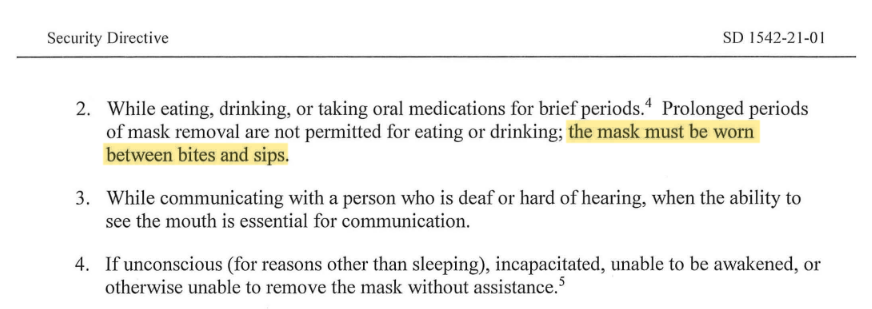
Despite it being completely out of their jurisdiction — or what lawyers call “ultra vires” (Latin: beyond power) — on January 31st, 2021, TSA issued several “security” directives to air carriers, airport operators, and even bus and train station operators, ordering them to enforce strict mask rules and to report passengers who do not comply to TSA (over the next few days, TSA Twitter accounts informed the public that it would issue fines of up to $1,200 against non-compliant passengers). TSA’s mask rules apply anywhere within the transportation system: from the curb outside of check-in, to TSA’s checkpoints, to the gate, lounge, bathroom, on the airplane, and even while seated in the food court (“the mask must be worn between bites and sips”):

Security Directive

It is unclear why this was necessary at all, given that all airlines and airports in the country require masks anyway. And, in fairness, TSA did not get the idea to implement a mask policy on its own. The day after inauguration day, new President Biden issued an executive order “promoting COVID-19 safety in domestic and international travel” that asked an alphabet soup of agencies to enforce mask regulations, and he made the mistake of including TSA on that list. He could have just named the FAA and CDC and been done with it; if you suggest to TSA that they assert more power, they will not hesitate to accept your invitation.

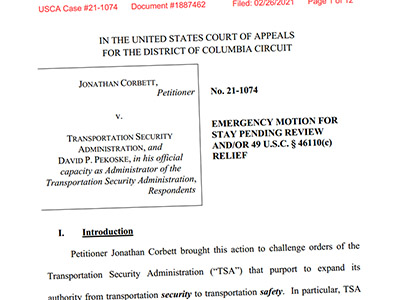
Notwithstanding, an executive order cannot increase the jurisdiction of an agency beyond Congress’ mandate, and if we do not stop them now, you can expect TSA will continue to issue more and more mandates for general public health and safety concerns. Therefore, after a 2-week process of getting myself admitted to the bar of the U.S. Court of Appeals for the D.C. Circuit, I filed a petition for review of these orders and asked for an emergency stay pending the resolution of the case. (The Court of Appeals, rather than a district court, is the appropriate court because of a jurisdictional statute that says so.) Case is Corbett v. TSA, 21-1074, and I think it is likely the court will in some way address the emergency motion next week. Documents below.

Corbett v. TSA – Petition for Review (.pdf)

Corbett v. TSA – Emergency Motion for Stay (.pdf)


Fighting for civil rights in court is expensive and time-consuming!  Want to contribute to the fight against government assholery? Donate via PayPal, Venmo, Chace QuickPay, Bitcoin, or check.

U.S. District Court: TSA Not Immune in Right-to-Film Lawsuit

TSA says right on its Web site that photo and video at the checkpoint is no problem, so long as you’re not in the way and not trying to capture the content of their computer screen. It’s also a First Amendment right to record government officials doing their work in public, as has been affirmed time and time again. So why was my client, who simply wanted to capture his husband’s pat-down on their cell phone camera, told by a TSA supervisor at Richmond International Airport that not only must they stop, but also delete the video that they started to take?

Probably some bad training, probably some bad attitude, but regardless, U.S. District Judge John A. Gibney, Jr., in the Eastern District of Virginia, wasn’t having it, and today denied TSA’s motion to dismiss on qualified immunity grounds, as well as rebuffing TSA’s attempt to preclude Bivens remedies from being applied to checkpoint abuse.

Bivens is the landmark case allowing for money damages for some constitutional violations, most often for Fourth Amendment search-and-seizure abuse. The U.S. Supreme Court has shown some hostility towards using Bivens in other contexts, recently calling it a “‘disfavored’ judicial activity” and requiring courts to accept pretty much any reason that might suggest that Bivens remedies should be disallowed as good enough to disallow it. Ziglar v. Abbasi, 137 S. Ct. 1843 (2017). And here, TSA argued them all: that it would harm national security, interfere with their ability to do their job, and cause great hardship in their screener training process. But making TSA screeners follow the Constitution doesn’t implicate some kind of state secrets, and regarding training, well:

Federal officials should not evade liability for constitutional violations because their employer has not provided adequate training.

…or in other words, if TSA isn’t already training their employees to follow the Constitution, now would be a great time to get started with that.

Regarding qualified immunity — the idea that government officials should get a pass if the courts hadn’t already made clear that similar conduct was illegal — the court had no trouble concluding that TSA is not “special:”

“[T]he First Amendment protects the right to record government officials performing their duties … to enable any citizen at any time to bring the government and any person in authority to the bar of public opinion …

In addition, when we protect the right to record public officials, we protect against the degradation of various other constitutional rights. This country’s racial unrest highlights this principle. Because a cell phone video captured George Floyd’s death, the world watched. The world’s reaction to this video — and others — sent millions into the streets in protest. Although the racial reckoning continues, this video and the protests it sparked bent ‘the arc of the moral universe … towards justice.’ Dr. Martin Luther King, Jr., Remaining Awake Through a Great Revolution (Mar. 31, 1968). What if the officers had ordered the video that captured George Floyd’s death deleted?”

It certainly makes this civil rights lawyer warm and fuzzy to have a judge quote Dr. King while a ruling in his favor.

Dyer v. TSA – Motion to Dismiss, Denied (.pdf)

TSA Sued for Asking Child to Remove Pants to “Feel” Her Genitals

Transgender Pride FlagJamii Erway is a 16-year-old girl in North Carolina who is used to getting false alarms when she goes through TSA body scanners. The reason is that Jamii is transgender — she was born male and now lives as a young woman — and the TSA screener operating a body scanner must press a “Male” or “Female” button for each passenger.  If the operator presses “Female,” the machine will alarm if the traveler has external genitals.  If the operator presses “Male,” the machine will alarm they are wearing a bra.  (And, well, if you have a penis while wearing a bra, the machine will alarm no matter which button is pushed.)
I can only imagine that dealing with transitioning genders as a teenager is an extraordinarily difficult experience even without having to deal with the TSA.

TSA standard procedure for when the body scanner alarms on the “groin area” is that a quick pat-down using the back of the screener’s hands is done at the checkpoint to ensure that the traveler is not in possession of any prohibited items, as Jamii had experienced several times before.  But, when triggering the scanner last May at Raleigh-Durham International Airport, a confused scanner operator called over a supervisor who decided to invent a new procedure for transgender travelers: she told Jamii she must go to a private room, expose herself, and let her “feel up in there.”  That is, a TSA supervisor demanded to molest a child.  When Jamii’s mother, traveling with her, attempted to intervene, the supervisor told the mother to “mind her business” before trying to recruit her to pressure Jamii into submitting to the “search.”

TSA policies prohibit checkpoint screeners (and supervisors) from conducting strip searches (even though they continue to happen at the hands of “rogue” screeners, knowing that they are unlikely to face discipline).  Police and high-level TSA managers were called thanks to a mother unwilling to bend under pressure from a blue-shirted thug, and when police refused to back the search, Jamii and mother left the airport and drove 600 miles to their destination.

As best we can tell, neither the police nor TSA management took any action against the supervisor who wanted to violate Jamii — so on Monday I filed suit on behalf of Jamii in the U.S. District Court for the Eastern District of North Carolina.  The actions of the TSA here disgust me more than usual given that this is my first case on behalf of a child, and given the apparent discriminatory motivation.  I look forward to obtaining some justice for my clients and hopefully sending a message that transgender people are not second-class citizens while flying.

Erway v. TSA – Complaint (.pdf)

Woman Sues TSA for Inserting Fingers Inside of Her During “Search”

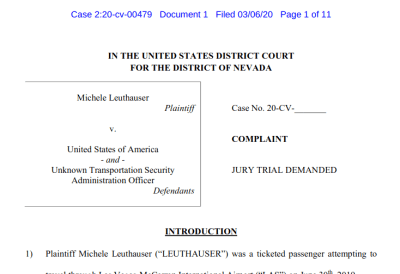
Leuthauser ComplaintMichele Leuthauser was traveling from Las Vegas-McCarran International Airport last June wearing yoga pants that should have made it quite easy to determine that she was concealing nothing on the lower half of her body.  But, because the TSA uses body scanners with a false positive rate somewhere in the range of 20-40% (some studies higher), Michele was flagged for additional screening: a pat-down of her “groin area.”
Unfortunately, a yet-to-be-identified TSA screener used this as an opportunity to violate Michele.  While typically body scanner alarms are resolved with a quick and limited (yet still often invasive) pat-down right next to the machine, the screener directed Michele to a “private room.”  Screening in a private room is supposed to be an option offered to passengers who feel more comfortable (an option I advise all travelers against taking at all costs), but for Michele it was mandatory.

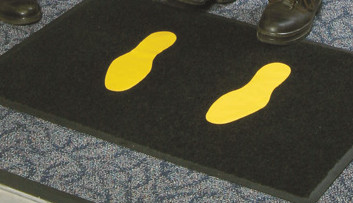
TSA Footprints MatWhen doing pat-downs, the TSA has little mats with footprints painted on to indicate to the passenger how to stand.  But, the screener told Michele to spread her legs far wider than the mat — an order that seems common for TSA screeners about to inflict abuse.  She then proceeded to rub her hand on Michele’s vulva, pressing firmly enough to penetrate her labia with her finger through her leggings, and then continuing to rub her vulva until Michele, in shock, finally recoiled and told the screener to stop.

On Friday, I filed suit on behalf of Michele after TSA supervisors, local police, and TSA’s Office of the Chief Counsel refused to do anything about this incident.  While TSA policies (and the Constitution) obviously prohibit checkpoint body cavity searches, no one seems to care when normal screening turns to blatant sexual assault.  I look forward to giving TSA incentive to care in the U.S. District Court for the District of Nevada.

Leuthauser v. TSA – Complaint (.pdf)

Blog at WordPress.com.

Up ↑