In a second victory for travelers this year, the U.S. Court of Appeals for the Ninth Circuit held 3-0 that the Federal Tort Claims Act allows lawsuits against the government when TSA screeners violate passengers. Two months ago, the Fourth Circuit held the same, and previously the Third and Eighth Circuits took the same path in 2019 and 2020, respectively.
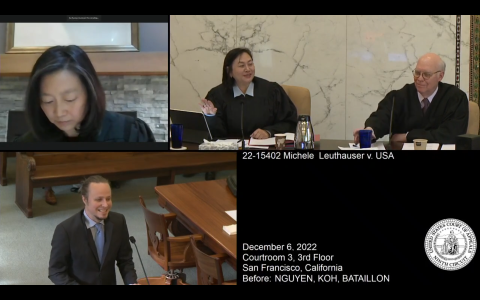
Oral Arguments in Leuthauser in San Francisco, CA
I was pleased to represent Michele Leuthauser in both the district court and appellate court. The court aptly summed up her experience as follows:
Leuthauser was told that she had to submit to a “groin search.” Leuthauser then entered a private room with two TSOs, including Defendant Anita Serrano. Leuthauser was directed to stand on a floor mat with footprints painted on it to show where to place her feet. Leuthauser alleges that TSO Serrano directed her to spread her legs far more widely than the footprints indicated. TSO Serrano then conducted a pat-down during which TSO Serrano slid her hands along the inside of Leuthauser’s thighs, touched her vulva and clitoris with the front of her fingers, and digitally penetrated her vagina.
One would think that under such circumstances, it would be obvious that the screener or her employer would be on the hook for such egregious conduct. But, the government attempts to combine two laws to preclude any lawsuits against anyone. First, the Westfall Act allows the government, when one of its employees gets sued for on-the-job conduct, to say, “sue us instead of the employee.” This would not be a problem — the treasury is more likely to pay a judgment than a random TSA employee anyway — except they next use the Federal Tort Claims Act, which basically says, among other things, “the government can’t be sued for certain conduct.” In this case, it’s assault and battery when committed by anyone other than an “investigative or law enforcement officer.” So the argument is: 1) you have to sue only the government, but 2) the government isn’t liable.
Luckily, now four appellate courts have concluded that TSA screeners are “investigative or law enforcement officers. I wrote more about this when the Fourth Circuit ruling came out in April for those interested in the details, but suffice to say: if your local letter carrier, social security clerk, or receptionist at a VA hospital doesn’t like your attitude and punches you in the face, you may have no recourse, so long as the government protects the employee with the Westfall Act, because they are not “investigative or law enforcement officers.” But the law is now clear: TSA screeners are, and the government may be sued for their intentional (and negligent) misconduct.
Leuthauser v. United States, 22-15402 – Reversed & Remanded (.pdf)
 It seems that masks reduce transmission of coronavirus: some studies showing reduction of
 Last week, the New York State Liquor Authority announced a rule that food service establishments licensed to sell alcohol could no longer advertise any music offered during the dining experience, in a rule absurd enough to surely have been drafted by Governor Andrew Cuomo himself. This rule, which also bans tickets or admission charges to food service establishments, is a clear violation of the First Amendment rights of the state’s liquor licensees.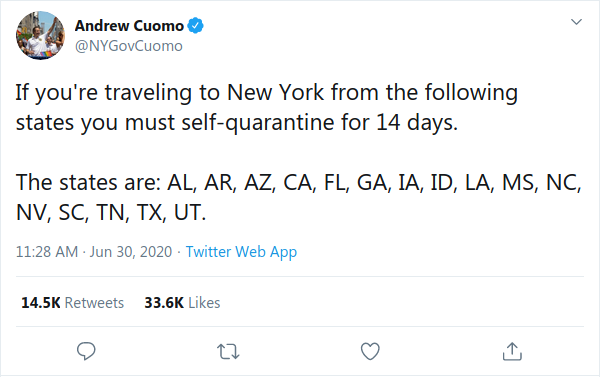

 Michele Leuthauser was traveling from Las Vegas-McCarran International Airport last June wearing yoga pants that should have made it quite easy to determine that she was concealing nothing on the lower half of her body. But, because the TSA uses body scanners with a false positive rate somewhere in the range of 20-40% (some studies
 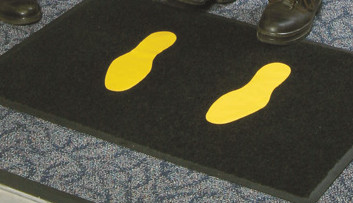 When doing pat-downs, the TSA has little mats with footprints painted on to indicate to the passenger how to stand. But, the screener told Michele to spread her legs far wider than the mat — an order that

 Professional Troublemaker ®