TSA Loses Immunity in Eleventh Circuit, Doing Away With Only Appellate Decision in Its Favor

Well over a decade ago, the U.S. Court of Appeals for the Eleventh Circuit tossed aside a case I filed as a young, pro se litigant, without oral arguments, on the basis that TSA screeners aren’t “officers of the United States” and therefore can’t be sued under laws that hold such officers accountable. This decision, along with the sting of being denied justice over a brief false arrest by TSA, was one of the most motivating factors for enrolling in law school, which I did months later.

Until this week, I had obtained rulings in 3 other Courts of Appeals holding that TSA screeners are “officers of the United States” who may be sued under this particular law (and two other law firms obtained similar rulings in another pair of appeals courts), but that pesky contra opinion from the Eleventh still remained. On Wednesday, however, my firm obtained victory in Koletas v. United States, 24-10505 (11th Cir. 2025), reversing U.S. District Judge Sheri Polster Chappell in the Middle District of Florida:

As our sister circuits noted, the reasoning in Corbett I is not persuasive for two reasons. First, it did not conduct a textual analysis of the relevant statute, the FTCA. See e.g., Iverson, 973 F.3d at 850 (explaining that the ATSA postdates the FTCA and cannot “silently alter[]” the scope of a statute enacted 30 years prior). Second, as the Third Circuit explained, it is perfectly consistent for TSOs to be classified as both “employees” and “officers,” but not “law enforcement officers.” See Pellegrino, 937 F.3d at 171 (“[T]here is no textual indication that only a specialized ‘law enforcement officer’ in the [ATSA] qualifies as an ‘officer of the United States’ under the [FTCA].”).

Because the government does not meaningfully defend Corbett I’s holding that TSOs are not “officers” under the law enforcement proviso, and because we are persuaded by the plain-meaning analysis conducted by our sister circuits, we conclude that TSOs qualify as “officers” under the proviso.

Notable of the lower court’s ruling was that the prior decision in my long-ago case was not binding precedent because it was an “unpublished” decision of the Eleventh Circuit, and the lower court not only adopted it wholesale, it completely ignored (as in, did not even mention) the other then-four appellate courts to go the other way:

But the district court’s economical dismissal order did not grapple at all with the thorough analyses provided by the Third and Eighth Circuits in the cases cited by Koletas, nor with other then-recently published decisions from the Fourth and Ninth Circuits reaching the same conclusion.

Accordingly, we caution district courts from relying on our unpublished decisions purely because they are our decisions, without carefully evaluating the legal suasion of an unpublished Eleventh Circuit opinion.

It is, of course, too late to go back and re-open my case, but my client here will now have her day in court after having been unlawfully strip searched by TSA screeners in Orlando — a massive win for justice.

The issue of whether TSA screeners may be sued for intentional torts under the Federal Tort Claims Act is now 6-0 in favor of “indeed they may!” in the twelve circuit courts (and, now that the government has lost the one opinion in its favor, I expect this may be the end of the issue). Summary of the law by circui

  • First Circuit – No Decision
  • Second Circuit – No Decision
  • Third Circuit – TSA Lost (Pellegrino, 2019)
  • Fourth Circuit – TSA Lost (Osmon, 2023)
  • Fifth Circuit – No Decision
  • Sixth Circuit – No Decision
  • Seventh Circuit – No Decision
  • Eighth Circuit – TSA Lost (Iverson, 2020)
  • Ninth Circuit – TSA Lost (Leuthauser, 2023)
  • Tenth Circuit – TSA Lost (Mengert, 2024)
  • Eleventh Circuit – TSA Lost (Koletas, 2025)
  • DC Circuit – No Decision

Koletas v. United States – Eleventh Circuit Opinion (.pdf)

TSA Loses on Immunity for Fifth Time: Tenth Circuit Court of Appeals Holds TSA Screeners Can Be Sued Under FTCA

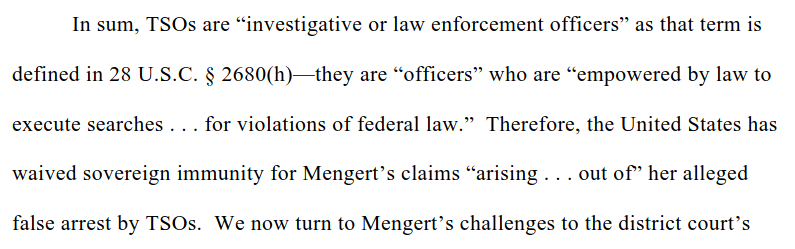
Last week, the U.S. Court of Appeals for the Tenth Circuit was the fifth federal appeals court in a row to hold that TSA screeners are “investigative or law enforcement officers,” a category of federal employees who may be sued for intentional misconduct like battery or false arrest under the Federal Tort Claims Act. The decision was a 2-1 victory in Mengert v. U.S., argued by my firm on behalf of a woman who was strip searched by TSA screeners in Oklahoma who alleged they were confused by a feminine hygiene product she was wearing.


The opinion in this case was unfortunately not all good news, as the court also held that in Oklahoma, one can’t recover for emotional distress claims unless their emotional distress is so severe that it, for example, affects their daily life. This is bad news for those injured in Oklahoma (although attorneys seeking to recover in Oklahoma should consider negligence, battery, and other tort claims that may still be viable), though we will, of course, consider our options to challenge that overly-strict standard for emotional distress.

There are twelve regional federal circuit courts of appeals and each one is precedential only for its own region — so the government can try in each circuit to get a different decision, but it is extremely rare for one circuit to go against a consensus of five. Undeterred, TSA is now pursuing the same issue in the Eleventh Circuit, likely to be heard on oral argument in March, which I’ll be arguing for a fourth client.

Summary of the law by circuit:

  • First Circuit – No Decision
  • Second Circuit – No Decision
  • Third Circuit – TSA Lost (Pellegrino, 2019)
  • Fourth Circuit – TSA Lost (Osmon, 2023)
  • Fifth Circuit – No Decision
  • Sixth Circuit – No Decision
  • Seventh Circuit – No Decision
  • Eighth Circuit – TSA Lost (Iverson, 2020)
  • Ninth Circuit – TSA Lost (Leuthauser, 2023)
  • Tenth Circuit – TSA Lost (Mengert, 2024)
  • Eleventh Circuit – Oral Arguments Likely March 2025 (Koletas)
  • DC Circuit – No Decision

TSA, Having Lost Immunity in Four Courts of Appeals, Tries Again Twice More

TSA loves arguing that it’s exempt from Federal Tort Claims Act (FTCA) lawsuits based on the misconduct of its checkpoint screeners. The text of the FTCA states that it only applies to intentional misconduct when committed by an “officer of the United States who is empowered by law to execute searches, to seize evidence, or to make arrests for violations of Federal law,” and TSA argues that checkpoint screening isn’t really “executing searches.” Given that the FTCA is the only viable way to redress checkpoint abuse in the courts, it’s no wonder that they give serious effort to this strategy despite it requiring… er, linguistical creativity… to say that TSA screeners don’t search.

Every U.S. Court of Appeals to hear the matter and come up with a precedential ruling — four so far — has ruled against them. I argued two of them that were decided last year (Osmon in the Fourth Circuit, Leuthauser in the Ninth) and the Third and Eighth Circuits took the same path in 2019 and 2020, respectively. But, there are twelve federal circuits that hear general appeals and a decision of one of them is only binding within the states covered by that particular circuit, so unless the Supreme Court takes up the matter, TSA is free to give all twelve circuits a try. If TSA wins in one of them, it can use that as a reason to persuade the Supreme Court to hear the case (lawyers call this a “circuit split”).

So try they do. In March, I’ll be doing oral arguments in Mengert v. U.S., on behalf of a woman who was subject to a back-room strip search by TSA screeners (TSA rules categorically prohibit their screeners from conducting strip searches for any reason). TSA lost on the FTCA issue in the lower court and is now raising it in the Tenth Circuit. TSA also tried again in a Florida federal district court in Koletas v. U.S., and prevailed on the FTCA issue in that trial court. That Florida ruling rubber-stamped TSA’s argument without even mentioning the Third, Fourth, Eighth, and Ninth circuit rulings, which is pretty outrageous even for Florida. We filed a notice of appeal to the Eleventh Circuit.

So in summary:

  • First Circuit – No Decision
  • Second Circuit – No Decision
  • Third Circuit – TSA Lost (Pellegrino, 2019)
  • Fourth Circuit – TSA Lost (Osmon, 2023)
  • Fifth Circuit – No Decision
  • Sixth Circuit – No Decision
  • Seventh Circuit – No Decision
  • Eighth Circuit – TSA Lost (Iverson, 2020)
  • Ninth Circuit – TSA Lost (Leuthauser, 2023)
  • Tenth Circuit – Oral Arguments in March 2024 (Mengert)
  • Eleventh Circuit – Oral Arguments Likely Winter 2024 (Koletas)
  • DC Circuit – No Decision

Ninth Circuit Holds Government Liable for TSA Misconduct at Airport Checkpoints

In a second victory for travelers this year, the U.S. Court of Appeals for the Ninth Circuit held 3-0 that the Federal Tort Claims Act allows lawsuits against the government when TSA screeners violate passengers. Two months ago, the Fourth Circuit held the same, and previously the Third and Eighth Circuits took the same path in 2019 and 2020, respectively.

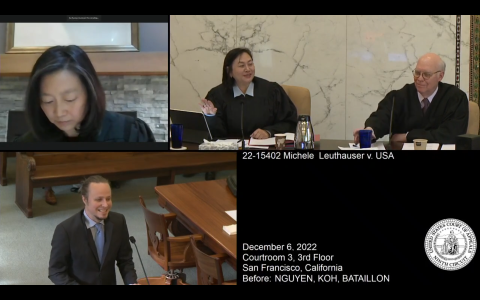
Oral Arguments in Leuthauser

Oral Arguments in Leuthauser in San Francisco, CA


I was pleased to represent Michele Leuthauser in both the district court and appellate court. The court aptly summed up her experience as follows:

Leuthauser was told that she had to submit to a “groin search.” Leuthauser then entered a private room with two TSOs, including Defendant Anita Serrano. Leuthauser was directed to stand on a floor mat with footprints painted on it to show where to place her feet. Leuthauser alleges that TSO Serrano directed her to spread her legs far more widely than the footprints indicated. TSO Serrano then conducted a pat-down during which TSO Serrano slid her hands along the inside of Leuthauser’s thighs, touched her vulva and clitoris with the front of her fingers, and digitally penetrated her vagina.

One would think that under such circumstances, it would be obvious that the screener or her employer would be on the hook for such egregious conduct. But, the government attempts to combine two laws to preclude any lawsuits against anyone. First, the Westfall Act allows the government, when one of its employees gets sued for on-the-job conduct, to say, “sue us instead of the employee.” This would not be a problem — the treasury is more likely to pay a judgment than a random TSA employee anyway — except they next use the Federal Tort Claims Act, which basically says, among other things, “the government can’t be sued for certain conduct.” In this case, it’s assault and battery when committed by anyone other than an “investigative or law enforcement officer.” So the argument is: 1) you have to sue only the government, but 2) the government isn’t liable.

Luckily, now four appellate courts have concluded that TSA screeners are “investigative or law enforcement officers. I wrote more about this when the Fourth Circuit ruling came out in April for those interested in the details, but suffice to say: if your local letter carrier, social security clerk, or receptionist at a VA hospital doesn’t like your attitude and punches you in the face, you may have no recourse, so long as the government protects the employee with the Westfall Act, because they are not “investigative or law enforcement officers.” But the law is now clear: TSA screeners are, and the government may be sued for their intentional (and negligent) misconduct.

Leuthauser v. United States, 22-15402 – Reversed & Remanded (.pdf)

U.S. Court of Appeals Clears Path to Lawsuits Against Abusive TSA Screeners

Osmon DecisionIn 2012, a TSA screener refused to allow me to leave a checkpoint after I told him I wouldn’t consent to having him touch my genitals. He told me I would be forcibly searched, called the police, and spent 45 minutes tearing apart my baggage looking for drugs. TSA screeners, of course, have no authority to conduct a detention, a forcible search, or a search for drugs.
I sued TSA that year — long before I had even started law school — and the U.S. Court of Appeals for the Eleventh Circuit held against me, without allowing oral arguments as is traditional, because, they said, the law under which I sued only applied to “investigative or law enforcement officers” and TSA screeners are not “officers.” This despite their badge reading “U.S. Officer,” their job title being “Transportation Security Officer,” and obviously meeting the statutory definition, which was one “empowered by law to execute searches, to seize evidence, or to make arrests.”

Fast forward a decade, a law degree, and a law license later, and two U.S. Courts of Appeals have held the opposite — and today I’m proud to announce that the Fourth Circuit joins them in a unanimous opinion in Osmon v. United States, 22-2045, a case I argued on behalf of a woman who was sexually assaulted on video, right at a checkpoint, while the TSA screener commented on how short her shorts were:

The government disagrees, insisting the relevant language covers only searches that are part of “criminal law enforcement.” U.S. Br. 21 (quotation marks omitted). Per the government, the law enforcement proviso permits suits for battery only when the officer could perform “a criminal, investigatory search” rather than “an administrative search,” which takes the form of an “inspection” or “screening.” U.S. Br. 26.

The problem with the government’s argument is that it reprises a tactic the Supreme Court has already rejected: “read[ing] into the text additional limitations designed to narrow the scope of the law enforcement proviso.” Millbrook, 569 U.S. at 55. The word “criminal” appears nowhere in the law enforcement proviso—let alone as a modifier of “searches.” See 28 U.S.C. § 2680(h). Here, as elsewhere, we “may not narrow a provision’s reach by inserting words Congress chose to omit.” Lomax v. Ortiz-Marquez, 140 S. Ct. 1721, 1725 (2020).

Having joined the Third Circuit in Pellegrino v. United States, 15-3047 (3rd Cir. 2019, en banc) and Iverson v. United States, (8th Cir. 2020), there are now 15 states where TSA may no longer use the “we’re not officers” defense. Because the Eleventh Circuit did not publish their opinion in my 2012 case, it is non-precedential and lawsuits may proceed in all 35 other states, where TSA will have an uphill battle convincing courts to apply different logic.

Suffice to say, I am ecstatic to open the courthouse doors for all injured by abusive feds, I am thrilled to bring my client closer to getting some justice for this brazen misconduct, and I feel personally vindicated after having been swept out the courthouse door a decade ago by judges who, frankly, did not want to deal with a pro se litigant challenging the government’s status quo. My firm continues to handle cases of checkpoint abuse, and I encourage anyone violated by TSA at the checkpoint to get in touch.

Osmon v. TSA – Reversed & Remanded (.pdf)

Barr DOJ Argues TSA Screeners Can Never Be Sued for Checkpoint Abuse

In the nearly a full decade that I’ve been filing lawsuits against the TSA, they have argued for a full panoply of immunities and protections to insulate them from any accountability.  They argue qualified immunity — that their screeners shouldn’t be liable except for violations of “clearly established law.”  They argue that if TSA screeners are following policy, that lawsuits in the normal federal trial court can’t proceed.  They argue that they are immune from state tort claims (.pdf) — ordinary false arrest, assault, etc..

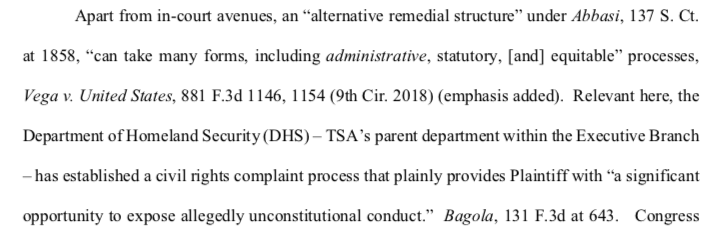
But earlier this week, in the case of grandmother Rhonda Mengert who was strip searched by TSA without suspicion and in blatant violation of TSA policy, the TSA added it all up and argued that because of all of these immunities, there actually doesn’t need to be a way to sue screeners for checkpoint abuse, no matter how egregious, at all.  You see, what travelers should actually do instead of suing is just file complaints with the TSA:

Use the TSA's

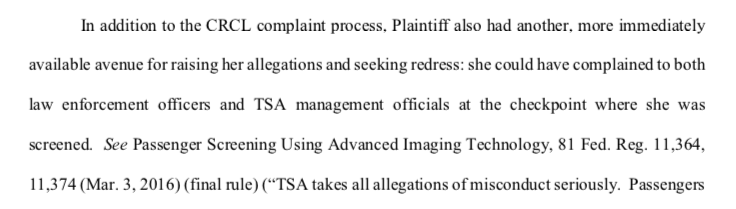
Or!  Ms. Mengert, who was just sexually assaulted by a TSA screener, could have vindicated her rights by telling a cop or a manager!

Complain to both law enforcement and TSA management?

And so, because a traveler can file an online complaint or tell a cop or a supervisor, there is no need for a lawsuit with money damages:

Complaint Process Precludes Bivens Claim?

For the lawyers out there, yes, this argument is that a Bivens claim cannot lie against a TSA screener, after TSA has already argued that Federal Tort Claims Act claims also cannot lie, and that state tort claims are also precluded so long as the screener was even nominally performing their duties (even if performance was in direct contradiction to their training and TSA rules) — in other words, no money damages against TSA screeners for checkpoint abuse, ever.

I am sure the government would love it if the remedy for a cop falsely arresting you or beating you back at the precinct was that you get to file a complaint and no more.  That if the FBI searches your house without a warrant, you get to file a complaint and no more.  That if your free speech rights are violated, you get to file a complaint and no more.

Obviously, we are here because people have complained and the injuries keep happening.  Those who are injured by the government are, and should be, entitled to some compensation from the government.  The argument that TSA is special and should be protected from lawsuits no matter what is antithetical to justice and, frankly, legally frivolous, and I look forward to filing a motion regarding the same in due time.

Mengert v. TSA – Motion to Dismiss Individual Defendants (.pdf)

Blog at WordPress.com.

Up ↑