TSA Loses Immunity in Eleventh Circuit, Doing Away With Only Appellate Decision in Its Favor

Well over a decade ago, the U.S. Court of Appeals for the Eleventh Circuit tossed aside a case I filed as a young, pro se litigant, without oral arguments, on the basis that TSA screeners aren’t “officers of the United States” and therefore can’t be sued under laws that hold such officers accountable. This decision, along with the sting of being denied justice over a brief false arrest by TSA, was one of the most motivating factors for enrolling in law school, which I did months later.

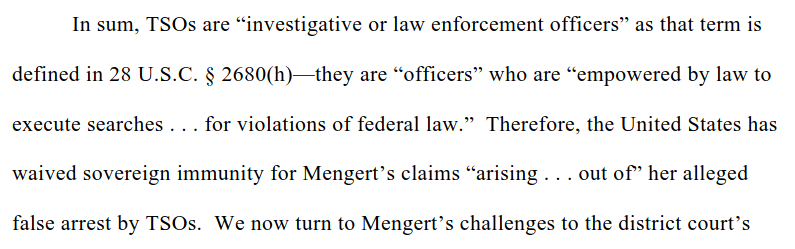
Until this week, I had obtained rulings in 3 other Courts of Appeals holding that TSA screeners are “officers of the United States” who may be sued under this particular law (and two other law firms obtained similar rulings in another pair of appeals courts), but that pesky contra opinion from the Eleventh still remained. On Wednesday, however, my firm obtained victory in Koletas v. United States, 24-10505 (11th Cir. 2025), reversing U.S. District Judge Sheri Polster Chappell in the Middle District of Florida:

As our sister circuits noted, the reasoning in Corbett I is not persuasive for two reasons. First, it did not conduct a textual analysis of the relevant statute, the FTCA. See e.g., Iverson, 973 F.3d at 850 (explaining that the ATSA postdates the FTCA and cannot “silently alter[]” the scope of a statute enacted 30 years prior). Second, as the Third Circuit explained, it is perfectly consistent for TSOs to be classified as both “employees” and “officers,” but not “law enforcement officers.” See Pellegrino, 937 F.3d at 171 (“[T]here is no textual indication that only a specialized ‘law enforcement officer’ in the [ATSA] qualifies as an ‘officer of the United States’ under the [FTCA].”).

Because the government does not meaningfully defend Corbett I’s holding that TSOs are not “officers” under the law enforcement proviso, and because we are persuaded by the plain-meaning analysis conducted by our sister circuits, we conclude that TSOs qualify as “officers” under the proviso.

Notable of the lower court’s ruling was that the prior decision in my long-ago case was not binding precedent because it was an “unpublished” decision of the Eleventh Circuit, and the lower court not only adopted it wholesale, it completely ignored (as in, did not even mention) the other then-four appellate courts to go the other way:

But the district court’s economical dismissal order did not grapple at all with the thorough analyses provided by the Third and Eighth Circuits in the cases cited by Koletas, nor with other then-recently published decisions from the Fourth and Ninth Circuits reaching the same conclusion.

Accordingly, we caution district courts from relying on our unpublished decisions purely because they are our decisions, without carefully evaluating the legal suasion of an unpublished Eleventh Circuit opinion.

It is, of course, too late to go back and re-open my case, but my client here will now have her day in court after having been unlawfully strip searched by TSA screeners in Orlando — a massive win for justice.

The issue of whether TSA screeners may be sued for intentional torts under the Federal Tort Claims Act is now 6-0 in favor of “indeed they may!” in the twelve circuit courts (and, now that the government has lost the one opinion in its favor, I expect this may be the end of the issue). Summary of the law by circui

  • First Circuit – No Decision
  • Second Circuit – No Decision
  • Third Circuit – TSA Lost (Pellegrino, 2019)
  • Fourth Circuit – TSA Lost (Osmon, 2023)
  • Fifth Circuit – No Decision
  • Sixth Circuit – No Decision
  • Seventh Circuit – No Decision
  • Eighth Circuit – TSA Lost (Iverson, 2020)
  • Ninth Circuit – TSA Lost (Leuthauser, 2023)
  • Tenth Circuit – TSA Lost (Mengert, 2024)
  • Eleventh Circuit – TSA Lost (Koletas, 2025)
  • DC Circuit – No Decision

Koletas v. United States – Eleventh Circuit Opinion (.pdf)

Federal Judge: During Unlawful Civil Forfeiture, Government Liable for Seized Property AND False Arrest

“Civil asset forfeiture” is a legal framework that allows the government to take money or other assets that it has probable cause to believe are connected to a crime. Meant to allow the government to drain the assets of drug cartels, the law is now used to take cash wherever a law enforcement officer finds it and then make the owner prove it wasn’t drug money if they want it back.

Frequently, this results in innocent citizens having to hire, and pay for, an attorney to force the government to return their money. They usually do not get their attorney’s fees paid back, and often, the government tries to “settle” the matter by offering a percentage of the money back to avoid a trial, leaving the innocent owner to either take back a fraction of their cash or face the time, expense, and uncertainty of a trial. Further, if the government detained you in the process of stealing your cash and you try to sue for false arrest or an illegal search, they argue that a law immunizing the government when “property was seized for the purpose of forfeiture under any provision of Federal law” (see 28 U.S.C. § 2680(c)(1)) also immunizes them from any misconduct incident to the seizure, including arrest and search.

My firm has been known for pressing back on that, starting in 2021 when we got the return of a full $70,000 taken from a filmmaker traveling with cash and then an additional $15,000 settlement for false arrest. But because that case, and others, ended in settlement, a judge has never determined whether an individual who was detained for a nonsense civil forfeiture could sue for damages beyond the value of the property. Today, U.S. District Judge Margo A. Rocconi in the U.S. District Court for the Central District of California ruled for my client — who runs a legitimate, licensed cryptocurrency exchange and has had DEA agents harass him in airports on multiple occasions despite carrying paperwork proving his legitimacy — allowing him to recover for false arrest despite my firm having already recovered 100% of his seized currency in an earlier proceeding:

“Ultimately, the Court makes the general finding that the detention of goods exception bars Plaintiff’s claims to the extent that they are based on the agent’s seizure of Plaintiff’s cash but does not bar Plaintiff’s claims that they are based on the search of his bags or any temporary seizure of his person”

The court also refused TSA’s backup argument, which is that a brief stop of a traveler who is carrying large amounts of cash is legal because carrying large amounts of cash constitutes reasonable suspicion:

“Here, Plaintiff alleges that TSA noticed his cash and reported the cash, along with his flight itinerary, to the DEA, who stopped him at his arrival destination — seemingly without conducting much further investigation, given that Plaintiff had registered both transactions with the U.S. Department of Treasury. FAC ¶¶ 10–13.44–47. These allegations invite the inference that DEA stopped Plaintiff solely on the basis of the large sum of cash he had in his luggage. To find that Plaintiff has failed to allege that the DEA had no lawful basis to detain him on these facts would essentially require the Court to find that a large sum of cash, without more, can constitute reasonable suspicion. The Court will not take such a leap…”

Now, my client — and everyone else stopped for no reason other than having cash — can actually make himself whole, and the government will be further discouraged from using a “take first, make them justify themselves later” approach. Excellent!

White v. U.S. – Opinion Denying in Part Motion to Dismiss (.pdf)

White v. U.S. – Motion to Dismiss (.pdf)
White v. U.S. – Motion to Dismiss, Opposition (.pdf)
White v. U.S. – Motion to Dismiss, Reply (.pdf)

TSA Loses on Immunity for Fifth Time: Tenth Circuit Court of Appeals Holds TSA Screeners Can Be Sued Under FTCA

Last week, the U.S. Court of Appeals for the Tenth Circuit was the fifth federal appeals court in a row to hold that TSA screeners are “investigative or law enforcement officers,” a category of federal employees who may be sued for intentional misconduct like battery or false arrest under the Federal Tort Claims Act. The decision was a 2-1 victory in Mengert v. U.S., argued by my firm on behalf of a woman who was strip searched by TSA screeners in Oklahoma who alleged they were confused by a feminine hygiene product she was wearing.


The opinion in this case was unfortunately not all good news, as the court also held that in Oklahoma, one can’t recover for emotional distress claims unless their emotional distress is so severe that it, for example, affects their daily life. This is bad news for those injured in Oklahoma (although attorneys seeking to recover in Oklahoma should consider negligence, battery, and other tort claims that may still be viable), though we will, of course, consider our options to challenge that overly-strict standard for emotional distress.

There are twelve regional federal circuit courts of appeals and each one is precedential only for its own region — so the government can try in each circuit to get a different decision, but it is extremely rare for one circuit to go against a consensus of five. Undeterred, TSA is now pursuing the same issue in the Eleventh Circuit, likely to be heard on oral argument in March, which I’ll be arguing for a fourth client.

Summary of the law by circuit:

  • First Circuit – No Decision
  • Second Circuit – No Decision
  • Third Circuit – TSA Lost (Pellegrino, 2019)
  • Fourth Circuit – TSA Lost (Osmon, 2023)
  • Fifth Circuit – No Decision
  • Sixth Circuit – No Decision
  • Seventh Circuit – No Decision
  • Eighth Circuit – TSA Lost (Iverson, 2020)
  • Ninth Circuit – TSA Lost (Leuthauser, 2023)
  • Tenth Circuit – TSA Lost (Mengert, 2024)
  • Eleventh Circuit – Oral Arguments Likely March 2025 (Koletas)
  • DC Circuit – No Decision

TSA, Having Lost Immunity in Four Courts of Appeals, Tries Again Twice More

TSA loves arguing that it’s exempt from Federal Tort Claims Act (FTCA) lawsuits based on the misconduct of its checkpoint screeners. The text of the FTCA states that it only applies to intentional misconduct when committed by an “officer of the United States who is empowered by law to execute searches, to seize evidence, or to make arrests for violations of Federal law,” and TSA argues that checkpoint screening isn’t really “executing searches.” Given that the FTCA is the only viable way to redress checkpoint abuse in the courts, it’s no wonder that they give serious effort to this strategy despite it requiring… er, linguistical creativity… to say that TSA screeners don’t search.

Every U.S. Court of Appeals to hear the matter and come up with a precedential ruling — four so far — has ruled against them. I argued two of them that were decided last year (Osmon in the Fourth Circuit, Leuthauser in the Ninth) and the Third and Eighth Circuits took the same path in 2019 and 2020, respectively. But, there are twelve federal circuits that hear general appeals and a decision of one of them is only binding within the states covered by that particular circuit, so unless the Supreme Court takes up the matter, TSA is free to give all twelve circuits a try. If TSA wins in one of them, it can use that as a reason to persuade the Supreme Court to hear the case (lawyers call this a “circuit split”).

So try they do. In March, I’ll be doing oral arguments in Mengert v. U.S., on behalf of a woman who was subject to a back-room strip search by TSA screeners (TSA rules categorically prohibit their screeners from conducting strip searches for any reason). TSA lost on the FTCA issue in the lower court and is now raising it in the Tenth Circuit. TSA also tried again in a Florida federal district court in Koletas v. U.S., and prevailed on the FTCA issue in that trial court. That Florida ruling rubber-stamped TSA’s argument without even mentioning the Third, Fourth, Eighth, and Ninth circuit rulings, which is pretty outrageous even for Florida. We filed a notice of appeal to the Eleventh Circuit.

So in summary:

  • First Circuit – No Decision
  • Second Circuit – No Decision
  • Third Circuit – TSA Lost (Pellegrino, 2019)
  • Fourth Circuit – TSA Lost (Osmon, 2023)
  • Fifth Circuit – No Decision
  • Sixth Circuit – No Decision
  • Seventh Circuit – No Decision
  • Eighth Circuit – TSA Lost (Iverson, 2020)
  • Ninth Circuit – TSA Lost (Leuthauser, 2023)
  • Tenth Circuit – Oral Arguments in March 2024 (Mengert)
  • Eleventh Circuit – Oral Arguments Likely Winter 2024 (Koletas)
  • DC Circuit – No Decision

Ninth Circuit Holds Government Liable for TSA Misconduct at Airport Checkpoints

In a second victory for travelers this year, the U.S. Court of Appeals for the Ninth Circuit held 3-0 that the Federal Tort Claims Act allows lawsuits against the government when TSA screeners violate passengers. Two months ago, the Fourth Circuit held the same, and previously the Third and Eighth Circuits took the same path in 2019 and 2020, respectively.

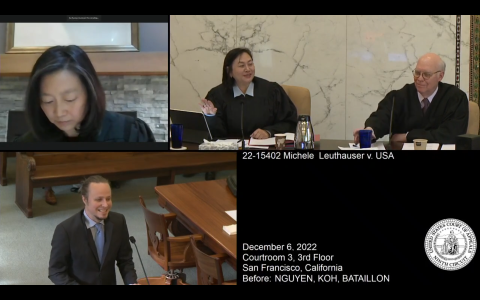
Oral Arguments in Leuthauser

Oral Arguments in Leuthauser in San Francisco, CA


I was pleased to represent Michele Leuthauser in both the district court and appellate court. The court aptly summed up her experience as follows:

Leuthauser was told that she had to submit to a “groin search.” Leuthauser then entered a private room with two TSOs, including Defendant Anita Serrano. Leuthauser was directed to stand on a floor mat with footprints painted on it to show where to place her feet. Leuthauser alleges that TSO Serrano directed her to spread her legs far more widely than the footprints indicated. TSO Serrano then conducted a pat-down during which TSO Serrano slid her hands along the inside of Leuthauser’s thighs, touched her vulva and clitoris with the front of her fingers, and digitally penetrated her vagina.

One would think that under such circumstances, it would be obvious that the screener or her employer would be on the hook for such egregious conduct. But, the government attempts to combine two laws to preclude any lawsuits against anyone. First, the Westfall Act allows the government, when one of its employees gets sued for on-the-job conduct, to say, “sue us instead of the employee.” This would not be a problem — the treasury is more likely to pay a judgment than a random TSA employee anyway — except they next use the Federal Tort Claims Act, which basically says, among other things, “the government can’t be sued for certain conduct.” In this case, it’s assault and battery when committed by anyone other than an “investigative or law enforcement officer.” So the argument is: 1) you have to sue only the government, but 2) the government isn’t liable.

Luckily, now four appellate courts have concluded that TSA screeners are “investigative or law enforcement officers. I wrote more about this when the Fourth Circuit ruling came out in April for those interested in the details, but suffice to say: if your local letter carrier, social security clerk, or receptionist at a VA hospital doesn’t like your attitude and punches you in the face, you may have no recourse, so long as the government protects the employee with the Westfall Act, because they are not “investigative or law enforcement officers.” But the law is now clear: TSA screeners are, and the government may be sued for their intentional (and negligent) misconduct.

Leuthauser v. United States, 22-15402 – Reversed & Remanded (.pdf)

U.S. Court of Appeals Clears Path to Lawsuits Against Abusive TSA Screeners

Osmon DecisionIn 2012, a TSA screener refused to allow me to leave a checkpoint after I told him I wouldn’t consent to having him touch my genitals. He told me I would be forcibly searched, called the police, and spent 45 minutes tearing apart my baggage looking for drugs. TSA screeners, of course, have no authority to conduct a detention, a forcible search, or a search for drugs.
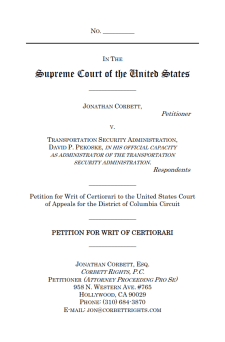
I sued TSA that year — long before I had even started law school — and the U.S. Court of Appeals for the Eleventh Circuit held against me, without allowing oral arguments as is traditional, because, they said, the law under which I sued only applied to “investigative or law enforcement officers” and TSA screeners are not “officers.” This despite their badge reading “U.S. Officer,” their job title being “Transportation Security Officer,” and obviously meeting the statutory definition, which was one “empowered by law to execute searches, to seize evidence, or to make arrests.”

Fast forward a decade, a law degree, and a law license later, and two U.S. Courts of Appeals have held the opposite — and today I’m proud to announce that the Fourth Circuit joins them in a unanimous opinion in Osmon v. United States, 22-2045, a case I argued on behalf of a woman who was sexually assaulted on video, right at a checkpoint, while the TSA screener commented on how short her shorts were:

The government disagrees, insisting the relevant language covers only searches that are part of “criminal law enforcement.” U.S. Br. 21 (quotation marks omitted). Per the government, the law enforcement proviso permits suits for battery only when the officer could perform “a criminal, investigatory search” rather than “an administrative search,” which takes the form of an “inspection” or “screening.” U.S. Br. 26.

The problem with the government’s argument is that it reprises a tactic the Supreme Court has already rejected: “read[ing] into the text additional limitations designed to narrow the scope of the law enforcement proviso.” Millbrook, 569 U.S. at 55. The word “criminal” appears nowhere in the law enforcement proviso—let alone as a modifier of “searches.” See 28 U.S.C. § 2680(h). Here, as elsewhere, we “may not narrow a provision’s reach by inserting words Congress chose to omit.” Lomax v. Ortiz-Marquez, 140 S. Ct. 1721, 1725 (2020).

Having joined the Third Circuit in Pellegrino v. United States, 15-3047 (3rd Cir. 2019, en banc) and Iverson v. United States, (8th Cir. 2020), there are now 15 states where TSA may no longer use the “we’re not officers” defense. Because the Eleventh Circuit did not publish their opinion in my 2012 case, it is non-precedential and lawsuits may proceed in all 35 other states, where TSA will have an uphill battle convincing courts to apply different logic.

Suffice to say, I am ecstatic to open the courthouse doors for all injured by abusive feds, I am thrilled to bring my client closer to getting some justice for this brazen misconduct, and I feel personally vindicated after having been swept out the courthouse door a decade ago by judges who, frankly, did not want to deal with a pro se litigant challenging the government’s status quo. My firm continues to handle cases of checkpoint abuse, and I encourage anyone violated by TSA at the checkpoint to get in touch.

Osmon v. TSA – Reversed & Remanded (.pdf)

Court of Appeals: TSA May Force Travelers to Aggravate Medical Conditions During Search

I fight civil rights cases, which necessitates asking the government (courts) to tell the government (executive) that they can’t do something. It’s always an uphill battle, and not every case gets justice for those who encounter government abuse. But this decision left me equal parts depressed and angry.

Rohan Ramsingh is a disabled veteran. In addition to physical injuries incurred during his service to our country, he has PTSD that would be triggered by certain parts of TSA’s pat down procedure. His PTSD is documented and treated by the VA.

When he went through a TSA checkpoint just before the pandemic and TSA asked him to undergo a pat-down, he respectfully advised them of his medical limitations. Instead of finding an alternate method of screening (as is frequently done for casts or otherwise medically-inaccessible areas of the body) or simply saying, “We can’t clear you today, sorry,” they called police to try to force him to submit, and when police declined to play that role, they ejected him from the checkpoint and sent him a fine for $2,050.

I represented Mr. Ramsingh in “TSA court,” wherein the agency acts as judge, jury, and executioner, expecting success would be unlikely at that level, which produced gems such as this one:

“TSA did not dispute Respondent’s claims to STOSs Pagan and McClelland that he suffers from a condition preventing him from lifting both arms and PTSD, and it does not dispute Respondent’s VA medical documentation, in Exhibit A. … However, as discussed in Ruskai, supra, an individual’s bona fide medical condition does not invalidate the requirement to complete screening.”

In other words, TSA can ask you to do something you medically cannot or should not do, and you must comply or face a fine. TSA court was “nice enough” to reduce that fine to $680.

“As expected, no problem,” I thought, as I prepared the petition for the U.S. Court of Appeals for the D.C. Circuit to review the case, fully expecting them to set the TSA straight that no, they cannot force someone to injure themselves at the checkpoint. Wrong I was. In 22 pages of opinion, all they managed to say regarding whether TSA may force a traveler to obey despite a medical condition is this:

When Ramsingh explained his discomfort with a pat-down, TSA offered to conduct the search in a more private area. While the accommodations provided did not fully meet Ramsingh’s medical needs, the TSA officers made a good-faith effort to respect his particular conditions while also performing their security and public-safety duties.

Triggering a PTSD episode is not “discomfort,” and a “good-faith effort” that fails to accommodate a disability should not result in the person with the disability being fined. It also follows that physical injuries will be similarly treated. You’ve got a wound that’s sensitive to the touch? You better let TSA touch it or face a fine!

I am outraged by the decision of the Court of Appeals, and we will be continuing this fight. If any disabilities or veteran’s rights groups, or mental health advocacy groups, would be wiling to assist by helping to explain to the court the seriousness of mental health episodes, please be in touch.

Ramsingh v. TSA – Opinion (.pdf)

Corbett Files Petition for U.S. Supreme Court to Consider TSA Mask Mandate

Petition for CertiorariOn April 20th, 2022, TSA stopped enforcement of its travel mask mandate after a federal district court decided the CDC’s similar mandate was unlawfully issued. But, TSA has never publicly, formally rescinded its mandate, and so it could be immediately reinstated whenever the next strain or virus crosses some arbitrary threshold. I asked attorneys for TSA to indicate whether rescission was forthcoming, and they refused to answer (which, to me, is a pretty clear answer).

So, I’ve asked the U.S. Supreme Court to review the decision of the U.S. Court of Appeals for the D.C. Circuit allowing TSA authority to regulate anything that affects the “operational viability” of the transportation system. TSA’s mandate from Congress is security, not “operational viability,” a term which to me would include basically anything: the price of jet fuel, the hours pilots are allowed to work, the routes which airlines are allowed to fly… what doesn’t affect “operational viability?”

The Supreme Court (at least of recent) has been clear that agencies may not deviate from the normal boundaries of their authority based on creative interpretation of their enabling statutes. In the last year, OSHA was prevented from issuing vaccination mandates because corona is not an “occupational” hazard, the CDC was not allowed to maintain an eviction moratorium because housing is far from disease control, and the EPA was prevented from forcing power plants to switch from coal because the law gave them powers to set standards for coal, not eliminate it. Regardless of whether you agree with these decisions, and regardless of whether you agree that a mask mandate is a “good idea,” it clearly follows that TSA should be prevented from issuing mandates on communicable diseases when their mandate was to stop terrorism.

My case was assigned number 22-33, and the high court will be able to hear it, refuse it, ask the government to weigh in, or immediately send it back to the D.C. Circuit for further consideration. This was my first petition for certiorari as an attorney after having been admitted to the court’s Bar last month, and shockingly only the tenth time anyone has ever asked the court to hear a TSA-related case (3 of the other 9 were also mine over the last decade). Interestingly, filing is actually made more difficult when you’re an attorney: in addition to still needing to send in 40 paper copies in funny booklet format and pay by old-school check, you also need to submit the documents electronically through a buggy and, frankly, insecure-seeming custom platform.

Corbett v. TSA – Docket | Petition (.pdf)

Supreme Court petitions are expensive! If this work seems valuable to you, donate!

TSA Mask Mandate Ends After Court Strikes Down CDC’S Mask Mandate

I spent my weekend writing an appellate petition regarding TSA’s mask mandate, and of course as soon as I finished proofreading and sending it to the printer on Monday, I see the alert that a judge for the U.S. District Court for the Middle District of Florida vacated the CDC’s rule — which supposedly TSA was just “supporting” — as beyond its authority and improper under the Administrative Procedures Act. A few hours later, TSA announced it would rescind its mask mandate.

My personal frustration about the wasted weekend notwithstanding, I naturally welcome the news. CDC — an actual public health agency — was stretching its mandate, but TSA was absolutely sprinting past its mandate by cramming a public health order under the umbrella of “transportation security.” I don’t have an opinion to share on whether yesterday’s order would survive appellate review, as the 59 page document certainly requires more than a moment to parse, but it appears the government will not be appealing and is ready to let the mask mandate go. So, although the D.C. Circuit certainly did not agree in my case, it appears to me (at least if nothing changes) that the issue may now be moot before my deadline to ask the Supreme Court to review that decision next week, which means I am left with nothing to ask the Supreme Court to review.

I’ll be representing individuals who have been fined (or worse) under the mask mandate and look forward to pressing the important issue of agency boundaries in those cases — and will update you all as much as I can. And, I’ll be enjoying a mask-free flight tomorrow!

D.C. Circuit Asked to Re-Hear TSA Mask Mandate Challenge After Supreme Court Rejects OSHA’s Mandate

In December, a 3-judge panel of the U.S. Court of Appeals for the District of Columbia Circuit emphatically tossed my challenge to whether TSA has the authority to create public health regulations. Two of the judges ruled that TSA has authority over both “security and safety” while the third judge would have held that I had no standing to even make the challenge.

I intended to chalk up my loses and leave the case at rest, but on January 13th, 2022, with 11 days left for me to ask the D.C. Circuit to change their minds, the U.S. Supreme Court decided NFIB v. OSHA, 595 U.S. __ (2022) (Case No. 21A244), in which they were asked to consider a challenge to the Occupational Safety and Health Administration’s rule requiring all employers across the country who have at least 100 employees to force their employees to either vaccinate or wear a mask and test weekly. The Supreme Court enjoined OSHA from enforcing the rule:

The Solicitor General does not dispute that OSHA is limited to regulating “work-related dangers.” She instead argues that the risk of contracting COVID–19 qualifies as such a danger. We cannot agree. Although COVID–19 is a risk that occurs in many workplaces, it is not an occupational hazard in most. COVID–19 can and does spread at home, in schools, during sporting events, and everywhere else that people gather. That kind of universal risk is no different from the day-to-day dangers that all face from crime, air pollution, or any number of communicable diseases.

I had argued in my case that the Transportation Security Administration was limited to security matters (terrorists, criminals, and the like) and that regulating safety matters (accidents, natural disasters) is outside of their powers. But the OSHA case made clear that even if an agency has authority over safety, they still do not have authority over matters of general public health. That is, OSHA has authority over occupational safety, and so it follows that TSA, if it has any authority over safety at all, has authority over transportation safety. In other words, just as TSA obviously doesn’t control whether a sidewalk at the airport is slippery, or whether the terminal is painted with lead paint, or whether exposure to UV rays at 35,000 feet should be limited to reduce cancer risks, they do not get to address coronavirus absent a special risk to transportation.

Could they create a regulation that requires masks at security checkpoints due to the special transportation-related risk created by the close proximity required to search travelers? Could be. Could they possibly do a study and conclude that the density of travelers on airplanes creates a special transportation-related risk, and thus require masks on airplanes? Maybe (although the advanced air filtration systems on passenger planes may mitigate that risk). But can they possibly continue to defend a regulation requiring me to wear a mask while shopping at the duty free or eating at the food court? It seems to me that the OSHA case forecloses that possibility.

My petition for re-hearing or re-hearing en banc was filed late Monday night. It is likely that the court will respond in a few weeks.

Corbett v. TSA – Petition for Re-Hearing (.pdf)

PS – Court clerks apparently read this blog last month and bunched their panties due to the name of the blog. I do detail the rationale behind the “Professional Troublemaker” name. It would be nice if the law were decided not based on whether one is pro- or anti-mask/vax/mandate/whatever or by trying to judge the attorney who filed a petition and instead decided strictly based on what the law says. Trying to stretch the powers of the agency created to prevent the next 9/11 to cover public health matters is foolish and entirely unnecessary: even if you like a mask mandate, let the agencies which actually do have authority make it.

Blog at WordPress.com.

Up ↑