Detained, Removed From Airplane By Feds @ LAX

In the history of my advocacy, I’ve been kicked out of airports three times (for refusing to allow the TSA to “touch my junk”).  I’ve had airport police called at least a couple times. But having the feds come down the jetway just for me?  That was a new experience I had last Wednesday at Los Angeles International Airport.
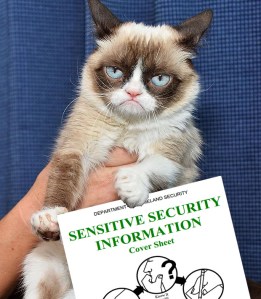
Grumpy Cat with SSI
An artist’s rendition of the TSM upon finding my documents

I went through the security line as usual, opting out of the nude body scanners, but one of my bags was flagged for extra screening.  Upon opening it, they were shocked to find… TSA documents, bound into several books, labeled “Sensitive Security Information” (“SSI”).  “These are our documents,” a sassy Supervisory Transportation Security Officer exclaimed at me before fetching the highest-ranking traveler molester TSA staff member at the checkpoint, a suited Transportation Security Manager (“TSM”) who wanted to know how I got those documents and why I had them.

As you guys probably guessed, I have them because the government sent them to me during litigation, and I was traveling with them because I have a brief due based on those documents in Corbett v. Transportation Security Administration, 15-15717 (“Can the TSA make the body scanners mandatory?”) next week.  They contained mundane details of how the TSA came to the decision to implement the body scanners and then to make them mandatory under certain circumstances, rather than any kind of epic secrets ISIS would moisten themselves over.  But I’ll be damned if I have to explain my reading material to the TSA, so I told them they were documents lawfully in my possession and I didn’t feel compelled to share anything further.

The bag check and the pat-down were soon completed, finding nothing other than my “concerning” documents, but I was instructed to “wait” and not to touch my bags, as airport police were on their way because they needed “someone else to make the decision.”  “How are airport police supposed to determine whether it’s a problem if I have ‘your’ documents,” I asked Mr. TSM.  He shrugged, and then airport police arrived and asked him exactly the same question, then wandered over to the side to let the TSA handle it.  Kudos to Airport Police for not buying into their bullshit as they sometimes do in other airports.

Unsatisfied, the TSM calls the Federal Security Director’s office.  The FSD is basically a “regional director,” typically overseeing several airports in a geographic area.  The FSD’s office sent an assistant to come to the checkpoint while they found someone who could actually clear me.  The assistant was friendly enough, and we spoke a little.  After about 45 minutes had passed and it was approaching final call for my flight, I said to her, “It’s really a shame that the TSA is going to detain me for this long and cause me to miss my flight over the contents of paper when they’ve already determined that I have no hazardous items,” to which she replied, “Oh, you’re not being detained.  We don’t detain people!”

Well that’s funny, since I was told to “wait” and not to touch my bags.  The current standard for whether or not one is being detained was first contemplated in Terry v. Ohio, 392 U.S. 1 (1968) as “whether a reasonable person would feel like they were not free to leave.”  I must disagree with the assistant, as it seemed clear to me that I was not free to leave until someone other than the TSM (such as the assistant) made the call, but I packed my bags, walked to my gate, and boarded my plane.

Of course, the story does not end there.  After boarding, putting my stuff in the overhead, and taking my seat, an airline employee comes on board and says, “Mr. Corbett, the TSA would like to speak with you off the plane, can you show me where your bags are?”  Ugh.  I do so, and meeting me on the jetway was a smiley man (along with the original TSM) who showed me his ID: “TSA Inspector.”  TSA Inspectors are the only TSA employees that are law enforcement officers.  His position is, essentially, equivalent to an FBI Special Agent, although I’m sure far less trained given the lower pay grade associated with the job.  He seemed to understand that the documents were for litigation and pressed me for a few minutes to explain my business, which I politely declined.  After copying down the information from my ID, he miraculously allowed me to return to the plane, to face the looks of the flight attendants (who, to their credit, largely seemed understanding that the TSA is absurd) and passengers.

So there you have it… how you can be harassed and treated like a terrorist for possessing “suspicious” paper.  The best part?  The documents I had didn’t actually contain any SSI — they were redacted copies for public distribution.  I’m tempted to print books with an SSI cover sheet and the U.S. Constitution underneath it.  Or, maybe just 100 copies of the 4th Amendment underneath the cover sheet, and I can tear one out and give it to them each time they think it’s acceptable to detain people without probable cause (let me know if you’d like one to travel with, perhaps I’ll print a few dozen and mail them out if there’s interest!).


Civil rights advocacy is expensive!  Want to contribute to the fight against police abuse, TSA assholery, and other civil rights issues? Donate via PayPal, Venmo, Chace QuickPay, Bitcoin, or check
Court Refuses to Hear International Security Interviews Lawsuit; TSA Ramps Up Domestic Version

Last month, the 11th Circuit Court of Appeals abruptly terminated my case against the TSA’s international security interview program, wherein the TSA forces US-flagged airlines to interview their passengers before they return to the U.S.  Their reason?  I asked for an injunction (forcing them to stop or modify the program), and the court ruled that I can’t prove that I will be subject to it again, and therefore I lack standing.  The rationale for this interpretation of standing comes from a case over 30 years ago where the U.S. Supreme Court that ruled that a black man who was choked out by the L.A.P.D., nearly to death, during a traffic stop still could not seek an injunction against the chokehold policy, despite proving that the L.A.P.D. had a widespread practice of chokeholds, that they were regularly deadly, and and that he was a victim of the policy.   Los Angeles v. Lyons, 461 U.S. 95 (1983).

Lyons was a bad ruling, and I’m not certain the court would make the same decision today given its trend against rubber stamping blatant racial discrimination, but importantly, it ruled that while Mr. Lyons could not sue for an injunction, he could indeed sue for money, so I’ll get to renew my case as a request for money damages.  If I win even a trivial amount, the TSA would have to stop the program, because then thousands of passengers daily could sue for that trivial amount.  Even $100 would do, given that about 2 million passengers would be able to sue every moth by my calculations.  So, I shall proceed in that direction.

In the meantime, as I noted before, the case is already won, because it forced the TSA to: 1) publicly disclose the existence of the program, which had been previously described nowhere on the public Internet, and 2) state in open court that it wouldn’t force travelers to participate in the program with a threat of denied boarding, which is what I encountered.  I continue the lawsuit because the TSA needs to direct the airlines to stop the practice of threatening denied boarding, which it has thus far refused (at least publicly) to do.

With that said, I received an e-mail from a woman this weekend who said she was questioned at a gate for a domestic flight:

In Tulsa yesterday, three [uniformed TSA screeners] fanned out among people waiting AT THE GATES and began interrogations.  They asked EVERYONE up and down my concourse, “Are these your bags?  (Yes) Do you have any others? (No) Did you check any?  (No)  Where are you going? (Charlotte) After Chicago, where are you going?  (I’m not going to Chicago, I’m going to Charlotte.) Okay after Charlotte, where are you going?  (Portland)  Portland Oregon or Portland Maine?  (Y’all are scaring me.  Is something going on here?  What’s up?)  We have to talk to everybody.  Portland Oregon or Portland Maine?  (Maine)

[It was American Airlines, the gates near A5, Saturday, August 6, waiting for a 1:40 pm flight to Portland Maine, after a flight to Chicago had taken off from the same gate.]

This is likely an extension of the SPOT program, the largely discredited waste of taxpayer dollars by which the TSA thinks its poorly-trained screeners can pick out terrorists just by looking at and talking with them.  Please remember that you have no obligation to answer their questions, and although there may be additional screening, they cannot deny you boarding for remaining silent.

Corbett v. TSA III – Appeal Dismissed (.pdf)

PS – Delta, you suck.  7 hours of scheduled flying became 14 today because you still use a computer system designed during the Reagan administration.

DHS Wants Tourists To List Their Facebook Accounts to Enter Country

If you’re a non-U.S. citizen entering the U.S. with a passport issued by one of our friends in Europe, you can enter “without a visa” by completing an “Electronic System for Travel Authorization” form online and paying a fee (which, if you think about it, is really no different from getting a visa… it’s just you print a piece of paper instead of get a mark in your passport).

The questions on the application are mostly the typical stuff you’d expect we might ask those entering our country, but DHS now proposes to add one more:

“Please enter information associated with your online presence—Provider/Platform—Social media identifier.”

What’s wrong with that?  Well, I’ve explained in a letter opposing the proposed rule that there are many problems with this.  The first is that it’s not even clear what one would need to disclose, and sometimes disclosure may be a troubling basis for discrimination:

Do I need to think back to the MySpace account that I created in 2003 and have not used since 2006?  If I have a username for a chat room or message board, does that count?  What about Tinder?  Or perhaps I use the popular dating app for gay men known as Grindr.  Do you think it’s reasonable that I would then need to indirectly disclose my sexual preference as a condition of entering this country?  Or perhaps I use the Web site for connecting individuals with sexual fetishes known as FetLife.  Will you then review my FetLife account and determine if my preferred variety of kinky sex is acceptable?  If it is uncovered that I enjoy being dominated by women in latex bodysuits while ball gagged, will a CBP officer consider me the same level of security risk as one who prefers long walks on the beach and seeks a partner who loves Jesus?  Speaking of Jesus, many people use social networking related to their religion (Christian Mingle, JDate, etc.).  Now you’d like to know my religion, too?

Not particularly worried since you’re a U.S. citizen and therefore won’t have to personally deal with this problem?  Think again…

When the U.S. government implements a stupid rule affecting foreign visitors, other countries implement retaliatory rules on U.S. citizens seeking to enter their territory. …  Many other countries require visa fees only from U.S. citizens (or higher visa fees only for U.S. citizens), or fingerprinting only for U.S. citizens, in retaliation for what we do to their citizens.  I don’t want to have to share my Facebook details in order to travel, and if you implement this rule, it is all but certain that I shall have to do so as other countries decide to implement retaliatory rules.

It would be nice if DHS, for once, could do something that would actually improve our safety rather than play around with technology that they know nothing about.

[Edit – Online comments are now allowed from the public!  Let DHS know what you think!]

TSA: Taking Pictures Of Our Dogs Is Illegal!

tsak9
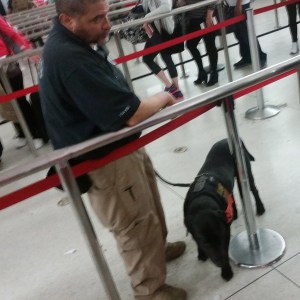
I’m told that this picture is very illegal.  TSA K-9 handler at JFK T1 immediately before ordering me to stop taking pictures.

On Friday, I flew out of New York’s JFK T1 after experiencing what was the longest airport security line I have ever seen. It literally stretched from the zig-zag queue at the center of the terminal to the far end of the terminal, and then around the corner. The TSA, of course, knows that terrorists now target security lines, rather than airplanes, and doesn’t seem to care that they are putting us at risk, but I digress.

After finally reaching the front of the queue, I spotted, for the first time, the TSA’s new experiment with bomb-sniffing dogs. Interested in finally seeing the TSA put a far better solution in place for the detection of non-metallic explosives than the body scanners, I snapped a few pictures, including the one here.

But, of course, the TSA can’t leave well enough alone. “You can’t take pictures!” barks the dog’s handler. I can’t? Well that’s news to me, and I consider myself pretty up-to-date on aviation security law. 🙂 I soon spot an STSO (supervisory transportation security officer — the “3 stripe” blue uniform people) and ask her to clarify, but she tells me she doesn’t have time to talk to me. Eventually, I spot her boss, the TSM (transportation security manager — always wearing a suit), a very friendly South Asian woman who is cheerfully tells me that my First Amendment right to photograph has been suspended:

Jon: Are you the TSM by chance?

TSM: Yes.

Jon: I have a question for you.

TSM: Sure.

Jon: What’s the policy on taking pictures in line?  The person with the K-9 told me I was not allowed to take pictures.

TSM: Yes, that’s a screening process, what he’s doing there, so you’re not allowed to take pictures.

Jon: OK, so that’s a federal regulation?

TSM: Yes.

Jon: Not New York state, that’s a TSA…

TSM: No, not New York state, it’s federal.

Jon: Ok, so if I ask the TSA, because I’m a civil rights advocate, and my job is to sue the TSA, if I ask them, they’re going to tell me that I’m not allowed to take the pictures, and that’s official TSA policy?

TSM: You have to specify what you were doing.

Jon: Taking a picture of a K-9.

TSM: You can’t.

Jon: OK.

TSM: Because that’s a screening process.

Where legal, I generally record my interactions with the TSA, and New York being a 1-party consent state (any party to a conversation may record it), I got an audio recording (.mp3).  (As a side note, a reasonable argument can be made, and some courts have held, that audio or video recording of government officials while working in public is constitutionally protected even in 2-party consent states.)

Why is this a “big deal,” some may ask: Any time the government restricts our ability to take pictures, they are reducing their accountability to the people. Thousands of times per day, law enforcement in this country violates the rights of citizens, but only occasionally is it caught on camera, and only then is it punished (sometimes).  By removing our ability to document their actions, they are insulating themselves from consequences for wrongdoing, and this a free society cannot stand.

I’ve asked the TSA’s Civil Rights Office to comment as to whether this is official TSA policy and await a reply, but expect a new lawsuit to be filed soon either way.

Terrorists Detonate Bombs in Brussels Airport — Before The Security Checkpoint

International media reports today that 2 bombs went off in BRU airport, just outside of Brussels, Belgium, and Islamic State has claimed responsibility.  How did they get these bombs past security?  They didn’t…

Passengers queuing at terminal counters described sudden panic and mayhem as the explosions turned the departure area into a death trap with flames, smoke, flying glass and shrapnel.

This is far from the first time such attacks have happened.  For example, just 5 years ago terrorists bombed DME outside Moscow, Russia, killing 37 people.

As passengers flying from US airports this year have been told to gear up for longer wait times, largely due to the additional time added to screening by body scanners that don’t actually stop threats, they should realize what this means is that the security queues are getting longer.  It sounds an awful lot to me like the TSA is creating a target rather than protecting one.  Would it make less of a terroristic statement for ISIS to blow up a TSA checkpoint with 150 people than to blow up a 737 with 150 people?  Of course not.

This mess brought to the taxpayer at a cost of $8B per year.


Fighting the TSA in court is expensive!  Want to contribute to the fight against TSA assholery? Donate via PayPal, Venmo, Chace QuickPay, Bitcoin, or check

TSA Tries Doing Exactly What I’ve Asked It To Do for 5 Years: Metal Detectors + Dogs

The TSA announced an “exciting” “new” program that it’s trialing in MSP airport in Minnesota:

After a explosives-detection dog sniffs passengers for traces of explosives, travelers can then move through expedited screening like the Precheck program, where they can leave on shoes and light coats, and leave laptops and small containers of liquids in their carry-on bags.

“You’ll see them snaking up and down the line,” Neffenger said of the canine teams. “I’m very excited about getting extra teams here.”

(source)

In other words, passengers that pass a dog skip the body scanner and go through a metal detector.  This is exactly what I’ve been asking the TSA to do since the very beginning, because:

  1. dogDogs are by far cheaper than the body scanners.  A body scanner costs $300,000, functions for less than a decade, and requires significantly more man-hours per
    passenger than a dog, which may cost low-5 figures to train and a couple bucks a day in food.
  2. Dogs are by far tougher to beat than the body scanners.  The fact of the matter is that if you’ve been working with explosives, you likely have traces of it all over your body, and you’re likely not fooling Rover, while in 2012 I proved that beating the body scanners takes no more than a sewing kit.
  3. Dogs are far less invasive than the body scanners.  These dogs are trained to detect explosives only, while a body scanner is set to alert on anything on your body, including medical devices, scars, hygiene products, your baggie of weed, etc. Dogs are a targeted search only for the stuff the TSA should actually be looking for.

Instead of spending nearly $2B by now on technology that people hate because they are slow, invasive, and emit poorly-studied radiation… instead of fighting tons of legal battles… instead of making them perhaps the most hated federal agency on the planet… they could have just done this 5 years ago.

Let’s hope their pilot program goes well and the body scanners are relegated, along with a pat-down option, to those who fail Fido’s nose.

Fully Briefed: Can The TSA Force You To Speak To Fly Home?

lipssealedAfter being told that I wouldn’t be allowed to board a flight back to the U.S. without cooperating with a “security interview” last December, I filed suit against the TSA in February challenging this program on Fifth Amendment grounds.  We all have the right to remain silent AND the right to return to our home country, and we should not have to give up one to use the other.

The TSA has already backtracked on the issue, telling the court that whoever told me I’d be denied boarding (a TSA representative, an airline representative, and the interviewer himself) was mistaken.  So, in some ways, this issue is already won, but the problem remains that the TSA’s written policy is ambiguous as to what should happen to someone who refuses to speak, and so airlines and their interviewers may not know that the TSA’s position (now that they’ve been called out on it in court) is that denied boarding is not required.

The case is now fully briefed before the U.S. Court of Appeals for the Eleventh Circuit, which means that all sides have spoken and the court may now rule on the matter.  Or, it may order additional argument, orally or in writing, before it makes its decision.  There is no set timeframe, but it will likely take “a few months.”

The docs:

Corbett v. TSA III – Opening Brief (.pdf)

Corbett v. TSA III – Administrative Record, Vol. 1 (.pdf, 14 MB)
Corbett v. TSA III – Administrative Record, Vol. 2 (.pdf, 18 MB)

Corbett v. TSA III – Respondent Brief (.pdf)

Corbett v. TSA III – Reply Brief (.pdf)


Fighting the TSA in court is expensive!  Want to contribute to the fight against TSA assholery? Donate via PayPal, Venmo, Chace QuickPay, Bitcoin, or check


TSA to the 94% Opposed to Body Scanner Rule: “Oh, you thought that we cared?”

In 2010, the TSA implemented the nude body scanners as primary screening without publishing a formal rule, as agencies are required to do in such circumstances.  Thanks to the Electronic Privacy Information Center‘s lawsuit, they were ordered to do so in 2011, and started that process by soliciting public comment in 2013.

As I wrote about in January, over 5,500 people responded, and of those who took a position, 94.0% opposed the rule (with many opposing the existence of the TSA entirely).  If you were a part of that 94.0%, or agree with them, the TSA has a message for you:

itdoesntmatter
The TSA’s official response to the 5,129 people who wrote in opposition to its proposal to use nude body scanners.

At the end of last week, the TSA issued a 157 page document detailing why it is going to scan you anyway (.pdf).  The document devotes approximately 17 pages to the background of the issue and the actual rule itself, less than 1 page addressing the supporters of the body scanners, and the remaining 138 pages going through the opposition to the rule and explaining that it knows better than everyone else, whether they be pilots, aviation security experts, civil rights groups, or just people explaining their own personal feelings.

The notice-and-comment rulemaking that the Administrative Procedures Act required the TSA to perform was intended to make the government responsive to the people. Do you think that the TSA is demonstrating what a responsive government looks like?  The TSA is hoping that it doesn’t matter what you think.  But we continue the fight, because eventually agencies that overstep their bounds are humbled by our representatives or the courts.  It takes a lot of pressure to build before that happens, but as the TSA continues full-steam ahead, the pressure rises.

Update: TSA Asks Court Not to Hear Brief Regarding Stay

Earlier today, I posted the briefs relating to my motion to stay the TSA’s new rule allowing it to refuse opt-outs.  Not long after, I received an e-mail noting that the TSA will oppose allowing the court to consider my reply brief.

Why? Because it’s long.

The Federal Rules of Appellate Procedure govern how things work in cases heard by the Court of Appeals.  Indeed, Fed. R. App. P., Rule 27(d)(2) limited my reply to 10 pages, when it was 19, “unless the court permits or directs otherwise.”  My reply was filed along with a routine motion for permission to file excess pages, and I’ve actually never seen such a motion opposed, let alone denied.

In my reply brief, I noted that “avoidance of judicial review” is common for the TSA, which argues anything it can to get a court to decline to even consider whether the TSA’s actions are lawful.  It’s wrong, and plainly, it’s against the deep-rooted American value that we should be able to meaningfully petition our government for redress.  To reply to a brief accusing you of evading judicial review with a request that the court not hear the brief is the definition of an agency — and its attorneys — demonstrating their contempt that one would dare to challenge them.

I take this as a positive: I don’t expect the court to refuse to hear my brief, and I don’t think the TSA would have filed such a disfavored opposition if they weren’t scared that my Motion to Stay had a chance of being granted.

Corbett v. TSA IV – Opposition to Motion for Leave to File Excess Pages (.pdf)


Fighting the TSA in court is expensive!  Want to contribute to the fight against TSA assholery? Donate via PayPal, Venmo, Chace QuickPay, Bitcoin, or check

Motion to Stay TSA No Opt-Out Policy Fully Briefed

When I challenged the TSA’s new policy allowing it to refuse a request to opt-out of going through the body scanners in favor of a pat-down, I included a motion asking the U.S. Court of Appeals to stay the TSA’s new policy until the case is resolved.  That motion is now “fully briefed,” meaning the court may rule on it at any time:

“The TSA’s opposition to the instant motion fails to explain why it felt the need to make the policy change in question.   Respondent summarily states that ‘[p]reventing TSA from requiring certain passengers posing a heightened security risk to undergo AIT scanning would undermine national security and jeopardize public safety.’  But unlike when it rolled out the body scanner / pat down program in 2010 and clearly told the public that it needed to do so to stop nonmetallic explosives, the TSA has never explained why it feels that passengers posing a ‘heightened security risk’ need to go through a body scanner instead of a pat down. If something has changed such that there is, all of the sudden, a new, compelling reason [that pat-downs are insufficient], the TSA must identify that to the Court rather than make generic statements about how they are charged with providing aviation security and want to do what they want to do because they know best.”

I also asked for oral arguments on the matter before the court rules, but I think it’s likely that they will rule simply on the documents without hearing us in person.  Source documents (my motion, their opposition, and my reply to their opposition):

Corbett v. TSA IV – Motion to Stay (.pdf)

Corbett v. TSA IV – Opposition to Motion to Stay (.pdf)

Corbett v. TSA IV – Reply to Opposition to Motion to Stay (.pdf)

As we wrote about this week, the TSA’s body scanner & pat down program was opposed by 94% of the public when asked for formal comment.  The idea that they would take public comment, hear negative feedback, and then double-down on exactly what the public asked them not to do by making it mandatory is insulting and emblematic of the TSA’s failure to serve the public rather than do as it pleases.

If you were one of the many who have donated since this challenge was filed a few weeks ago, this motion happened because of you — thank you once again!

Blog at WordPress.com.

Up ↑