No Surveillance State Month, Part 5: Anonymous Electronic Payments

Bitcoin Sometimes, electronic transactions are the only practical method of payment. Making a purchase at Amazon.com or holding open a bar tab will be frustrated if you have no plastic. You can still complete these transactions without creating a log that can be tied back to you thanks to prepaid debit cards that you can purchase virtually anywhere these days.

At my local Walgreens, you can grab $200 cards for $205.95, which works out to a 3% fee or the cost of about 2 ATM transactions. You can also find these guys at banks, money services companies (Western Union), and department stores (Kmart, Walmart). Terms vary, and you can find better or worse deals than Walgreens has to offer. In addition to holding on to some of your privacy, you also reap the benefit that a fraudster can’t clean out your bank account if that Internet retailer you just shopped at gets hacked, and there won’t be any surprise recurring fees from any merchants — by the time recurring fees would hit your card, it’s empty. A beautiful thing.

Prepaid cards can also be turned into Bitcoin, an untraceable (if done right) Internet currency that is starting to gain significant acceptance at Web-based merchants. Bitcoin works by using a peer-to-peer transaction database and strong encryption that allows only the present “owner” of the money to send it to someone else. The “owner” of the money is identified only by a string of random numbers (think like a debit card number, except there’s no name on the card). How to use Bitcoin is beyond the scope of what I can fit into a brief blog post, but the Wiki article is a great place to start if you’re interested.


This is one of a 30-part series, “No Surveillance State Month,” where daily for the month of June I’ll be posting ways to avoid invasion of your privacy in the digital age. The intent of these posts is not to enable one to escape detection while engaging in criminal activity — there’s still the old-fashioned “send a detective to watch you” for which these posts will not help. Rather, this series will help you to opt-out of the en masse collection of data by the government and large corporations that places Americans in databases without their knowing and freely-given consent for indefinite time periods. We all have the right to privacy, and I hope you demand it.
No Surveillance State Month, Part 4: Ditch the Plastic

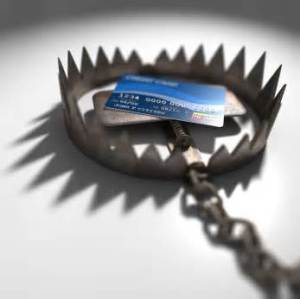
Credit Card TrapI love putting things on credit and debit cards. It’s more convenient than dealing with change and ATM trips, and it organizes my business expenses for tax purposes at the end of the year.

But, when I go through my statements at year-end to find tax deductable expenses, I find that I can basically pinpoint exactly where I was for pretty much every day of the year based on my purchases. In addition to the location information, credit card companies have detailed information on your spending patterns.

Will your credit card company sell your spending pattern data? Who knows, but when last year during my deposition for my lawsuit against stop-and-frisk, the attorney for the city asked me to list my credit cards, it became abundently clear that all of this data is just waiting to be abused. (The idea that someone suing the city for abuse should have to bend over and expose his private information in order to have a shot at justice is offensive and wrong, but I digress…)

So, I shall endeavor to use cash whenever possible (tomorrow’s post will allow you to keep your privacy for those when times cash is not an option). To keep track of business expenses, I’ll be using my smartphone to take a picture of receipts rather than holding onto crumpled up, faded pieces of paper. And I’ll save my local small businesses the ~3% they pay to run credit cards rather than see that money go to the banks. Win win win.


This is one of a 30-part series, “No Surveillance State Month,” where daily for the month of June I’ll be posting ways to avoid invasion of your privacy in the digital age. The intent of these posts is not to enable one to escape detection while engaging in criminal activity — there’s still the old-fashioned “send a detective to watch you” for which these posts will not help. Rather, this series will help you to opt-out of the en masse collection of data by the government and large corporations that places Americans in databases without their knowing and freely-given consent for indefinite time periods. We all have the right to privacy, and I hope you demand it.

No Surveillance State Month, Part 3: Online Database Opt-Out

Search PeopleSo many companies exist solely to gather your personal information and sell it to others: nosy neighbors, your employer, and most definitely the government (you might be surprised how much of Equifax and other consumer reporting companies’ business comes from the government). The information can consist of your address and other contact info, how much you paid for your house, public debt information, links to your family, and other intrusive details that you may simply prefer not to share with the world. But, it may seem like there are so many places on the Internet that have your data that going around and asking them to take down your data would be futile (or worse, be ignored by the data providers).

Actually, there are only a few big sources for data, and most of the vast quantities of data providers are simply resellers, and further, all of the big online data companies have opt-out policies that allow you to remove your listing from public view. A few clicks of some forms, sometimes with a copy of an ID attached (black out your ID card number before sending!), and you’ve disappeared from a large portion of the Internet — both the big databases and the resellers alike.

Here’s where to go:

Happy removing!


This is one of a 30-part series, “No Surveillance State Month,” where daily for the month of June I’ll be posting ways to avoid invasion of your privacy in the digital age. The intent of these posts is not to enable one to escape detection while engaging in criminal activity — there’s still the old-fashioned “send a detective to watch you” for which these posts will not help. Rather, this series will help you to opt-out of the en masse collection of data by the government and large corporations that places Americans in databases without their knowing and freely-given consent for indefinite time periods. We all have the right to privacy, and I hope you demand it.

No Surveillance State Month, Part 2: VPN for Privacy

Locked NetworkWhen you send data across the Internet, in order to get where it needs to go, that data will likely pass through a dozen or more other computers before it gets to the proper destination. These computers belong to various telecoms, Internet Service Providers, and corporate routers, and any one of those computers can read everything you’re sending. Additionally, if you’re connected to the Internet using a wireless network, anyone within a few hundred feet of you can also read everything you’re sending. If the government wanted to snoop on you, all they need is to compel one of the many device owners to save a copy of your data, or, easier yet, sit outside your home and collect the data that you’re sending through the air. Many sources suggest that the U.S. government collects the Internet traffic of ordinary Americans en masse by putting data collection devices at telecoms.

A “Virtual Private Network” (VPN) is a way of securely getting information from one point to another across the Internet. All data between the two points is securely encrypted, so no one other than the end point can understand your data even if they have access to it. Those computers between you and the endpoint will only see scrambled data, and unscrambling it is roughly impossible (if the government were able to unscramble it, they would never admit to it or waste such a valuable secret to spy on random citizens). When the other end of the VPN connection receives your data, it decrypts it and forwards it on to wherever it needs to go — your mail server, your favorite porn site, etc. The whole process is transparent and incredibly easy to use.

Companies implement VPNs all the time to ensure that their employees can access file servers, e-mail, and the like from home without eavesdropping. But, there are plenty of VPN services available for personal use at low (~$10/month) or no cost. This protects all of your wireless traffic from eavesdropping, and it protects you from en mass data collection by governments with “black boxes” sitting at your local Verizon office. It also makes it significantly harder to spy even with a warrant. Without a VPN, the government can simply serve a warrant on your ISP to demand that they capture your data. With a VPN, they’d have to serve the warrant on the VPN provider, and if your VPN provider is half way around the world in a country that looks down on compliance with warrants issued by foriegn countries, this becomes infeasible. [Edit: VPNs are also great for stoping those pesky copyright trolls, who sue people for file sharing, so long as your VPN provider is in a foreign country.]

A few VPN providers that offer reasonable prices and have reasonable reviews (and for which I have no association and get no commission):

While VPNs provide protection against “local” threats, be aware that you still shouldn’t do things like send credit card or social security numbers without using additional protection. This is because once your data reaches the other end of the VPN, it is decrypted and sent on to its final destination without protection. This also means you must trust your VPN provider, since they will be handling your data. For how to protect credit card info, against the potential for VPN providers to eavesdrop, and other spying that is still possible (although made greatly difficult — remember the goal isn’t necessarily to make the spying “impossible,” but simply “difficult,” to encourage the government to utilize its power only when it actually has reason to do so) with VPNs, come back tomorrow. 🙂


This is one of a 30-part series, “No Surveillance State Month,” where daily for the month of June I’ll be posting ways to avoid invasion of your privacy in the digital age. The intent of these posts is not to enable one to escape detection while engaging in criminal activity — there’s still the old-fashioned “send a detective to watch you” for which these posts will not help. Rather, this series will help you to opt-out of the en masse collection of data by the government and large corporations that places Americans in databases without their knowing and freely-given consent for indefinite time periods. We all have the right to privacy, and I hope you demand it.

No Surveillance State Month, Part 1: Turn Off Your Cell Phone

Slide to Turn OffImagine if the government were to pass a law requiring every American to carry around a GPS monitor that would at all times report your location back to the government. The government “wouldn’t be allowed” to use these records without a warrant, of course, and the government would simply keep these records on-file for 18 months, after which they would be “destroyed.”
There would be outrage, protests, lawsuits, calls for impeachment and revolution, etc. etc. etc.. The good news is that this will never happen; the bad news is that it won’t happen because the government already has this data since any American who carries a cell phone has his or her location constantly recorded by his or her cell phone company.

Your cell phone provider can (and does) estimate your location by the measuring your signal strength from nearby cell towers. The stronger the signal, the closer you are, and because multiple towers likely reach you, triangulation is possible and your location can generally be determined within about a few dozen yards.

Cell Provider Data Retention
Data Retention for Major U.S. Cell Phone Providers

Your cell phone provider constantly records this data and keeps it on file for a year or more, depending on your provider. So if you’ve attended the Communist Meetup Group, cheated on your spouse, or really enjoy strip clubs, your cell provider already knows that, and can tell you exactly when it happened.

The solution to this is both simple and mind-blowing: turn off your phone. In addition to the privacy benefits, you’ll perhaps gain the benefit of becoming re-connected with the real world. Except if you work for very specific jobs, you have no obligation to be accessible to the world 24/7/365. The world will indeed go on without you, and “emergencies” will solve themselves just as they did before the advent of cell phones.

Many phones also have an airplane mode which may or may not be helpful. (Who’s to know whether all transmissions have actually ceased? I once had a phone that would occasionally receive text messages, much to my surprise, after enabling flight mode!) Most phones (including iPhones) can be turned off by holding the power button for several seconds and following the on-screen instructions.

So, pick a time when you’re off-the-grid and every day, “disappear” for a while.


This is one of a 30-part series, “No Surveillance State Month,” where daily for the month of June I’ll be posting ways to avoid invasion of your privacy in the digital age. The intent of these posts is not to enable one to escape detection while engaging in criminal activity — there’s still the old-fashioned “send a detective to watch you” for which these posts will not help. Rather, this series will help you to opt-out of the en masse collection of data by the government and large corporations that places Americans in databases without their knowing and freely-given consent for indefinite time periods. We all have the right to privacy, and I hope you demand it.

Consumer Finance Protection Bureau: Protecting Consumers or Banks?

A bit off topic, but I just can’t resist blogging about any useless or counterproductive federal agency.

A couple weeks ago, my gym membership dues hit one of my debit cards and overdrafted one of my checking accounts (the perils of having more than one account, it seems, is that occasionally one ends up empty… but I digress…). This shocked me, since federal rules that went into effect in 2010 bar debit overdrafting and associated fees without an explicit opt-in, which there’s not a chance I would give. I called my bank and asked if they enjoyed flouting federal rules, to which they replied that these rules only apply to “one-time” transactions and my gym membership doesn’t count.

A quick review of the rules shows that they are correct that these rules apply only to “one-time” transactions, but there’s no definition of “one-time.” Debit card transactions aren’t “scheduled” with the banks or anything — merchants process them as agreed whenever they get around to it, so really, every transaction, in my opinion, is “one-time.” So where is the line drawn? If I go to a restaurant twice and use the same card, is that no longer one-time? Does it have to be on regular intervals or a specific number of instances?

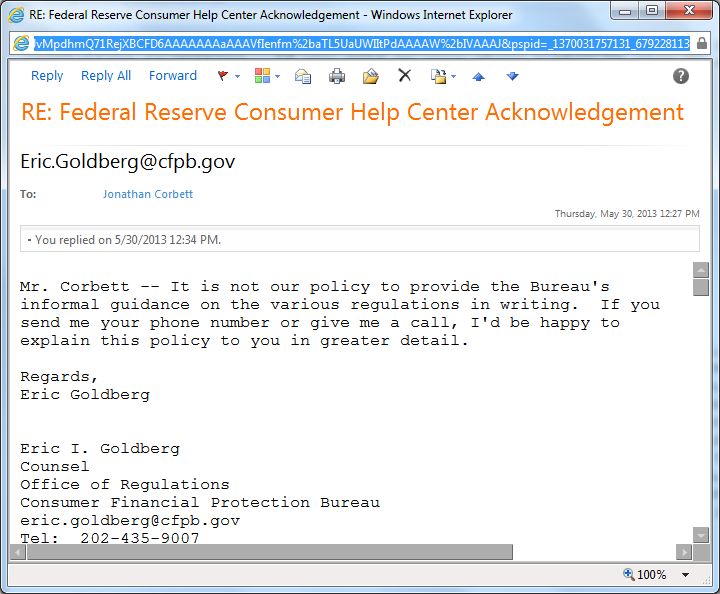
The agency responsible for the rule gets the first pass at defining the ambiguous (that is, courts give “deference” to an agency as to the interpretation of their own rules, so long as that interpretation isn’t absurd). So I asked the agency responsbile for the rule: while original the rule was issued by the Federal Reserve, authority for the rule was passed on to the Consumer Finance Protection Bureau upon its creation in 2011. So I e-mailed the agency asking for their interpretation of “one-time,” and was surprised to get a fast response from an attorney for the agency who asked me to call him to discuss. I politely declined, explaining that I’d prefer it by e-mail such that I could forward a copy on to my bank if the interpretation was useful for the return of my $35 overdraft fee.

nowrittenHere’s where it gets weird (well, weirder than a government agency that’s actually responsive other than when they want your money): The CFPB attorney refused to tell me the agency’s interpretation in writing. At first I’m told that “informal” guidance can’t be given in writing, and upon asking how to get formal guidance, I was told that individuals can’t.

So if consumers can’t get informal guidance in writing or formal guidance at all, who is this “Consumer” Finance “Protection” Bureau protecting? Is this another one of those, “we’ll protect the people by protecting the financial institutions” type things? Too big to fail, too big to jail, and too big to talk about in writing (unless, of course, they request it). Naturally, they picked the wrong person to refuse — I’ll be continuing my query via Freedom of Information Act requests until I have my answer.

Stay tuned tomorrow for the start of our 30-part series, “No Surveillance State Month,” where daily for the month of June I’ll be posting ways to avoid invasion of your privacy in the digital age.

Reddit: Pictures of Kittens, Inteviews with Makeup Artists = Good, Civil Rights Advocacy = Spam

I’m a little bit bitter. When news of my video last year broke, the story topped Reddit for at least 2 full days. Little did I know that during those two days, I was actually banned from the site because an automated spam filter decided I must be a spammer since I was focused on one topic. I say “little did I know” because when you’re banned from Reddit, they don’t tell you and everything appears as normal, but your posts aren’t visible to anyone but you. I figured it out a year later — a year’s worth of my posts there went down the memory hole.

When I figured it out and contacted Reddit’s admins about it, they fixed it and told me it was a mistake, but I got no apology and was told it could happen again. Sure enough, today I was doing an officially scheduled “Ask Me Anything” (a Reddit mainstay where people who have done something interesting are essentially interviewed by the community) to promote awareness of the public comment period now open regarding the TSA’s nude body scanners and my post was deleted, again silently. For hours I checked my computer for questions from the community to respond to before trying from another device to see that my post had been vaporized. I was told that my post was “mistakenly” deleted, but told to repost only if I didn’t include the words “We need your help.”

Reddit, your priorities are misaligned when photos of cats and AMAs with make-up artists dominate, but a civil rights advocate can only do an AMA if he doesn’t advocate. Your culture of silent bans and deletions unnecessarily make legitimate posters waste countless hours interacting with a site that will never post those interactions and making people feel like their contributions are of no value to your community. Please remove the ability of subreddit (forum) moderators to silent delete and remove the ability of the automated spam filter to silent ban. It’s worth a little more spam to avoid missing out on the contributions of your legitimate users.

Feel free to share on Reddit. 🙂

June is “No Surveillance State Month” …plus Catch Me on Reddit IAmA!

Databases, technical gadgets, electronic payment, and cameras everywhere mean that each person can be tracked like never before. Where once the government had to use scarce human resources, thereby limiting its ability to spy to worthy targets only, computers make it possible to spy on everyone at all times.

June is my birth month, and to celebrate, I’ll be posting one way to avoid the constant intrusion on your privacy — whether that intrusion is effected by governments, corporations, or mere fraudsters — each day for the entire month. These 30 tips will highlight some more obvious, some less obvious, things that most of us do (or fail to do) that help our watchers to watch us, and what we can do instead to “opt-out” with minimal time and effort.

Also, this Tuesday, May 28th, 2013, at 11:00 AM ET, I’ll be doing an “Ask Me Anything” on Reddit. Reddit sent literally hundreds of thousands of hits to my blog back when my video was released and consists of a community that is largely interested in and aware of privacy issues and government overreach. Register an account and come chat with me then! 😀

It’s a little TOO quiet…

It’s now been a full month since I’ve seen the familiar “Activity in Case…” e-mails that the federal court system sends to litigants registered for electronic filing. Considering I have four cases open in four different courts, it’s the first time I’ve had a month of quiet since 2011. This gives me a little time to write my comment for the TSA’s public rulemaking regarding nude body scanners (due by June 24th, 2013 — no legal experience required, just let the TSA know how you feel!) and my appeal that is inevitable regarding (in largest part) U.S. District Judge Joan A. Lenard’s decision that TSA screeners enjoy qualified immunity for unlawful searches even when they know they intentionally continue their search beyond what is necessary to find weapons.

So, here’s where we are right now:

I have this sneaking suspicion that I will shortly be innundated with rulings and legal documents to write. The calm before the storm… 😉

U.S. Attorney Discusses TSA Case with Judges — Without Informing Other Side

My petition to review the constitutionality of the TSA’s nude body scanner programs is presently before three judges of the Eleventh Circuit Court of Appeals, who are trying to figure out how much information the TSA can refuse to provide to me (or require me to keep secret), some of which is clearly non-disclosable (classified information) and others of which are laughable (copyrighted documents, documents stamped “For Official Use Only” — a designation invented by the TSA with no legal significance, etc.).

I received notice today that the government has filed these documents under seal (meaning not publicly) and ex parte (meaning I don’t get a copy) “at the request of the Court.” But, I’ve never seen that request. I’ve never been a party to — or even aware of — discussions where the Court woud have made such a request.

If the Court is going to insist on secret filings, it could at least be up front about it.

Corbett v. DHS – Notice of Lodging (.pdf)

Blog at WordPress.com.

Up ↑