Passing the California First Year Law Students’ Exam, a/k/a The Baby Bar, FYLSX, FYLSE, Your Second Year Nightmare

[Edit 12/8/2017Welcome June 2018 FYLSX test takers!  It seems CalBar status pages have been updated.  If yours wasn’t, you probably didn’t pass.  It’s Friday — go out, have a drink or four, and start studying again in a week or two.  Tips are above, and, push that Follow button on the right side of the page!  I’m finishing my 4th year and regularly blog about issues relating to law school that you’ll want to read…]

Last week I got confirmation that I passed (indeed, annihilated) the October 2016 California First Year Law Students’ Exam!

The Exam

For those not in the know, this test, cutely dubbed the “Baby Bar,” is required for all California law students who are not in an ABA-accredited law school. As the ABA, being the grumpy old people that they are, refuses to accredit any online law schools, those like me and want to do law school while having a job (or traveling the world, raising a family, or whatever else makes you happy) are stuck taking the Baby Bar.  The exam is taken after you’ve finished your first year. It is offered every June and October, and you must pass within 3 sittings for the exam (e.g., I finished my first year in November 2015, and therefore was required to pass either June 2016, October 2016, or June 2017). If you don’t pass, your law school studies are over until you do, and when you eventually pass, you can receive law school credit only for your first year.

The exam is 100 multiple choice questions and 4 essay questions, allegedly each representing half your grade, at the same difficulty level as the real Bar Exam. The only difference is that the real Bar Exam tests 12 subjects instead of the 3 on the Baby Bar: criminal law, tort law, and contract law. The nice thing about this is that you can use actual past Bar Exam questions as prep for the Baby Bar. The bad thing about this is the pass rate for the Baby Bar is typically in the range of 20% – 25% — the odds are against you from the start. And, the cost to take the exam including all fees is $777, plus travel to Los Angeles or San Francisco if you’re not local.

My First Attempt

In the spring, I was getting ready for the test and taking practice exams, and from what I could see, my scores were in the passing range. Confident, in June I went to Oakland and sat for the Baby Bar exam, which felt pretty good upon taking it. The exam takes 45 days to grade, and in early August I got my results: failed by 1 percentage point.

I was disappointed and a bit surprised (although with a pass rate of 20% – 25%, not passing the first time is not exactly unexpected), since all the practice exams said that I was doing great on the multiple choice and ok on the essays. When I reviewed the written score report, the answer became clear: the Bar’s curving of the exam effectively made the essays count significantly more than the multiple choice.  My multiple choice received nearly a perfect score, but the bar examiners did not like my essays. This was frustrating since the State Bar specifically published that the sections would be given “equal weight:”

An applicant’s total score on the examination is the sum of an applicant’s converted scores on the multiple-choice and essay sections.  This step gives these sections equal weight in determining the total score.

The State Bar lies!

I tried appealing my grade to the State Bar since it would clearly have been passing had they weighted equally as they had promised, but they wouldn’t hear it.  So, it probably won’t surprise you, if you’re a long-time reader, that I’ll be filing a small lawsuit to get my exam fees back since the exam I was given was not the exam advertised. 🙂  But, I digress…

My Second Attempt

To fix my essay writing, I did two things:

First, during the previous sitting, I hand-wrote the exam rather than typed it.  The Bar charges an extra fee for the “privilege” of typing your exam, and I figured it was better to rely on pen-and-paper and avoid any technical issues that day.  But, quite simply, I can type more words per minute than I can hand-write, and on this exam, you need to be working as fast as possible.  I think if I had typed the June sitting, I probably would have passed (being 1% away from a passing score, pretty much any improvement at all would have made the difference!).  Seriously, do not hand-write this exam!

Second, I spent time going through several past exams, writing out the answers, and comparing them to the model answers that the State Bar published to figure out what I had missed.  This also gets you a feel for how the State Bar likes to see answers presented to them.  There’s a pattern, and it seems that following it may be a good idea. 🙂

The end result was that my multiple choice score stayed about the same, but each essay increased in score by, on average, almost 15 percentage points.  I could have actually written my 4th essay on “why it’s important to advertise the correct scoring methodology when you’re giving exams to law students” and taken a 0 and still passed.  (Actual essay questions for October 2016 FYLSX).

Study Tips

Here’s what I recommend for practice (these products are what I actually used and I receive no compensation for listing them):

1) PMBR Audio Lectures. PMBR is a company that, before they were bought by Kaplan, produced awesome bar review lectures. If it’s not on the Bar Exam (and thus not on the Baby Bar exam), it’s not covered, allowing you to focus on only the material that you need to know. Their criminal, tort, and contract lectures total about 14 hours and are by far the best use of 14 hours spent on reviewing substantive law. The easiest place to find their CDs is on eBay or Amazon.com (search “pmbr contracts audio,” or torts, criminal), as they don’t seem to offer the CDs as a stand-alone product anymore.

2) Fleming’s Baby Bar Review. Prof. Fleming runs one of the very few courses that targets the Baby Bar specifically. He has take-home materials, but for about $300 you can take a 3-day, in-person workshop where you’ll review substantive law, practice writing essays in exam-day conditions, and are given the opportunity to take home 6 practice essays which Fleming’s will grade for you, along with detailed feedback, for no additional charge.

3) AdaptiBar. Adaptibar licenses official Multistate Bar Exam questions from the National Committee of Bar Examiners (NCBE) and allows you to practice the multiple choice section on their Web site. The NCBE doesn’t actually write the questions for the Baby Bar, but they are substantially similar. Great for both getting an idea of how you’re doing and for learning what you need to study more of.

4) The Famed 1980 Exam. While the California Bar releases every Baby Bar’s essay questions and answers, they have only released one multiple choice exam ever — from 36 years ago! To be perfectly honest, this is because they are lazy and re-use questions from year to year, so if they released every exam, they’d have to re-write them. But, if you take the 1980 exam as practice and then take the next Baby Bar, it will astonish you how many questions they still re-use with only minor variations. You’d think for $777 per test taker they’d be able to afford to come up with fresh material.

5) Past Essay Exams. Take the questions, write them in an hour each, and compare your answers to the practice answers. They’re showing you exactly how they want it done. Do it that way.

…and finally, make sure you pay the laptop fee and type the exam, and if your typing is slow, learning how to type faster should be a part of your studies (you’ll need that as a lawyer anyway!).

Two Years In at NWCU Law — Updated Review & Tips for New Students

I started law school on November 16th, 2014 at Northwestern California University School of Law, one of the few online law schools thanks to California’s relatively progressive stance on legal education. I wrote a review a few months in, noting that all seemed well so far. Now that I’ve passed my 2nd year final exams in my 4 year, part-time program and thus broken the half way mark, I think an update is well-deserved.

Some thoughts on the experience:

First, if you expected that online law school would be easy, you’ve miscalculated. Each course, taken over the full length of the year, requires about 2,000 pages of reading and comes with several assignments to be completed. At 4 courses per year, you’re looking at about 8,000 pages, or 22 pages per day (roughly an hour — there’s no speed reading law school texts!) if you study 365 days per year. It’s very easy to fall behind, and to be perfectly up-front, about 70% of students who start their first year at NWCU do not make it to their second year. This is an online degree with no required class time, and there is no one there to let you know that you need to pick it up a notch until it is too late. You must pace yourself, as the difficulty of the final exams is on par with the difficulty of Bar Exam questions for the relevant topic, so there’s no softball testing.

Second, although there’s no requirement to attend online classes (you could read your casebooks and outlines and pass, if you learn well by reading), they exist and are useful. You can pick and choose from several time slots that cover the subjects you’re taking, and there’s no requirement to attend every week. Come when you can, no penalty when you can’t. There are also discussion boards for each subject where you can interact with other students. Also not required, but extra credit is given to those who regularly contribute in online classes and in the forum. You want that extra credit — it makes a big difference.

Third, start with the understanding that you don’t know how to write an essay for law school. You can’t simply read the instructions on the midterm or final exams and start typing, expecting to produce the results necessary. This applies even though I know quite well how to write legal briefs in the federal court system: law school writing is a different style altogether. If you want to pass, in my opinion you must complete the “How to Write an Essay” activity that the school offers in the online forums, as well as review passing answers for similar essay questions to get a feel for how they look (see below). This is not required by the school, but it very much should be, because you won’t pass otherwise.

Fourth, the goal of the school during your first year is to prepare you for the California First Year Law Students’ Exam — the “Baby Bar.” The Baby Bar is taken by students in California non-ABA law schools (as every online law school is) who have completed their first year, and you are, essentially, required by the state to pass it within a year and a half of the end of your first year. It is the same difficulty level as the real Bar Exam, but only covers 3 subjects — those you are studying in your first year — instead of 14. The NWCU midterm and final exam questions track the Baby Bar questions fairly well (I’d say the NWCU questions are actually slightly more difficult), and California publishes the essay questions and answers from past Baby Bar exams. The pass rate for the Baby Bar is typically in the range of 20% – 25%, so keep in the back of your mind that you’ve got to not only retain, but enhance, all of your first year knowledge even after you finish your first year, until you take and pass the Baby Bar. (A separate post about the Baby Bar is soon to come…)

So, prospective students: don’t start if you’re not 100% committed, because you will fall behind and waste your time and money when you can’t finish your first year. But, if you can stay on top of things, NWCU is the best value in legal education by far: I’ll have a law degree for less than $15,000 total, while traditional schools charge more than that per semester.  Current 1L students: really really learn how to write essays, as that is 100% of your grade at NWCU and roughly 60% of your grade after grade scaling for the Baby Bar. Do the “How to Write an Essay” activity, review past Baby Bar answers, and make sure you write at least one practice essay (while timing yourself — 1 hour!) for each subject. NWCU offers a practice grading service for a really nominal fee, which is very much worth it.

Jon Corbett’s Endorsement for President

As a younger guy who lives in urban settings, I’m surrounded by individuals who almost uniformly detest Donald Trump, and there is a lot of social pressure to vote for Hillary Clinton in my world.  However, I won’t be voting for Hillary Clinton.  Nor will I be voting for Donald Trump.  For the first time in my life, I’ll be voting for a third-party candidate, Gary Johnson, and I’d like to explain.

First, I agree with those around me that Donald Trump would make a horrible president.  I don’t care about the crude remarks so much as I care that I can’t make out most of his policy, and the parts that I can make out, I dislike more often than not.  In particular, I feel that his immigration policy cannot possibly work, that his foreign policy will get us into more conflicts than out, and that his “tough on crime” viewpoint is not the reform this country needs at a time when it has more prisoners than China despite a quarter of the population.  Beyond his views, I don’t think he has the political experience, the temperament, or the vision to “make America great again.”  I do appreciate that he is a Washington outsider and is willing to speak his mind rather than limit himself to speaking like a politician, but this is insufficient.

So why not vote for the only person who has a chance against him?  On the issues, Hillary and I agree a bit more than Trump, although I am concerned about her perspectives on civil liberties (and not just the second amendment) and on keeping the government lean and efficient.  But, I find Hillary to be dishonest.  It’s more than just her atrocious handling of the e-mail scandal — she just seems like a massive phony whenever she speaks.  Maybe she’s just a bad speaker, but that’s an important part of being president.  I also think her campaign was dishonest in how it played against Bernie Sanders.  I think the DNC is dishonest and does not deserve to be rewarded for its manipulation of the primaries.  I’m tired of the dishonesty, and candidates who can’t keep it real won’t get my vote.  I won’t feel that I am responsible for voting for her for “lesser of two evils” purposes, because this simply lets the DNC (and RNC too) know it can do whatever it wants and we’ll choose whatever it puts out there.     If Trump makes it into office, it is the DNC to blame, not the swing voters who couldn’t stomach Hillary.

The candidate who gets my vote instead is experienced — he’s been the governor of New Mexico for 8 years, and in the political world for over 2 decades — yet he doesn’t sound like a Washington politician.  He commitment to civil liberties is unyielding, and relevant to this blog, he is on the right side of every issue I personally fight for, from abolishing the TSA to securing reasonable gun rights.  He recognizes that the war on drugs has failed, that our national debt is a problem that needs to be fixed now, and that we should get the hell out of the Middle East.

In short, he’s what we need, and even if he has virtually zero chance of getting elected this round, I would rather vote for that than for the “lesser of two evils.”  We’ve done that for too many years now, haven’t we?  It seems to just lead to greater and greater evils.  Let’s stop that now and vote for someone who would actually represent us.  For the purpose of sending a message to the parties, as well as to support someone who I actually would like to see as president, I endorse Gary Johnson for President in 2016.

Check out these three candidates side-by-side on the issues, and don’t forget to vote!  Most states now have early voting, so it’s easier than ever to make it happen.

Is It *Really* Impossible To Get A Gun License in NYC? (Part III — NYPD Sued Over Requirement that License Applications Give “Good Reason”)

nysupremecourt
New York County Supreme Court

Over the last year I’ve documented the process of applying for a license to carry a handgun in New York City.  Part I described the initial application process, requiring an incredible amount of paperwork, money, and time, and the scheduling of an in-person interview.  Part II described the interview, as well as the eventual “NOTICE OF DISAPPROVAL” that ended up at my door, letting me know that there was no problem with my background, but I simply did not give a good enough “reason” for them to allow me to exercise my Second Amendment rights.

For Part III, I’m pleased to announce that I’ve taken up the fight in court with a lawsuit challenging the constitutionality of the City of New York’s interpretation of state laws that effectively allow the NYPD to deny a license whenever it wants.  I’ve additionally challenged the NYPD’s refusal to fulfill a Freedom of Information Law request, as well as 3 of the most absurd questions on the application form.

Beginning where we left off in Part II, after receiving the rejection letter, I filed an appeal with the NYPD itself, asking them to reconsider the decision of the commanding officer of the licensing division, Deputy Inspector Michael Endall, to deny my license.  I should really say the former commanding officer of the licensing division — about 2 weeks after he signed my rejection letter, he was removed from his post after a federal investigation uncovered that his subordinates were accepting bribes in exchange for approving gun license applications.  At least one officer under D.I. Endall’s command has so far pled guilty to corruption charges, and another will face trial shortly.

Departmental drama aside, as you can guess, I received a reply to my administrative appeal by Director of Licensing Division Thomas M. Prasso telling me to pound sand.  As best I can gather, the division has an officer head and a civilian head, and D.I. Endall was the former while Mr. Prasso was the latter.  This letter sets the clock ticking for a state court challenge, giving me 4 months to file what New York calls an “Article 78 Petition,” so named after the section of the law that allows people to challenge the final decisions of administrative agencies, so long as they do so within 4 months.  (Note that I could file in federal court directly, since my federal constitutional rights are in play, but let’s give the state a chance to correct itself first.)

Corbett v. City of New York IV – Petition & Complaint (.pdf), Case No. 158273/2016

There are 3 separate challenges within this lawsuit:

  1. First and foremost, NY Penal Law § 400.00(2)(f)  specifies that a license should be issued when an applicant shows “proper cause.”  The City of New York (as well as Westchester County, FWIW) interprets this to mean “a good reason that we approve of” rather than “filled out an application and is not disqualified.”  In particular, the city requires that applicants show a greater need than that of the general public (!!), so “I want to defend myself” is not good enough while “I want to defend myself because I regularly carry around bags of diamonds” probably is.  Virtually all of the rest of the state interprets this the other way, granting licenses to individuals who are U.S. Citizens with clean criminal records.  The “proper cause” requirement, as interpreted by New York City, is not only unconstitutional (imagine having to convince the government that you had “proper cause” to speak freely, practice your religion, say “no” to a search without a warrant, etc.), it leads to decisions that are arbitrary at best, and influenced by corruption as we’ve seen above at worst.
  2. Second, I challenged 3 questions in particular.  These three questions ask if you’ve ever been fired from a job, ever used painkillers or sedatives (under a doctor’s orders during/after surgery counts), and if you’ve ever testified under oath anywhere in the country.  Saying “yes” to any of these questions extends the application process, requiring you to explain yourself.  These three questions are highly invasive, not protected by, e.g, HIPAA confidentiality requirements, not evaluated by any professional qualified to do so (there are certainly no doctors in the NYPD Licensing Division qualified to say if your prescription regimen would make you unfit to have a gun), and are generally irrelevant for any purpose other than giving the NYPD an excuse — not a reason — to deny the license applications of good, qualified citizens.
  3. Third, after my application was denied, I sent the NYPD a Freedom of Information Law request (Exhibit C of the petition above), asking for every application for a gun license in a 3 month period with all personally identifying information redacted.  My intent here was to see whether the NYPD was consistent when considering applications or was granting preference to VIPs.  The NYPD said that they would not fulfill my request because doing so would be invasive to privacy and would interfere with law enforcement (Exhibit D of the petition).  How releasing these records could possibly do either of those things is a mystery to me, and therefore I’ve asked the court to review it.

I’m hopeful that this petition may push the NYPD to a more reasonable licensing scheme.  Despite people telling me that the NYPD’s rules are challenged all the time, I wasn’t able to find a challenge to the “proper cause” requirement in this state in the last 5 years, and never has the proper cause requirement been challenged in the context of the state’s ban on open carry + the Supreme Court’s decision that the right to bear arms is applicable to individuals and assertable against the states.  Whether you think we need more or fewer guns in this country, I hope you’ll agree that the licensing scheme should at least be fair, and to that extent support my reform against the NYPD’s “licenses only if we want to give them” scheme.


Fighting for civil rights in court is expensive!  Want to contribute to the fight against government assholery? Donate via PayPal, Venmo, Chace QuickPay, Bitcoin, or check

Briefed: Can the TSA Eliminate the Pat-Down “Opt-Out?”

petSince the nude body scanners were introduced by the TSA as primary screening in Fall 2010, they have always maintained that use of the technology is optional: that if you wanted, they would instead simply molest you using their new “pat-down” rather than use radiation to image your nude body.  Not exactly a pretty choice, but it was some choice nevertheless.
Five years later, after all the dust had settled over the lawsuits by passengers who felt that the TSA’s new screening techniques were unconstitutionally invasive (and down-right stupid considering that despite being the most intrusive search they had ever implemented, they were blatantly ineffective), the TSA doubled-down on their scanners and announced to passengers that they reserve the right not to honor “opt-out” requests in the future.  This new announcement flew in the face of the 94% of the public who formally told the TSA to ditch the scanners, and me being one of that 94%, I immediately filed suit in the U.S. Court of Appeals for the 11th Circuit.  Two other lawsuits were filed by EPIC and CEI, alleging that the TSA improperly disregarded that 94%.

It’s amazing how long these things take to progress.  It’s 7 months into the lawsuit and I just filed my principal argument, the appellant’s brief — a written statement of the entire case.  Those 7 months were filled largely with the TSA bickering about how much information they had to release to me, which resulted in the end with several thousand pages landing on my doorstep.  I’ll be posting those pages, known as the “administrative record,” shortly (scanning thousands of pages is an effort!), along with a few highlights (including, “How Any Terrorist Can Get Pre-Check,” an exposé on why the Pre-Check system is bullshit), but what was most interesting about them is they showed zero basis for their decision to eliminate the opt-out.  As I explain in my brief:

The Administrative Record is illuminative on the reasons for adopting the body scanner and pat-down program as primary screening in 2010 [Ed – Not that they were good reasons, but they were reasons.]. There are many documents that address the effectiveness of the body scanners and provide some evidence of cost/benefit thought process and procedures by which the program is tested. See, e.g., Admin. Rec., Vol. 4, p. 3893 (results of body scanner field testing). However, the elephant in the room is that there is no discussion on the effectiveness of the pat-down component of the program, nor a comparison between how likely a body scanner is to find a dangerous item on a passenger as compared to a pat-down.

Full brief below…

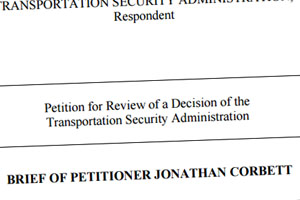
Corbett v. TSA IV – Appellant’s Brief (.pdf)


Civil rights advocacy is expensive!  Want to contribute to the fight against police abuse, TSA assholery, and other civil rights issues? Donate via PayPal, Venmo, Chace QuickPay, Bitcoin, or check

Detained, Removed From Airplane By Feds @ LAX

In the history of my advocacy, I’ve been kicked out of airports three times (for refusing to allow the TSA to “touch my junk”).  I’ve had airport police called at least a couple times. But having the feds come down the jetway just for me?  That was a new experience I had last Wednesday at Los Angeles International Airport.

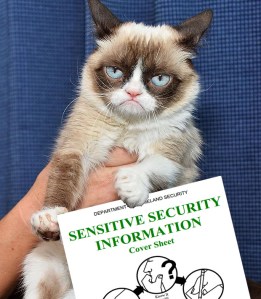
Grumpy Cat with SSI
An artist’s rendition of the TSM upon finding my documents

I went through the security line as usual, opting out of the nude body scanners, but one of my bags was flagged for extra screening.  Upon opening it, they were shocked to find… TSA documents, bound into several books, labeled “Sensitive Security Information” (“SSI”).  “These are our documents,” a sassy Supervisory Transportation Security Officer exclaimed at me before fetching the highest-ranking traveler molester TSA staff member at the checkpoint, a suited Transportation Security Manager (“TSM”) who wanted to know how I got those documents and why I had them.

As you guys probably guessed, I have them because the government sent them to me during litigation, and I was traveling with them because I have a brief due based on those documents in Corbett v. Transportation Security Administration, 15-15717 (“Can the TSA make the body scanners mandatory?”) next week.  They contained mundane details of how the TSA came to the decision to implement the body scanners and then to make them mandatory under certain circumstances, rather than any kind of epic secrets ISIS would moisten themselves over.  But I’ll be damned if I have to explain my reading material to the TSA, so I told them they were documents lawfully in my possession and I didn’t feel compelled to share anything further.

The bag check and the pat-down were soon completed, finding nothing other than my “concerning” documents, but I was instructed to “wait” and not to touch my bags, as airport police were on their way because they needed “someone else to make the decision.”  “How are airport police supposed to determine whether it’s a problem if I have ‘your’ documents,” I asked Mr. TSM.  He shrugged, and then airport police arrived and asked him exactly the same question, then wandered over to the side to let the TSA handle it.  Kudos to Airport Police for not buying into their bullshit as they sometimes do in other airports.

Unsatisfied, the TSM calls the Federal Security Director’s office.  The FSD is basically a “regional director,” typically overseeing several airports in a geographic area.  The FSD’s office sent an assistant to come to the checkpoint while they found someone who could actually clear me.  The assistant was friendly enough, and we spoke a little.  After about 45 minutes had passed and it was approaching final call for my flight, I said to her, “It’s really a shame that the TSA is going to detain me for this long and cause me to miss my flight over the contents of paper when they’ve already determined that I have no hazardous items,” to which she replied, “Oh, you’re not being detained.  We don’t detain people!”

Well that’s funny, since I was told to “wait” and not to touch my bags.  The current standard for whether or not one is being detained was first contemplated in Terry v. Ohio, 392 U.S. 1 (1968) as “whether a reasonable person would feel like they were not free to leave.”  I must disagree with the assistant, as it seemed clear to me that I was not free to leave until someone other than the TSM (such as the assistant) made the call, but I packed my bags, walked to my gate, and boarded my plane.

Of course, the story does not end there.  After boarding, putting my stuff in the overhead, and taking my seat, an airline employee comes on board and says, “Mr. Corbett, the TSA would like to speak with you off the plane, can you show me where your bags are?”  Ugh.  I do so, and meeting me on the jetway was a smiley man (along with the original TSM) who showed me his ID: “TSA Inspector.”  TSA Inspectors are the only TSA employees that are law enforcement officers.  His position is, essentially, equivalent to an FBI Special Agent, although I’m sure far less trained given the lower pay grade associated with the job.  He seemed to understand that the documents were for litigation and pressed me for a few minutes to explain my business, which I politely declined.  After copying down the information from my ID, he miraculously allowed me to return to the plane, to face the looks of the flight attendants (who, to their credit, largely seemed understanding that the TSA is absurd) and passengers.

So there you have it… how you can be harassed and treated like a terrorist for possessing “suspicious” paper.  The best part?  The documents I had didn’t actually contain any SSI — they were redacted copies for public distribution.  I’m tempted to print books with an SSI cover sheet and the U.S. Constitution underneath it.  Or, maybe just 100 copies of the 4th Amendment underneath the cover sheet, and I can tear one out and give it to them each time they think it’s acceptable to detain people without probable cause (let me know if you’d like one to travel with, perhaps I’ll print a few dozen and mail them out if there’s interest!).


Civil rights advocacy is expensive!  Want to contribute to the fight against police abuse, TSA assholery, and other civil rights issues? Donate via PayPal, Venmo, Chace QuickPay, Bitcoin, or check

NYPD Cops on Reddit: OK to “Get A Few Punches” While Arresting Suspects

cops_think_beating_is_ok_highlighted
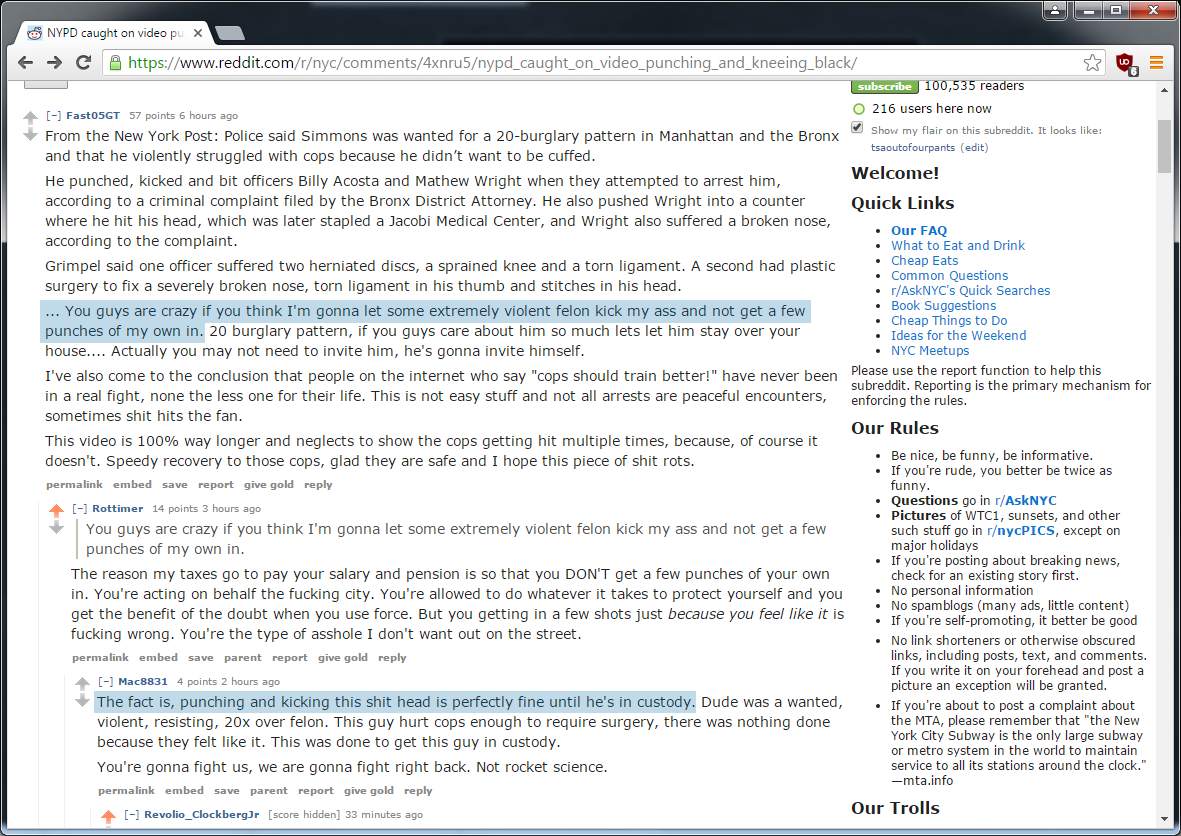
NYPD cops share their feelings on getting a couple extra punches on suspects who resist arrest…

Massive discussion forum Reddit‘s subforum for New York City-themed topics, /r/nyc, has a lively and diverse cross-section of New York’s population, with everyone from NYU students, retirees, young professionals, and even police officers.  I find the insight one can gain from seeing all these different points of view to be incredibly educational, and sometimes people are, perhaps, a little more candid than they should be.


This morning, one of the top threads on /r/nyc was a NYPD cop caught on camera punching and kneeing a suspect in the back of the head while he was on the ground during an arrest (original link, archive).  A cop on the forum, /u/Fast05GT, was quick to defend the actions of the officers, and while starting with a reasonable-sounding explanation that they were dealing with a suspect accused of violent crime who was resisting arrest, he continued to expose that police officers feel entitled to get a little retaliation, seemingly without knowledge that this is wrong:

“You guys are crazy if you think I’m gonna let some extremely violent felon kick my ass and not get a few punches of my own in.”

Another NYPD officer, /u/Mac8831, quickly clarifies:

“The fact is, punching and kicking this shit head is perfectly fine until he’s in custody.”

A read through the thread is filled with these and other gems (“Those cops did nothing wrong. ‘pain compliance’ is taught in the Police Academy, punching and kicking are 100% proper tactical procedures…”) and makes blatantly apparent that these officers do actually think that their conduct — getting in a few extra hits than is actually necessary to restrain a suspect — is perfectly acceptable.

The problem in the NYPD is not merely a few bad apples, but rather than every apple is exposed to systemic and cultural ideologies that condone tactics that are simply not allowed anywhere in our country, whether it’s stopping-and-frisking black people simply for existing, arresting for contempt-of-cop, or excessive force.  Let’s hope the addition of body cameras coming soon brings this issue to light and helps us stamp it out.


Civil rights advocacy is expensive!  Want to contribute to the fight against police abuse, TSA assholery, and other civil rights issues? Donate via PayPal, Venmo, Chace QuickPay, Bitcoin, or check


Court Refuses to Hear International Security Interviews Lawsuit; TSA Ramps Up Domestic Version

Last month, the 11th Circuit Court of Appeals abruptly terminated my case against the TSA’s international security interview program, wherein the TSA forces US-flagged airlines to interview their passengers before they return to the U.S.  Their reason?  I asked for an injunction (forcing them to stop or modify the program), and the court ruled that I can’t prove that I will be subject to it again, and therefore I lack standing.  The rationale for this interpretation of standing comes from a case over 30 years ago where the U.S. Supreme Court that ruled that a black man who was choked out by the L.A.P.D., nearly to death, during a traffic stop still could not seek an injunction against the chokehold policy, despite proving that the L.A.P.D. had a widespread practice of chokeholds, that they were regularly deadly, and and that he was a victim of the policy.   Los Angeles v. Lyons, 461 U.S. 95 (1983).

Lyons was a bad ruling, and I’m not certain the court would make the same decision today given its trend against rubber stamping blatant racial discrimination, but importantly, it ruled that while Mr. Lyons could not sue for an injunction, he could indeed sue for money, so I’ll get to renew my case as a request for money damages.  If I win even a trivial amount, the TSA would have to stop the program, because then thousands of passengers daily could sue for that trivial amount.  Even $100 would do, given that about 2 million passengers would be able to sue every moth by my calculations.  So, I shall proceed in that direction.

In the meantime, as I noted before, the case is already won, because it forced the TSA to: 1) publicly disclose the existence of the program, which had been previously described nowhere on the public Internet, and 2) state in open court that it wouldn’t force travelers to participate in the program with a threat of denied boarding, which is what I encountered.  I continue the lawsuit because the TSA needs to direct the airlines to stop the practice of threatening denied boarding, which it has thus far refused (at least publicly) to do.

With that said, I received an e-mail from a woman this weekend who said she was questioned at a gate for a domestic flight:

In Tulsa yesterday, three [uniformed TSA screeners] fanned out among people waiting AT THE GATES and began interrogations.  They asked EVERYONE up and down my concourse, “Are these your bags?  (Yes) Do you have any others? (No) Did you check any?  (No)  Where are you going? (Charlotte) After Chicago, where are you going?  (I’m not going to Chicago, I’m going to Charlotte.) Okay after Charlotte, where are you going?  (Portland)  Portland Oregon or Portland Maine?  (Y’all are scaring me.  Is something going on here?  What’s up?)  We have to talk to everybody.  Portland Oregon or Portland Maine?  (Maine)

[It was American Airlines, the gates near A5, Saturday, August 6, waiting for a 1:40 pm flight to Portland Maine, after a flight to Chicago had taken off from the same gate.]

This is likely an extension of the SPOT program, the largely discredited waste of taxpayer dollars by which the TSA thinks its poorly-trained screeners can pick out terrorists just by looking at and talking with them.  Please remember that you have no obligation to answer their questions, and although there may be additional screening, they cannot deny you boarding for remaining silent.

Corbett v. TSA III – Appeal Dismissed (.pdf)

PS – Delta, you suck.  7 hours of scheduled flying became 14 today because you still use a computer system designed during the Reagan administration.

Why NYC Rent Is So High (It’s *Not* Airbnb)

eastvillageRecently, Airbnb has received a lot of heat from New York City and State officials, who have accused the company of driving up rents for residents by reducing the available housing supply.  The state legislature has gone so far as to pass a bill levying fines of up to $7,500 against Airbnb users for listing their apartments “illegally” (as in, against a law pushed by the hotel lobby that prevents New Yorkers from renting out their own apartments); the bill sits on the governor’s desk awaiting his decision.

What legislators aren’t discussing is that one of the key reasons behind the high rents in Manhattan has nothing to do with supply and demand, but is government-imposed.  As someone who has lived in and around NYC for much of his life, I’m well aware that taxes are high, but when my landlord raised my rent citing his increased property taxes, I did some digging and found that my landlord wasn’t bluffing: I was astounded at how high they actually are.

In Miami Beach, you can expect to pay 1.39% of your condo’s value every year.  In San Francisco, it’s 1.18% for your house on the hill.  If you like the thrill of gunshots on your way to work, Chicago’s tax rate is 1.86%.

But in New York City, you owe the city between 10.6% and 20.0% of your property’s assessed value, every year. For apartment buildings with more than 3 units, the rate is 12.9%.

Let’s put this in perspective.  In the very residential and fairly affordable (for Manhattan) East Village, a pre-war, 5-story, apartment building with 15 1-bedroom units and a storefront may have a market value of about $5M.  “Assessed values” tend to be are lower than actual market values (both in NYC and most other cities), so you might end up with an assessed value of half the actual value, or $2.5M 45% of actual value, or $2.25M.  That building would likely be subject to the Class 2 tax rate of 12.9%, meaning $290,250 in taxes every year.  A typical apartment in these buildings may be $2,500 monthly, and a typical storefront may be $10,000 monthly, making annual rent revenue $570,000.  In this scenario, 51.0% of your rent money goes to the city in taxes, and that’s in addition to the NYC income tax of up to 3.876%, NYS income tax of up to 8.82%, sales tax on everything you buy of 8.875%, and other hidden taxes like the MTA tax on every taxi ride you take.

But, of course, it gets better.  Brand new buildings — which, these days, are almost exclusively luxury towers — get tax abatements, reducing the tax bill for the rich on their homes to pennies on the dollar.  So, while $1,275 of your $2,500 rent bill for a modest 1 BR in the East Village goes to Uncle deBlasio, the multi-million dollar condo owner a few blocks down may be paying only a few hundred dollars per month.

So, we can blame Airbnb for shitty neighbors throwing parties, but let’s not blame Airbnb for our rent bills: when more than half of my rent goes into the city’s coffers — at least if you’re middle class — I think we know where the problem lies.

[Edit: Numbers updated thanks to insight from /u/Tervia regarding the assessed value.]

[Edit 2: Want to look up your building’s taxes?  You’ll need to find a document that lists your building’s “Actual AV” and then multiply it by the tax rate for your building’s class (if you live in a building with more than 3 units, it’s 12.9%).

Peruta v. San Diego — Another Side-Step of Whether We Have the Right to “Bear” Arms

2agoodreason

In preparation for my lawsuit as part of my exposé on gun rights in NYC (Part I, Part II), I’ve been watching Peruta v. San Diego.  The reason is that the federal courts of appeals, divided into 13 circuits that each have jurisdiction over a different chunk of the United States, have been struggling to determine to what extent the Second Amendment (“…the right of the People to keep and bear arms…”) guarantees the right to not just keep (own guns in your home), as the Supreme Court made clear is covered by the Second Amendment in District of Columbia v. Heller, 554 U.S. 570 (2008) and McDonald v. Chicago, 561 U.S. 742 (2010), but the right to bear arms — that is, the right to carry them around with you.

Here in New York, the 2nd Circuit Court of Appeals has ruled that to whatever extent the Second Amendment gives us the right to bear arms, that right is not “fundamental” and is therefore subject to any restriction that furthers a government interest, subsequently concluding that a state may restrict the right to bear arms to those who show a “good reason” to carry them.  Kachalsky v. Cacace, 701 F.3d 81 (2nd Cir. 2012).

However, in the 7th Circuit Court of Appeals, legendary judge Richard Posner wrote the majority opinion invalidating an Illinois statute that required a “good reason.”  Moore v. Madigan, 702 F.3d 933 (7th Cir. 2012).  And, judges in several other circuits have suggested, without ruling, that they would lean the same.

Peruta was another court upholding the right to bear arms, the 9th Circuit Court of Appeals.  But, after a 3-judge panel upheld that right, the other judges in the court voted to rehear it en banc — in front of 11 judges — and last month overturned the 3-judge panel and allowed California to require a “good reason” before issuing a carry license.

The biggest problem with Peruta is that the judges, in their 190 page (!!) opinion entirely side-stepped the question.  You see, courts have been fairly consistent in ruling that a state may restrict open-carry, or restrict concealed carry, but they have not typically allowed a state to restrict both.  In other words, the general rule, save for the Kachalsky aberration in the 2nd Circuit, was that a state must guarantee your right to bear arms, but can tell you whether you must conceal your handgun or make it visible.  And so, the Peruta en banc court once again said that a state may ban concealed carry without deciding whether it may simultaneously ban open carry.  The attorneys in Peruta clearly argued the point that they are seeking the right to bear arms (either open or concealed), and felt compelled to spend 190 pages without ruling on that point.  (Peruta’s attorneys have moved the court to re-hear arguments and consider the true question, a motion likely to be declined.)

In fairness, of those 190 pages, many of them are written by 4 judges of the 11 that dissented from the majority opinion, and given the split in this case, plus the circuit split (2nd & 9th Circuits vs. 7th Circuit), the Supreme Court may hear it (and Peruta’s lawyers almost certainly will ask them to).  I have to ponder whether I want to file my case in New York before that happens or right now.  I shall give it some thought.

Blog at WordPress.com.

Up ↑