Federal Judge: Suit to Stop NYPD Street Body Scanners Must Wait

nypdscanOn January 28th of this year, I filed the first and only lawsuit against the NYPD’s testing and planned implementation of “street body scanners” — terahertz imaging devices designed to allow cops to peer under the clothes of unsuspecting passersby on the street for guns. In addition to highlighting New York’s longstanding disrespect for the Second Amendment by assuming that anyone bearing arms must be doing so illegally, this tool plainly ignores the Fourth Amendment’s requirement, made clear in Terry v. Ohio, that searches must have cause. By checking underneath the clothing of the public at random, the NYPD proposes to conduct the most widespread and general search ever demanded (outside of the airport checkpoint, of course).

U.S. District Judge Paul G. Gardephe ruled today, however, that the suit must wait because the immanency and effects of the NYPD’s proposed scanner use are, at this time, uncertain and speculative. This issue touches a gray area where, on the one hand, courts are allowed to protect the people from imminent loss of liberty, they must balance this against the constitutional requirement that only a live controversy may be reviewed.

The facts of this matter are that: 1) the NYPD has paid millions of dollars to fund the development of these devices, 2) the NYPD has procured at least one of these devices, and 3) NYPD Commissioner Kelly has stated his intent to begin use of the devices as soon as possible.

I think reasonable people could disagree as to whether this constitutes a situation where a constitutional injury is imminent, and it is, of course, no surprise that any benefit of the doubt be sent the government’s way by a federal judge. As of now, I don’t plan on appealing this ruling, but instead watching for the first sign that the NYPD has brought these machines into public, at which point I will move to re-open the case. Let the NYPD be on notice: if you start to scan the public, you will be sued on Day 1.
Corbett v. City of New York II – Dismissed (.pdf)

Sen. Dianne Feinstein: Add People to No-Fly List Based on Tips from Family

feinsteinI’m still going through the mounds of administrative record before me, some of which are documents that have been published many times, others of which seem to be brand new, and this one stood out as epicly stupid. It should be no surprise that it was authored by Sen. Dianne Feinsten (D-CA), the nation’s biggest supporter of NSA spying, worst enemy of second amendment rights, and general crazy old lady.

The TSA’s “no-fly list” is a database of individuals who may not board a flight on any U.S. airline or any foreign airline heading to America. If you get stuck on it while overseas, you will literally need to fly to Mexico and walk home to the U.S. A federal court just recently ruled that being on the no-fly list is a deprivation of a constitutional right, which should be common sense but the Department of Justice vehemently argued otherwise.

To get on this list, you get nominated by a government agency (the FBI, for example), and if there is sufficient evidence (in the eyes of a bureaucrat) that you are a threat to aviation security, you are added. Once you are added, without notice, you simply won’t be handed a boarding pass at the airport anymore. The government will never confirm or deny your inclusion on the list, and the appeals process is a nightmare.

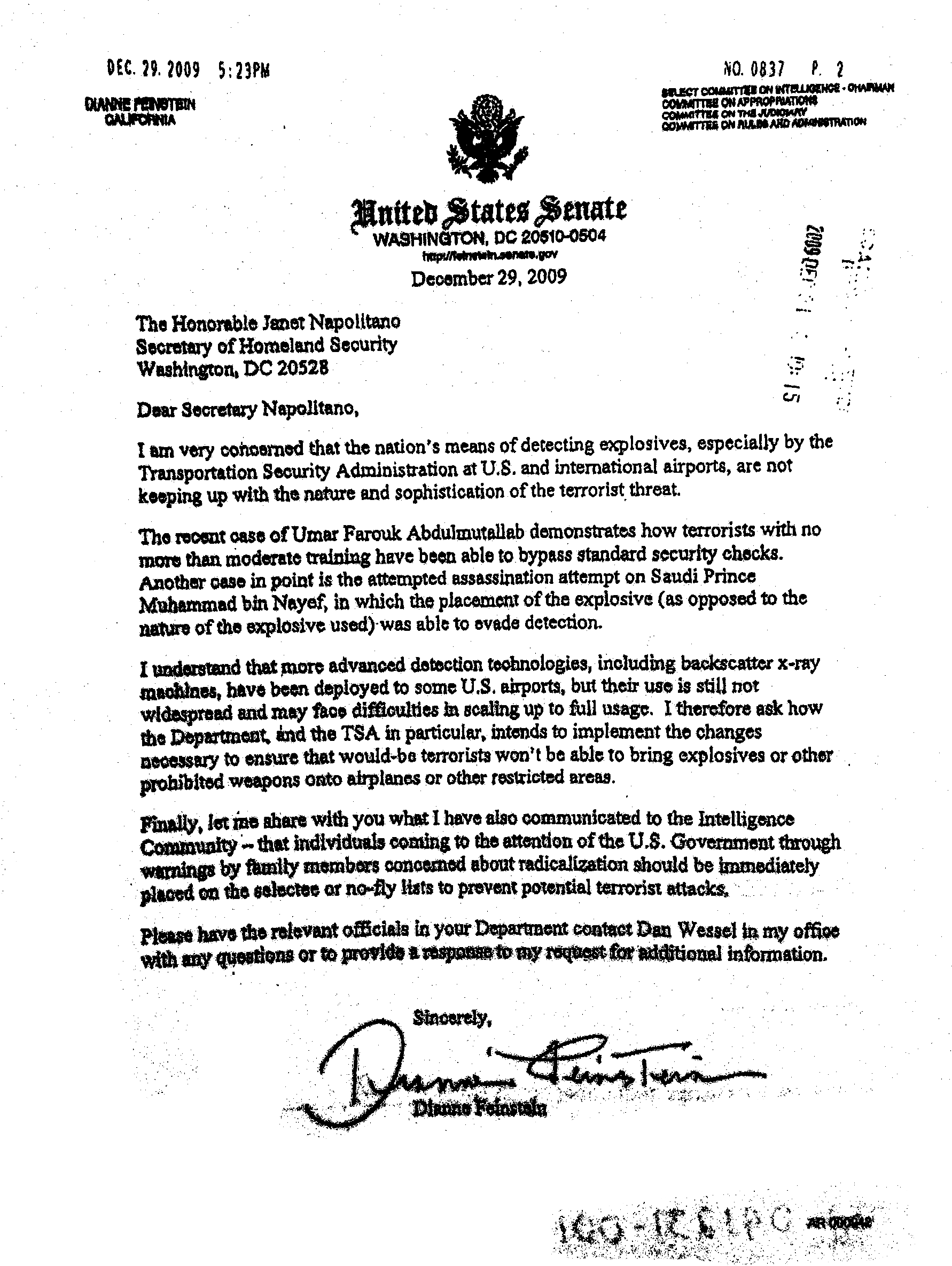
In this classic letter from 2009, Sen. Feinstein suggests that the process for getting on the list of people who can never travel by air again is way too difficult, and instead, we should simply accept tips from the public and start putting people on the list right away:

Finally, let me share with you what I have also communicated to the Intelligence Community — that individuals coming to the attention of the U.S. Government through warnings by family members concerned about radicalization should be immediately placed on the selectee or no-fly lists to prevent potential terrorist attacks.

Letter from Sen. Dianne Feinsten to DHS Secretary Janet Napolitano, Dec. 29, 2009

Apparently, Sen. Feinstein yearns to bring back the good old days of McCarthyism. Would you Cali people please take care of this??

Notice of Appeal Filed, + What is This “Mootness” Stuff?

Notice of Appeal I filed the Notice of Appeal today of U.S. District Judge Joan A. Lenard’s decision to allow the TSA to detain travelers, threaten them with false arrest, read through documents that they are traveling with, and lie in FOIA responses.

The next step (other than some housekeeping paperwork) is to write an appellate brief, which, IIRC is due in 40 days. This brief sets out the entire basis for the appeal, and typically ends up being quite lengthy. Since 19 of the 21 counts were dismissed 6 months ago, I’ve been able to get a head start on most of the brief. 🙂

Additionally, there’s been some commentary here and elsewhere on the Internets that Judge Lenard’s decision notes that my FOIA claim is “moot.” That is, my FOIA claim requested a copy of checkpoint video, and since I now have the video, even though they initially lied to me about it, there’s nothing more to be done.

Mootness is a doctrine that stems from the constitutional requirement that only “cases and controversies” may be heard by the federal courts. The idea is that if there’s no remedy the court can take to make it better, the court should not be wasting its time. But, there is an exception to the mootness doctrine for illegal actions that are “capable of repetition, yet evading review.” In other words, a live controversy still exists if the government can continue to do the illegal thing and always claim it would be moot.

In this instance, it is clear that the exception applies. FOIA would be meaningless if governments could simply lie and then, if caught, just say, “ok, you got me” and hand over the documents. I argued this exception passionately, and my argument was entirely ignored by this judge, as were many of my arguments for the 20 other dismissed charges.

Plaintiff seeks declaratory relief to ensure that Broward County cannot continue to invent its own rules for public records responses. Broward County argues that the issue is moot because Plaintiff currently knows the truth. However, without declaratory judgment, Broward County may continue to lie in public records responses and then, only if caught, release itself from liability by telling the truth. As Broward County‟s unlawful behavior is capable of repetition, yet evading review, mootness is inapplicable here. See Roe v. Wade, 410 U.S. 113 (1973). It should be noted that in the State of Florida, knowingly refusing to comply with a public records request is a criminal matter. See Fla. Stat. 119.02. It is in the public interest, as well as the interest of state officials, to put officials on notice that federal law does not create a basis for lying in a public records response because of an SSI designation.

Plaint. Opp. to Deft. Broward County’s Mot. for Summary Judgment, D.E. 95, p. 13 (Feb 27. 2013) (pdf)

I do think that the appellate court will overturn her ruling of mootness, as well as restore many (or all) of the remaining dismissed counts. Looking forward to this one.

Court: Federal Law Allows Lying in TSA-Related FOIA Requests

disscoverMoments ago, the remaining claims in my lawsuit stemming from being illegally detained at FLL airport and then lied to about the existence of CCTV video of the incident, were dismissed.

The questions before the court were as follows:

  1. Can the TSA (or local governments as directed by the TSA) lie in response to a FOIA request?
    Sure, no problem! Even the NSA responds that they “can’t confirm or deny the existence” of classified things for which admitting or denying existence would (allegedly, of course) damage national security. But the TSA? U.S. District Judge Joan A. Lenard granted the TSA the special privilege of not needing to go that route, rubber-stamping the decision of the TSA and the airport authority to write to me that no CCTV footage of the incident existed when, in fact, it did. This footage is non-classified and its existence is admitted by over a dozen visible camera domes and even signage that the area is being recorded. Beyond that, the TSA regularly releases checkpoint video when it doesn’t show them doing something wrong (for example, here’s CCTV of me beating their body scanners). But if it shows evidence of misconduct? Just go ahead and lie.
  2. Can the TSA hide the names and faces of its public-facing employees (and any local law enforcement coming to their aid) who are accused of misconduct?
    You bet! Despite the fact that they all wore name tags and I could have legally taken photos of them, Judge Lenard feels that the public servants who illegally searched and detained me deserve “privacy,” and upheld the TSA’s decision to redact their names from every document sent to me and to blur the entirety of every video sent to me. This is the same TSA that cares so much about privacy that they “accidentally” published a copy of my driver’s license in court filings.
  3. Can the TSA frustrate court review of whether or not a document is releasable under FOIA simply by “ordering” it secret?
    Why not?! Judge Lenard ruled that once a document is labeled “Sensitive Security Information” (which the TSA does by merely waiving a magic wand and writing “SSI” on the cover of a document) the U.S. District Court loses its power to review that determination, and the U.S. Court of Appeals is the proper forum. But wait, the Court of Appeals doesn’t evaluate FOIA claims, so now, in order to get a document you want, you must petition 2 courts and pay over $800 in filing fees alone. Yes, clearly this is how Congress intended public records laws — designed to allow transparency in government — to work.

On top of this recent heap of fail, Judge Lenard had previously tossed the bulk of my lawsuit — 19 out of 21 charges — and then refused to allow me to appeal those 19 charges until she contemplated these two remaining charges. She then took 6 months to write this 19-page opinion. Her decision today, therefore, is not much of a surprise to me, since Judge Lenard seems to be more inclined to rubber-stamp government thuggery, through convoluted, ill-supported, and needlessly delayed rulings, rather than to dispense justice. I will be filing a notice of appeal this week, sending this case to the U.S. Court of Appeals for the 11th Circuit, and I am strongly tempted to file a complaint of judicial misconduct based on her purposeful delay of my case and the sheer absurdity of some of her arguments. But, appeal first, misconduct complaint later.

Corbett v. TSA – Full Dismissal (.pdf)

Donate to help fund the appeal?
…or via Bitcoin: 15ftA2938sp7Mnsi8U7wYVmEtd4BRbFnkT

Blog at WordPress.com.

Up ↑