Last week, the U.S. Court of Appeals for the Tenth Circuit was the fifth federal appeals court in a row to hold that TSA screeners are “investigative or law enforcement officers,” a category of federal employees who may be sued for intentional misconduct like battery or false arrest under the Federal Tort Claims Act. The decision was a 2-1 victory in Mengert v. U.S., argued by my firm on behalf of a woman who was strip searched by TSA screeners in Oklahoma who alleged they were confused by a feminine hygiene product she was wearing.
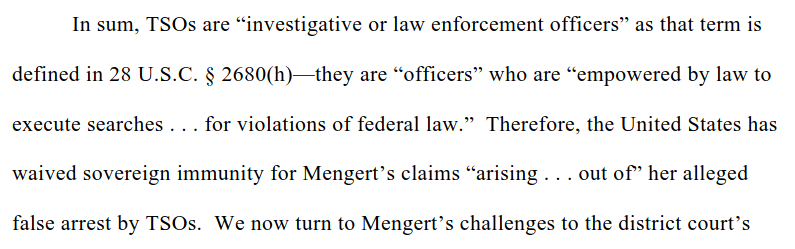
The opinion in this case was unfortunately not all good news, as the court also held that in Oklahoma, one can’t recover for emotional distress claims unless their emotional distress is so severe that it, for example, affects their daily life. This is bad news for those injured in Oklahoma (although attorneys seeking to recover in Oklahoma should consider negligence, battery, and other tort claims that may still be viable), though we will, of course, consider our options to challenge that overly-strict standard for emotional distress.
There are twelve regional federal circuit courts of appeals and each one is precedential only for its own region — so the government can try in each circuit to get a different decision, but it is extremely rare for one circuit to go against a consensus of five. Undeterred, TSA is now pursuing the same issue in the Eleventh Circuit, likely to be heard on oral argument in March, which I’ll be arguing for a fourth client.
Summary of the law by circuit:
- First Circuit – No Decision
- Second Circuit – No Decision
- Third Circuit – TSA Lost (Pellegrino, 2019)
- Fourth Circuit – TSA Lost (Osmon, 2023)
- Fifth Circuit – No Decision
- Sixth Circuit – No Decision
- Seventh Circuit – No Decision
- Eighth Circuit – TSA Lost (Iverson, 2020)
- Ninth Circuit – TSA Lost (Leuthauser, 2023)
- Tenth Circuit – TSA Lost (Mengert, 2024)
- Eleventh Circuit – Oral Arguments Likely March 2025 (Koletas)
- DC Circuit – No Decision
 Professional Troublemaker ®