Rohan Ramsingh is a disabled veteran of the United States Army. His service to his country left him with multiple disabilities, including minimal use of one of his shoulders and severe post-traumatic stress disorder (PTSD), sufficient that the government classifies him as having “permanent and total disability.” To give you an idea of the extent of the surgeries, medication, and other treatment he has required, his medical record with the Veterans Health Administration is nearly 900 pages.
A few months before the pandemic descended upon the world, Ramsingh went to the airport, presented himself at the security checkpoint, and candidly told TSA screeners about his disabilities at the start of screening. His shoulder injury precludes going through a body scanner (which requires a traveler to hold their arms above their head for several seconds) and his PTSD is triggered by having certain areas of his body touched by strangers. Upon hearing this, instead of working to find a solution, or at worst telling Ramsingh that they wouldn’t be able to clear him to enter, supervisors apparently interpreted Ramsingh’s medical limitations as disrespect of their authority and started to threaten him with detention, fines, and police intervention. Security video shows that the whole time, Ramsingh remained calm, not once yelling or create a scene, and after several minutes of being barked at, he asked TSA to allow him to leave the airport. Instead, TSA held him and police were called. The incident ended when the responding officer told Ramsingh that he wouldn’t be participating in detaining him and that he was free to go.
If only the story also ended there. Days later, Ramsingh received a letter proposing that he pay TSA a civil penalty of $2,050 for “interference” with the TSA screening process.
Surely this must be posturing by some supervisor with a hurt ego that will be abandoned once the adults in charge take a look, right? Wrong. Ramsingh retained competent counsel — yours truly — who retrieved the security video, the incident reports, and the medical records, and presented them to actual attorneys for TSA assigned to the case, David Hall and Bill Hernandez. Instead of dismissing, they argued that being disabled is no defense for failure to complete the screening process, and TSA court (yes, there is such a thing), of course, agreed:
“TSA did not dispute Respondent’s claims to STOSs Pagan and McClelland that he suffers from a condition preventing him from lifting both arms and PTSD, and it does not dispute Respondent’s VA medical documentation, in Exhibit A. … However, as discussed in Ruskai, supra, an individual’s bona fide medical condition does not invalidate the requirement to complete screening.
Order Granting TSA’s Motion for Decision, Mar. 4th, 2021, by Hon. Michael J. Devine, U.S. Coast Guard Administrative Law Judge
An appeal to the head of the agency was denied, and so on Friday we asked the United States Court of Appeals for the D.C. Circuit to explain to TSA that no, it cannot fine people for not completing screening when they are unable to do so. Case No. 21-1170 was assigned with briefing to begin next month.
One would think that a disabled veteran would be the last person the TSA would give grief to. In screening 2 million travelers daily, TSA could be expected to learn how to interact with people with disabilities generally. After all, according to the CDC, 1 in 4 Americans has some kind of disability. This behavior is a disgrace, and I look forward to fighting this battle in an actual Article III court.
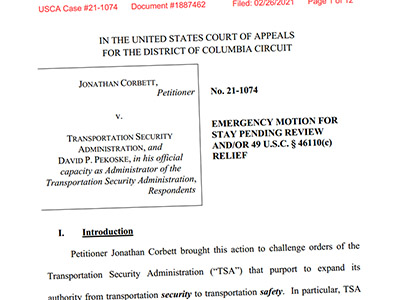 It seems that masks reduce transmission of coronavirus: some studies showing reduction of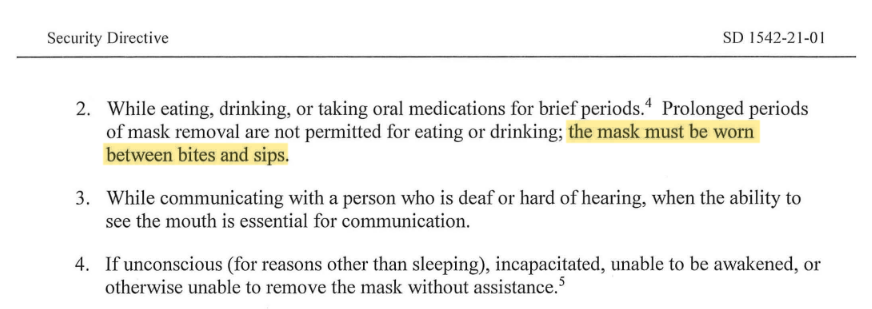
 Jamii Erway is a 16-year-old girl in North Carolina who is used to getting false alarms when she goes through TSA body scanners. The reason is that Jamii is transgender — she was born male and now lives as a young woman — and the TSA screener operating a body scanner must press a “Male” or “Female” button for each passenger. If the operator presses “Female,” the machine will alarm if the traveler has external genitals. If the operator presses “Male,” the machine will alarm they are wearing a bra. (And, well, if you have a penis while wearing a bra, the machine will alarm no matter which button is pushed.)
 Michele Leuthauser was traveling from Las Vegas-McCarran International Airport last June wearing yoga pants that should have made it quite easy to determine that she was concealing nothing on the lower half of her body. But, because the TSA uses body scanners with a false positive rate somewhere in the range of 20-40% (some studies
 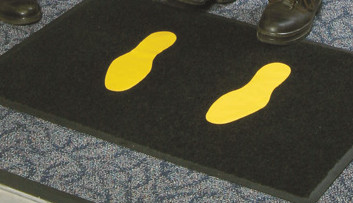 When doing pat-downs, the TSA has little mats with footprints painted on to indicate to the passenger how to stand. But, the screener told Michele to spread her legs far wider than the mat — an order that

 The blue-shirted TSA employees of which all travelers are familiar hold the job title, “Transportation Security Officer.” But despite the “officer” title emblazoned upon the plastic badge on their chest, TSA screeners are not law enforcement officers, do not have the authority to make arrests or hold travelers for any length of time, and if you break the law at a checkpoint, their only option is to call the real police to deal with the situation.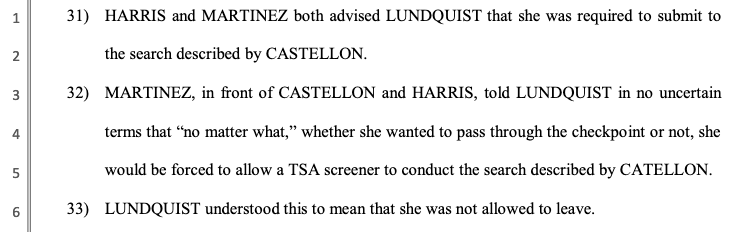
 Professional Troublemaker ®