
No Surveillance State Month, Part 26: Big Brother on the Road

License Plate ReadersOur last post covered how local governments can track you walking on the streets. It doesn’t get much better for other modes of transportation. Consider:

  • Do you drive? Mind the license plate readers (pictured) tracking you and putting you in a database every time you pass by. This man submitted a FOIA request for the records collected on his car and found that his location had been logged (and photographed!) 112 times.
  • On the highway? If you use E-ZPass, SunPass, or any other prepaid toll system, each trip you make is logged. They can potentially even use this data to show how fast you were going by timing your passage between two points.
  • Taking a train? Bought your ticket on your credit card? Or worse, bought a fare card (Metrocard, etc.), which records every swipe?
  • Taking an airplane? lol 🙂 You know the deal already.

All of these pieces of what the NSA would call “metadata” can be pieced together. You buy a fare card on your credit card, and they know who you are. You swipe it at a turnstyle, and there’s a camera there being recorded and retained. Your entire journey can be watched, and as facial recognition increases, their ability to have a computer follow you from camera to camera increases.

Scary, isn’t it?

What can you do? The #1 lesson here seems to be pay in cash. It’s much harder to track your every step if you don’t broadcast your entry into the dragnet with a credit card swipe. On the road there are nifty little license plate covers designed to make your plates harder to photograph (an example I found on Google). But remember, we should be fighting against these systems before they’re implemented. 🙂


This is one of a 30-part series, “No Surveillance State Month,” where daily for the month of June I’ll be posting ways to avoid invasion of your privacy in the digital age. The intent of these posts is not to enable one to escape detection while engaging in criminal activity — there’s still the old-fashioned “send a detective to watch you” for which these posts will not help. Rather, this series will help you to opt-out of the en masse collection of data by the government and large corporations that places Americans in databases without their knowing and freely-given consent for indefinite time periods. We all have the right to privacy, and I hope you demand it.
No Surveillance State Month, Part 25: Local Big Brother

In 2006, I accepted a contract to work as a technical consultant for the NYPD’s Counterterrorism Division. I soon found out that I was to be working on a project known as the Lower Manhattan Security Initiative, which was, at the time, a fairly reasonable security measure: link together the cameras near the stock exchange, a sensitive, non-residential area of downtown Manhattan, for monitoring by the police. We built them a beautiful operations center to do just that, and my contract ended. [Note: While my contract required non-disclosure, all of the information posted herein can be found by searching through news reports. The NYPD is quite proud of their surveillance.]

Of course, fast forward, and the NYPD has now persuaded dozens of private building owners in lower Manhattan to send them 1,000+ camera feeds and has expanded the project to midtown, an area significantly more residential. With the midtown project likely completed, the NYPD would now have 3,000 cameras accessible to them in their command center, giving them the ability to follow you around the city as you travel on foot. These cameras are, of course, recorded, so that the police can go back in time (allegedly for 30 days) to watch you walk around the city. This was especially useful for watching “hot chicks,” whom the officers would regularly review for “suspicious activity.”

New York is not alone. London actually did it first, and you can expect that many large cities have implemented some form of centralized camera monitoring. Many don’t have a problem with it: you’re in public, after all. But personally, I find it a bit creepy that the city can not only watch me live, but go back in time and watch me. Add this to the subway cameras, and you can track someone pretty much the entire time they’re outside.

What to do?

Well, awareness is half the battle. Know that the camera attached to the deli across the street may not be just to watch to make sure you didn’t steal a bag of Cheetos, but may be the police state keeping tabs on you. The rest of the battle is fighting these initiatives when they are proposed. What seemed like a fairly innocuous proposal to watch the financial centers has now expanded, and surely will continue to expand. Be aware that every “reasonable” tool will be twisted until it is nothing like the original.


This is one of a 30-part series, “No Surveillance State Month,” where daily for the month of June I’ll be posting ways to avoid invasion of your privacy in the digital age. The intent of these posts is not to enable one to escape detection while engaging in criminal activity — there’s still the old-fashioned “send a detective to watch you” for which these posts will not help. Rather, this series will help you to opt-out of the en masse collection of data by the government and large corporations that places Americans in databases without their knowing and freely-given consent for indefinite time periods. We all have the right to privacy, and I hope you demand it.

Comment Period for TSA Proposed Nude Body Scanner Rule Ends; 97% Opposed

Protest the NSA! Request, or request the deletion of, your NSA Records for free via our sister site, MyNSARecords.com


The TSA’s 2.5 year delayed notice and comment rulemaking, allowing them to use nude body scanners as primary screening in U.S. airports, came to a close yesterday after 3 months of accepting public feedback.

At the time of writing, the TSA has admitted to receiving 4,321 comments, a number sure to increase as they continue to post them (for example, mine hasn’t yet reached the public site). They are overwhelmingly in opposition to the proposed rule. I went through the last 100 posted, and of them:

  • 97% were in opposition
  • 2% were in favor
  • 1% did not appear to take a position

At least 20 people mentioned me by name (all in opposition, of course), a handful of others mentioned my blog or my video, and at least one likely TSA Out of Our Pants reader took my suggestion and simply told the TSA that they suck. (Thanks Kristina out in L.A.!)

What happens now? The TSA has to review and respond to the comments, and then can decide whether or not to adopt the proposed rule. They unfortunately have great leeway in their decision (for example, the USPS once adopted a rule after receiving 10 comments in favor and 8,097 in opposition). The good news is that they have to consider every comment and respond to every reason that people have given them to get rid of the nude body scanners, or else face lawsuits (for example, by me :)).

Thank you to all who took the time to get involved. You’ve ended the TSA’s gloating that poorly-worded and implemented opinion polls show that Americans don’t really mind the scanners. Your comments make a difference and allow us another avenue to fight!

My Comment – Comment of Jonathan Corbett (.pdf)

No Surveillance State Month, Part 24: The Smell of Packets

If you’ve done everything else we’ve suggested, but still are uber-paranoid that some sort of hacker, government or otherwise, is leeching data from your computer, there’s one way to find out for sure: packet sniffing.

Packet sniffers, also known as protocol analyzers, record and identify all traffic travelling through a network interface, such as your wireless card. When traffic leaves your computer, it is broken up into chunks called “packets,” and this software will make a list of each packet, its “metadata” (date/time, source, destination, port number, etc.), and optionally, the full contents of the packet. If someone is taking data from your machine, you’ll see it.

There is but one gold standard in packet sniffing, and has been for as long as I can remember: Wireshark (formerly known as Ethereal). It’s cross-platform, free, and awesome.


This is one of a 30-part series, “No Surveillance State Month,” where daily for the month of June I’ll be posting ways to avoid invasion of your privacy in the digital age. The intent of these posts is not to enable one to escape detection while engaging in criminal activity — there’s still the old-fashioned “send a detective to watch you” for which these posts will not help. Rather, this series will help you to opt-out of the en masse collection of data by the government and large corporations that places Americans in databases without their knowing and freely-given consent for indefinite time periods. We all have the right to privacy, and I hope you demand it.

An Open Letter to the @NYPost: Snowden is a Hero, Not a Traitor

We’re currently running a fundraiser for 1985, peer-to-peer phone call encryption that will prevent NSA spying on your “metadata.” We’re also running My NSA Records, a site to generate a free request to send you your NSA records (or delete them!).


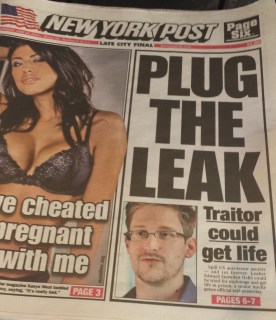
nypostsucks1The New York Post has persisted in running covers condemning whistleblower Edward Snowden as a man who has betrayed America. If by “America” they mean “the government of the United States while engaged in a a sneaky, immoral, and illegal program designed to spy on its citizens,” then perhaps they are right. But if they mean “America” as in “the people of the United States,” they are dead wrong.
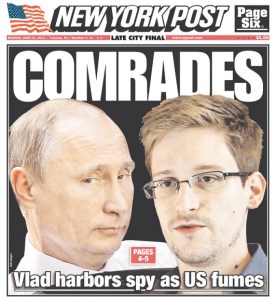
On June 12th, 2013, the Post ran a cover with the headline “Plug The Leak: Traitor Could Get Life.” This was before Snowden had been charged with any crime, and still today he has not been charged with treason. Today’s headline is “Comrades – Vlad [Putin] harbors spy as US fumes.” Snowden also has not been charged with, nor can his actions reasonably be construed to be, “spying.” Why the Post has decided to take a position on the matter at all (let alone such an absurd position), rather than simply reporting the news, is a mystery to me. Perhaps they simply prefer to be inflammatory.

Allow me to break down the argument advanced by those in favor of tarring and feathering the man who revealed the biggest invasion on the privacy of American citizens by its own government in history:

  1. The collection of phone records and PRISM data was not illegal. Incorrect. The only court to approve of this spying is the secretive Foreign Intelligence Surveillance Court. Their decision has never been reviewed by the U.S. Supreme Court (it is, after all, difficult to appeal an order that was kept secret!), and if it were (or really, when it is), it would likely be struck down on at least two grounds: a) The NSA, a part of the U.S. military, is only allowed to monitor foreign intelligence, but the phone records order specifically addressed domestic communications, and b) the order constituted a “general warrant” that requested the records of no less than 100 million Americans, presumably 99.99 million+ of which are not under suspicion. Arguments that “Congress authorized this” are dead wrong. Diane Feinstein may have supported the move, but as far as legislation rather than the opinion of a loud-mouthed Senator, even the Patriot Act does not authorize this under any reasonable reading.
     
  2. nypostsucks1There are better ways he could have blown the whistle. Wrong. At least three men before them tried blowing the whistle using official channels. Thomas Drake, William Binney and J. Kirk Wiebe all did what the Post would consider “responsible” whistleblowing. Drake was prosecuted, Binney and Wiebe had their houses raided by FBI SWAT teams, all three men lost their security clearances, and all of their stories were swept under the rug. Not quite change we can believe in.
     
  3. Snowden is a coward for fleeing. He probably wats to collaborate with our enemies, Russia and China. Really? First, regarding leaving the country, had he not, he’d presently be receiving the same treatment Bradley Manning received: sleeping naked in solitary confinement and permanently silenced. That’s not a noble way to advance a cause — that’s sheer stupidity. Second, regarding his choice of where to go, he can’t exactly enjoy a spot of tea in London or currywurst in Berlin: most of the world would bow to the U.S. and extradite him on these purely political charges. Hong Kong and Moscow are two places where he has a chance. Third, our enemies? China is our biggest trading partner, and the idea that Russia presents a threat to us reflects a mindset several decades in the past. If you want to talk about our enemies, you’ll need to look to the middle east at the people who are less than enthusiastic about us because we bomb the shit out of them. Finally, there is zero evidence that he intends to assist any foreign power. Let’s all be aware that the government is going to attempt to portray him in the most unfavorable light possible. We don’t need to buy into it.
     
  4. He aided the terrorists — there’s a reason these programs were secret! No. Any legitimate terrorist already knew that their communications would be intercepted as they travel through America. “Real terrorists” use sophisticated encryption and private forums when their “work” requires being on the grid. These programs were only “secret” from Americans who did not want to believe that their government would do such a thing, and the “reason these programs were secret” is that if the public found out about them, there would be outrage.

Edward Snowden risked his life to expose an ongoing governmental disgrace of epic proportions; an abuse directed squarely at the citizens who are forced to finance its continued operation and now, forced to finance political persecution. Over 100,000 Americans have signed the White House petition demanding that President Obama pardon Snowden and referring to him as a “national hero.” It is time that the Post also recognize the sacrifice he has made and that the evil here was not the release of documents, but what was contained in those documents.

Last Day to Send In Comment on Nude Body Scanners

The notice-and-comment rulemaking period regarding nude body scanners ends today. If you haven’t already, please take 5 minutes to submit a comment. Even a simple, “You suck and so do your scanners!” will be counted as a comment in opposition, so even if you don’t have much time, any comment in opposition will help:

https://www.federalregister.gov/articles/2013/03/26/2013-07023/passenger-screening-using-advanced-imaging-technology

I’ll be publishing my comment tomorrow. 🙂

No Surveillance State Month, Part 23: Hunting Malware

Ever go to a Web site, see things start to blink on your computer, and know that you probably just got some kind of epic computer virus? It happens every once in a while. There’s hope.

First, every Mac user tells me that Macs don’t get viruses, so fine, you guys are on your own. The first stop for a PC user should be Windows Defender (pre-Windows 7) / Microsoft Security Essentials (Windows 7+), which are free anti-malware apps put out by Microsoft. They’re very easy, they fix most malware, and did I mention, free?

Next on the list is to check your HOSTS file. A HOSTS file is a file that overrides DNS, which basically means that when you type in a domain name, you might actually end up somewhere else (generally, right where your attacker wants you). Run Notepad as an administrator (right click and click Run As Administrator), and open up C:\Windows\system32\drivers\etc\hosts. There should only be 2 lines that don’t start with a “#”, and both of them should end with “localhost.” If you see more than that in there, chances are, you have an issue. There are potentially legit (but somewhat rare) reasons your host files may be modified, so in order to make your changes reversible, instead of deleting lines, just add a “#” to the beginning of the undesired lines.

Last, the tool most pros will use to find bad things on your computer is called HijackThis (Note: Not for use at TSA checkpoints!). HijackThis is a brilliant piece of software that lists almost everywhere on your system that a virus can hide. The downside is that it take a bit of tech expertise to know what to remove — but Internet forums and/or that nerdy family member who knows the Interwebs can set you straight. Once you know what you want to remove, you just click on the item in HijackThis and select Fix, and the problem will be removed.


This is one of a 30-part series, “No Surveillance State Month,” where daily for the month of June I’ll be posting ways to avoid invasion of your privacy in the digital age. The intent of these posts is not to enable one to escape detection while engaging in criminal activity — there’s still the old-fashioned “send a detective to watch you” for which these posts will not help. Rather, this series will help you to opt-out of the en masse collection of data by the government and large corporations that places Americans in databases without their knowing and freely-given consent for indefinite time periods. We all have the right to privacy, and I hope you demand it.

No Surveillance State Month, Part 22: Archive Your E-mail

There are two good privacy-related reasons to archive (take offline and store somewhere on your local computer) your e-mail:

  1. If it’s not online, the government can’t request it. Perhaps the NSA has already intercepted it, but if they haven’t, or if another agency wants it but doesn’t have the clout to make the NSA produce it, you’re now in control — not Google or whoever your mail host is.
  2. The government thinks your old/read e-mail isn’t constitutionally protected. The DoJ has argued that e-mails that are read, or e-mails that are 180+ days old, are no longer subject to privacy if you leave them sitting on the server. This is obviously fucking absurd, but the idea still hasn’t been officially shot down because last time it was tried, the government withdrew its request rather than fight for it.

How to do it? If you use a corporate mail server such as Exchange server, you can set up personal storage folders (.pst files) using Outlook. Move your e-mail there, and they’re offline (assuming your company hasn’t retained them). Gmail user? Try this article on for size.


This is one of a 30-part series, “No Surveillance State Month,” where daily for the month of June I’ll be posting ways to avoid invasion of your privacy in the digital age. The intent of these posts is not to enable one to escape detection while engaging in criminal activity — there’s still the old-fashioned “send a detective to watch you” for which these posts will not help. Rather, this series will help you to opt-out of the en masse collection of data by the government and large corporations that places Americans in databases without their knowing and freely-given consent for indefinite time periods. We all have the right to privacy, and I hope you demand it.

No Surveillance State Month, Part 21: Password Questions Are the Devil

You know those, “If you forget your password, answer these questions to get into your account” things? That always ask you in what city you were born, what your mother’s maiden name was, etc.? Well, think about it for a second: assuming you answer those questions honestly, what are the odds that other people also know or can look up that information? There you were coming up with some kind of uber-complex string of characters for your password, which can be bypassed by searching for your mom’s marriage announcement.

This is how a lot of celebrity account hacks happened. Nude pictures of Scarlett Johannsen are on the ‘net thanks to password questions.

The solution is to make the answer to your password question a password in itself. Simply pick a new password, and use that for your password question. If that makes things too hard to remember, even something as simple as adding an arbitrary word before/after the real answer will make things significantly more secure. “New York” and “Smith” become “New York Blue” and “Smith Blue,” or “Alligator New York” and “Alligator Smith.” Easy to remember, unlikely to guess.


This is one of a 30-part series, “No Surveillance State Month,” where daily for the month of June I’ll be posting ways to avoid invasion of your privacy in the digital age. The intent of these posts is not to enable one to escape detection while engaging in criminal activity — there’s still the old-fashioned “send a detective to watch you” for which these posts will not help. Rather, this series will help you to opt-out of the en masse collection of data by the government and large corporations that places Americans in databases without their knowing and freely-given consent for indefinite time periods. We all have the right to privacy, and I hope you demand it.

No Surveillance State Month, Part 20: Snail Mail Services

Many people don’t like the idea of having their home address so easily searchable on the Internet. It used to be that if you wanted a way to receive mail without giving up where you live, you got a post office box, which is ok but let’s face it, there’s not much worse in this world than having to go to the post office.

I love to travel (hence the origins of this blog), and for me, I also would like to be able to receive my mail even when I’m not home. Rather than burdening my friends, I use one of the many services out there that receive mail on your behalf and, at your request, scan your mail and e-mail it to you, forward your mail to you, or simply drop it in the shredder if you don’t want it.

The services range in price from about $20 for the basics, and it’s the easiest way to get your address off the Google while still maintaining communication with those who still find it necessary to send paper. Two that I’ve used that I’ve been happy with (and receive no commission from) are:

One cool tip: with the check deposit feature that most banks have in their mobile apps, if you receive a check, you don’t have to request it be forwarded to deposit. Just request that they scan the item and then either print and endorse, or if you’re extra fancy, you can endorse using any graphics program and use the app to take a picture of your screen. It actually works.


This is one of a 30-part series, “No Surveillance State Month,” where daily for the month of June I’ll be posting ways to avoid invasion of your privacy in the digital age. The intent of these posts is not to enable one to escape detection while engaging in criminal activity — there’s still the old-fashioned “send a detective to watch you” for which these posts will not help. Rather, this series will help you to opt-out of the en masse collection of data by the government and large corporations that places Americans in databases without their knowing and freely-given consent for indefinite time periods. We all have the right to privacy, and I hope you demand it.

Blog at WordPress.com.

Up ↑