What a President Can Do With an Executive Order — And Why Trump’s Muslim Ban is Illegal

trump_signingOn Sunday I published a post about Trump’s “Muslim ban,” a decision to exclude green card holders and refugees from 7 Muslim countries.  The post was the most shared on this blog ever (over 10,000 shares on Facebook alone!), and attracted a lot of comments.  Some people felt that Trump’s decision, which he made by “executive order,” was perfectly legal.

Is it?

Well, let’s start with what a President does.  We know he runs the executive branch, but what does that mean?  The President’s authority comes from the U.S. Constitution (either directly or from Congress giving him some of their authority), and we can mostly divide what a President does into two categories:

  1. “Foreign stuff” – The President is our chief diplomat, the commander of our military,  and the person with whom other countries must negotiate when they want something from the United States.  These powers are granted in Article II, Section 2, of the Constitution.
  2. “Domestic stuff” – Some of this we’re familiar with: things like signing and vetoing laws, appointing U.S. Supreme Court justices, granting pardons, and the like.  These powers are also granted by Article II, Section 2.  Then there are the powers granted by Congress to run more day-to-day affairs.  Through the use of agencies, such as the FCC, FDA, FBI, and hundreds of others, the executive branch accomplishes its work, and the President is the head of those agencies.  And, sometimes Congress gives power specifically to the President rather than to an agency.

With this background, an executive order is a direction that an agency of the government enforce the law in a certain way, or to make a formal use of a power specifically granted to the President by Congress.  Since 1907, the Office of the Federal Register has cataloged and numbered each executive order — the Muslim ban order was #13769.

When it comes to agencies, the President gets to fill in the blanks.  So, a President could order the FBI to step up their enforcement of marijuana laws because Congress allows the FBI to enforce the laws, but didn’t specify how much emphasis should be placed on marijuana.  A President could also order the IRS to send bills to taxpayers only in gold-foil envelopes, because Congress authorized the IRS to send bills, but did not say what the envelopes in which they are sent must look like.

But, the President may not order something contrary to the law, nor fill in the blanks where there are no blanks to fill.  For example, Obama couldn’t order the FCC to confiscate the cell phones of those who text-and-drive, because that doesn’t fit into any grant of power by Congress to the FCC.

So, did the President issue the Muslim ban order pursuant to a legitimate grant of power by Congress?

No.  Here’s why.  Trump could try to defend his actions on the basis of a law passed by Congress numbered as 8 U.S.C. § 1182(f), which states in part: “Whenever the President finds that the entry of any aliens or of any class of aliens into the United States would be detrimental to the interests of the United States, he may by proclamation, and for such period as he shall deem necessary, suspend the entry of all aliens or any class of aliens as immigrants or non-immigrants, or impose on the entry of aliens any restrictions he may deem to be appropriate.”

At first glance, it does seem like Congress authorized the President to discriminate against anyone as long as he deems it necessary or appropriate.  But, if you scroll back up to the top of the page and read one sentence a little more carefully, you may see Trump’s problem: “The President’s authority comes from the U.S. Constitution (either directly or from Congress giving him some of their authority)…”

Congress cannot give the President authority which it does not have to give.  The U.S. Constitution does grant Congress the authority to deal with immigration, but that authority is restrained by limits set by other parts of the Constitution.  Specifically, the 14th Amendment reads in part: “No state shall make or enforce any law which shall abridge the privileges or immunities of citizens of the United States; nor shall any state deprive any person of life, liberty, or property, without due process of law; nor deny to any person within its jurisdiction the equal protection of the laws.”

This is the “Equal Protection Clause” you’ve surely heard of, and the U.S. Supreme Court has broadly interpreted it to prevent the government from discriminating against any race, religion, or national origin (among others), unless the government has an extraordinarily strong reason for doing so and cannot do so in another way which would be less discriminatory.  (It has also applied the 14th Amendment to the federal government even though the text of the law uses the word “states.”)

This is, in my opinion and the opinion of every federal judge to consider the matter so far, where Trump must fail.  Congress does not have the authority to give Trump a power that violates the Equal Protection Clause, and therefore to the extent that 8 U.S.C. § 1182(f) may purport to do so, it is void.  People may argue about whether the government has a compelling reason to discriminate here, but there is little argument that there is not a way to secure our country in a less discriminatory manner.  Trump’s order is, therefore, illegal.
Transcript of Oral Arguments in Muslim Ban Case Shows Department of Justice Entirely Lost on How to Defend; Trump Fires Acting Attorney General

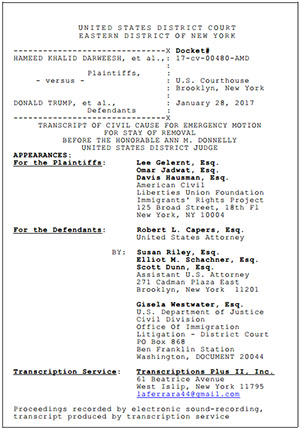
darweesh_transcriptBefore U.S. District Judge Ann Donnelly issued a temporary restraining order against
Donald Trump and the U.S. Customs and Border Patrol from enforcing a “Muslim ban” — prohibiting travel by green card holders and individuals with refugee status from 7 Muslim-majority countries — a hearing was held in which both attorneys for plaintiff Darweesh and attorneys from the Department of Justice for the government appeared.  Early media reports indicated that the U.S. Attorneys were entirely unprepared and had no defense for Trump’s executive order.  And, yesterday, Trump fired Acting Attorney General Sally Yates, allegedly after “she defiantly refused to defend his executive order closing the nation’s borders to refugees and people from predominantly Muslim countries,” according to the New York Times.

I noticed on the docket today (PDF or live version if you have a PACER account) that the transcript of these oral arguments was ready but not available over the Court’s Web site.  I managed to obtain a copy anyway which I’m now publishing for you all.

Darweesh v. DHS – Transcript of Oral Arguments on Motion for TRO, 1/28/2017 (.pdf)

Some highlights:

  1. There were five attorneys from the government there — four from the U.S. Attorney’s office and one from U.S. Customs & Border Patrol.  Not a single one of them, at any point in the 21 pages of transcript, even remotely attempted to argue that Trump’s order was lawful and the plaintiffs could not succeed on the merits.
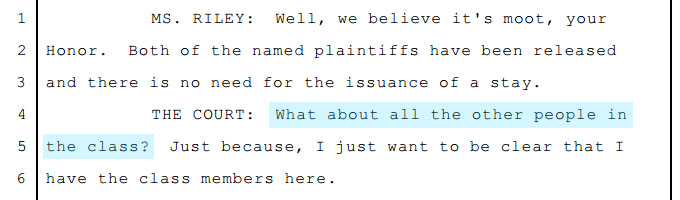
  2. The test for whether to issue a stay is a balancing of whether: 1) the requesting party is likely to succeed on the merits, 2) the requesting party will suffer irreparable injury, 3) the opposing party will be injured, and 4) the public’s interest will be harmed.  The only one the government even tried to address was irreparable injury, by saying that Darweesh was already released and therefore couldn’t be harmed.  The judge was not interested.
    not_so_moot
  3. But, the 3 attorneys for the plaintiff from the ACLU successfully argued that they would likely meet the requirements to proceed as a class-action, and thus were arguing on behalf of everyone who was detained or threatened with deportation under Trump’s new order — so Darweesh being released didn’t end the case.
  4. The judge made clear that her ruling applied to all affected by Trump’s order.  Thus, if at other airports across the country CBP was still detaining people, they were clearly in violation of the court’s order.  And for those who feel that Trump’s order is totally constitutional, the judge specifically ruled that it was likely that plaintiffs could prove otherwise:
    so_classy
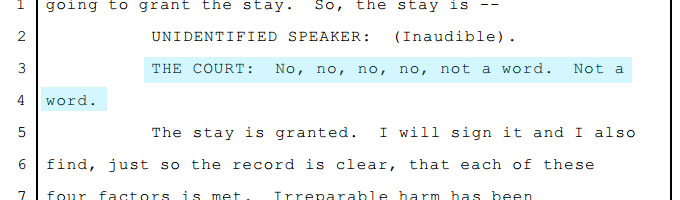
  5. The judge at times was clearly irritated with the government’s lack of response to her questions, and at one point told them that they would not be able to speak any longer.say_no_more_fam

Apparently, Trump is upset that his Acting Attorney General refused to defend his executive order.  But the real question is: What defense could they have plausibly given, especially given that apparently Trump gave the Department of Justice no notice of his plans?

If you want your executive agencies to work with you, they have to be kept in the loop.  Even then, however, it will be a hard sell for any attorney to walk into a courtroom with a straight face and say that the executive order by the guy who said he’d ban Muslims isn’t about banning Muslims, but just happens to be directed at 7 almost-all-Muslim countries.

I don’t envy anyone in the U.S. Attorney’s office’s civil litigation division right now.  They’re not getting paid enough for this shit.


“Jon Corbett is a civil rights advocate known for filing the first lawsuit against the deployment of TSA nude body scanners, as well as defeating the body scanners live in ‘How to Get ANYTHING Through TSA Nude Body Scanners.’  Presently a law student, he continues to advocate for travel and privacy rights.  Twitter: @_JonCorbett, Web:https://professional-troublemaker.com/

Fighting for civil rights in court is expensive!  Want to contribute to the fight against government assholery? Donate via PayPal, Venmo, Chace QuickPay, Bitcoin, or check

Federal Judge Sends U.S. Marshals to Prevent Trump from Enforcing Muslim Ban

foreign-us-customsOn Friday, our new President signed an executive order banning those from 7 Muslim countries from entering the United States, even if they had been granted refugee status, and even if they were green card or visa holders.  This blatant discrimination based on national origin (and, let’s be honest, it’s really based on religion, given that all 7 countries are Muslim-majority and Trump had flat-out said he would ban Muslims during his campaign) guaranteed a legal showdown which began yesterday after at least a dozen people with passports from those 7 nations were detained at JFK airport in New York.

Yesterday, attorneys for Hameed Khalid Darweesh filed a class action lawsuit requesting a writ of habaes corpus (court order to free a person) on behalf of Mr. Darweesh, who apparently was detained under this new order, and anyone similarly situated to him.  It’s worthy of note that this man is a refugee from Iraq who cannot return to his home country because he assisted the U.S. military during our operations there.  Filed with his petition was a motion for an emergency temporary restraining order, asking the court to prohibit U.S. Customs & Border Patrol from enforcing Trump’s order, and U.S. District Judge Ann Donnelly, after conducting an astoundingly prompt hearing,  granted that request, ordering all officers of the United States be:

ENJOINED AND RESTRAINED from, in any manner or by any means, removing individuals with refugee applications approved by U.S. Citizenship and Immigration Services as part of the U.S. Refugee Admissions Program, holders of valid immigrant and non-immigrant visas, and other individuals from Iraq, Syria, Iran, Sudan, Libya, Somalia, and Yemen legally authorized to enter the United States.

This is widely reported by the media (CNN, The Guardian, New York Times), but perhaps because of the late hour and lack of legal analysts on hand, they missed the significance of the next paragraph of Judge Donnelly’s order:

IT IS FURTHER ORDERED that to assure compliance with the Court’s order, the Court directs service of this Order upon the United States Marshal for the Eastern District of New York, and further directs the United States Marshal Service to take those actions deemed necessary to enforce the provisions and prohibitions set forth in this Order.

I’ve never seen an order like that directed against the U.S. government in my life.  What the judge just did is sent federal law enforcement affiliated with the court to JFK airport to make sure other federal law enforcement obeys the order.  In other words, Judge Donnelly does not trust that the Trump administration will follow the law and pre-emptively sent muscle to carry out her order.

If you’re to believe the Daily Kos, a source that I don’t necessarily consider reliable due to political bias on par with Fox News, but in the other direction, the U.S. Marshals were sent with good reason: they report that in other airports, U.S. Customs & Border patrol has ignored the order.  [Update: The Guardian also reporting non-compliance by CBP.]

If Trump chooses to direct his agencies to ignore court orders, this could be a very rapid beginning and end to his administration, as I cannot imagine Congress not impeaching a president who does so.  This situation may come to a head quite soon… stay tuned…


“Jon Corbett is a civil rights advocate known for filing the first lawsuit against the deployment of TSA nude body scanners, as well as defeating the body scanners live in ‘How to Get ANYTHING Through TSA Nude Body Scanners.’  Presently a law student, he continues to advocate for travel and privacy rights.  Twitter: @_JonCorbett, Web:https://professional-troublemaker.com/

Fighting for civil rights in court is expensive!  Want to contribute to the fight against government assholery? Donate via PayPal, Venmo, Chace QuickPay, Bitcoin, or check

What Are My Rights At The TSA Checkpoint?

tsacheckpointGoing through airport security manned by the TSA is an unpleasant at best, panic-inducing at worst experience, and it definitely helps to know what to expect and what you can do to ensure that you are harassed as little as possible.  The TSA is absolutely horrible at informing travelers as to the procedures they will face (often times declaring that they are “sensitive security information” and therefore cannot be published) and those working the checkpoints often misrepresent the rights and responsibilities of travelers (sometimes to be intentionally difficult, but generally because they were poorly trained).

So, here’s what every traveler should know before they collect their boarding pass at a U.S. airport:

  1. You have the right to opt-out of the body scanners and request a pat-down.  Unless your boarding pass indicates that you are subject to heightened security, which will be denoted by four S’s in big bold letters, you may simply tell the person running the body scanner that you “opt out.”  Try to keep a close eye on your belongings while they find someone to pat you down.
  2. You have the right to take pictures, video, and audio recording.  It can be comforting to many to know that they may document their interaction, especially if it looks like there’s going to be a problem.  You can take pictures, video, and audio recordings of the entire screening process with the following two exceptions: a) you can’t take pictures or videos of the x-ray monitors, and b) you can’t hold your belongings (including a camera) while you’re walking through the body scanner or metal detector, or while receiving a pat-down, but you can have a travel companion who has already been cleared do so on your behalf.  If the TSA ever denies you the ability to record your interaction other than for those two exceptions, please contact me.
  3. You have the right to request the TSA’s video of your experience!  Video from security cameras is almost always a public record covered by the federal Freedom of Information Act or similar state laws.  Generally, the video is in the possession of the local airport authority, so your request should be made to them, but I highly suggest sending simultaneous requests to both the TSA and the airport.  How?  Read about submitting FOIA requests to the TSA.
  4. You have the right to carry medicinal liquids as a carry-on, even if they are over 3 ounces.  Any liquid that you need for a medical purpose must be permitted through the checkpoint.  It does not have to be a prescription, and you do not need a doctor’s note.  If you have diabetes, you can easily justify a bottle of Gatorade.  If you have a baby, you may bring breast milk.  You also need not detail your condition for the TSA; simply take the items out of your bag to be separately screened and let the screener know that the items are medical liquids.
  5. You have the right to fly without ID.  If you forget, or lose, your ID, you may still travel.  They will simply verify your identity by calling in your information.  Leave extra time for the process, but fear not.  Note that if you can, but simply refuse to, show ID, the TSA’s policy is to refuse to screen you, although that policy does not exactly square with court rulings.
  6. You have the right to speak to a supervisor.  Blue-shirted TSA screeners come in 4 varieties, represented by 0 through 3 stripes on their shoulders.  0 = trainee, 1 = Transportation Security Officer (TSO), 2 = Lead TSO, 3 = Supervisory TSO.  If you have a problem and the person with whom you are speaking has less than 3 stripes, ask for an STSO.  If the STSO still gives you trouble, ask for a Transportation Security Manager (TSM), who will be wearing a suit.  A TSM is required to be on duty in the airport; do not believe any assertions that one is not available — they are.  Finally, if the interaction with the TSM is still unsatisfactory, you may ask to contact the Federal Security Director (FSD), who is a regional airport director and may not be on-site but generally has staffers who are.  Another resource is the TSA’s national “TSA Cares” hotline.  While the name is a misnomer, as the TSA certainly does not care, they may be of assistance at (855) 787-2227.
  7. You have the right to make a complaint.  Ask for a comment card on your way out, and the name of anyone who made your TSA experience more unpleasant than usual.  You can also file your TSA complaints online, but it makes them more nervous when you ask for a paper copy.
  8. You have the right to request a police officer supervise.  Did the TSA just ask to conduct an invasive search on your person?  Feel free to request that airport police supervise the situation.  Most, but not all, airport cops understand that the TSA is a disaster and that 0% of the times the TSA has demanded absurd levels of screening has the target actually been a terrorist.  As the saying goes, “‘I just caught a terrorist!’ said no TSA employee ever.”
  9. You have the right to refuse to take off anything but outer garments.  This includes, obviously, your clothes, but also includes any medical devices, prostheses, etc.  The TSA is not permitted to conduct strip searches.  If you are asked to do anything to the contrary, contact a supervisor and airport police.
  10. You have the right to refuse screening.  I cannot stress this enough: if the TSA demands that you continue screening in a private room, you should refuse.  You may miss your flight, but think about it: if the TSA does what you see at the checkpoint in full view of the world, you can only imagine what they will do if they determine you need “private screening.”  And, if you can’t imagine, let me fill you in: they will be touching your genitals with the front of their hands.  Know also that the TSA has not successfully leveled a fine or any other penalty against anyone for refusing screening, and their current policy is to simply escort the traveler out of the checkpoint.  Your airline will almost certainly re-book you at no cost.  It is your body, and your choice — do not let the TSA persuade you otherwise.  Just remain calm and firm.

Finally, if you have a negative experience, please don’t keep your story to yourself.  I would love to hear your story and may be able to help you to find resources to help.  Be in touch.  And, please share, print, and distribute to help others avoid TSA assholery.


“Jon Corbett is a civil rights advocate known for filing the first lawsuit against the deployment of TSA nude body scanners, as well as defeating the body scanners live in “How to Get ANYTHING Through TSA Nude Body Scanners.  Presently a law student, he continues to advocate for travel and privacy rights.  Twitter: @_JonCorbett, Web: https://professional-troublemaker.com/

Fighting for civil rights in court is expensive!  Want to contribute to the fight against government assholery? Donate via PayPal, Venmo, Chace QuickPay, Bitcoin, or check

Insomniac Attorney Flat-Out Calls Me a Drug Dealer for Lawsuit Over Medicine Policy

Last May, I filed suit against Live Nation subsidiary Insomniac, the producer of the Electric Daisy Carnival (EDC) music festival, because they refuse to allow OTC medicine into their music festivals and they require festival-goers to “consult” with a “safety officer” to carry Rx medicine, effectively requiring the disclosure of one’s medical condition without any privacy protections.

I wrote previously about how their attorney, Greg Hurley of Sheppard Mullin, has been extraordinarily unprofessional throughout litigation.  But, the filing they just submitted a few minutes ago takes the cake:

“Plaintiff has failed to put forward any evidence that he is disabled or how the alleged policy denied him access. Instead, this entire lawsuit appears to be motivated by a desire to make it easier for him to smuggle illegal drugs into future music festivals.”

This is, apparently, Insomniac’s and Sheppard Mullin’s position on disabled people who need medicine: that they are probably just drug dealers who are faking it.  Their claim of a lack of “any evidence” is belied by the fact that I’ve submitted a sworn declaration to the contrary, and quite simply, Mr. Hurley appears to wish to use the immunity he enjoys when he falsely calls someone a criminal in a court document that, were he to say it anywhere else, would be actionable defamation.

greg-hurley-is-unprofessional

Source Document: Corbett v. Insomniac – Motion for Summary Judgment Reply

TSA Quietly Forcing Some Passengers To Go Through Body Scanner *And* Pat-Down — Even If Body Scanner Says Clear!

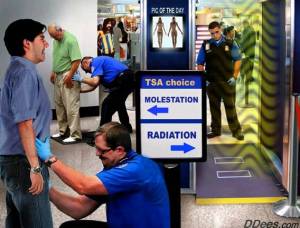
tsa_molestation_or_radiation

Image credit: DDees.com


When the TSA announced in 2015 that for “some passengers” they were eliminating the body scanner opt-out option, which allowed passengers to be screened via pat-down instead of body scanner, they phrased it as follows:

“TSA is updating the AIT PIA to reflect a change to the operating protocol regarding the ability of individuals to opt opt-out of AIT screening in favor of physical screening. While passengers may generally decline AIT screening in favor of physical screening, TSA may direct mandatory AIT screening for some passengers. … The individual will undergo physical screening if ATR alarms for the presence of an object.”

For those not into TSA jargon, AIT = body scanner, ATR = the software on the body scanner that allegedly detects stuff on your body, and “physical screening” = pat-down.

But, new documents I obtained in my lawsuit against these policies (source, pp. 27, 28) show that they lied about a key fact: if you are selected as one of these “some passengers,” you will be screened with both body scanner and pat-down, even if the body scanner does not alarm:

“That does not preclude TSA from determining that security considerations may sometimes justify exceeding the baseline established by the pat-down technique by requiring certain passengers to undergo both AIT screening and a pat-down—two screening methods that provide distinct benefits when used in tandem. … These [redacted] empirical findings supply ample justification for TSA’s decision to require selectees to be screened using both AIT scanners and a pat-down, without the ability to opt for a pat-down alone.”

Further, the pat-down you’ll receive in this scenario has been modified, although the TSA has redacted from the document exactly how (my best guess, based on my research of all documents and the TSA’s past treatment of passengers selected for additional screening, is that your “sensitive areas” will be touched with the screener’s front-of-hand, rather than back-of-hand).

So, who are these “some passengers” that the TSA is subjecting to both a scan and a proper groping?  As discussed in my previous post on this lawsuit: anyone can be randomly selected for this treatment.  If you’re on the TSA’s “we think you might be a terrorist” list, you’ll be a “selectee” every time you fly.  But, if you buy a one-way ticket with cash, or something else the TSA finds to be “suspicious,” or even if you don’t and you just get unlucky, you can now expect blue gloves between your legs.

It is highly troubling that the TSA is demanding invasive double-searches without disclosing their intentions to the public.  And what does this say about the nearly $2B body scanner program, if the TSA feels the need to pat people down after using them?  Clearly it shows that the TSA knows the body scanners can easily be beaten, so why have them at all?

The reason, of course, is [REDACTED] — the best way to avoid being accountable to the people.

Another Day, Another Mental Health Failure, Another Mass Shooting in a “Gun-Free Zone,” Another “Before the Checkpoint” Tragedy

fllshootingAs you probably heard, a man today pulled out a gun in the non-secure area, near baggage claim, of Ft. Lauderdale/Hollywood Int’l Airport (FLL) and shot and killed at least 5 people, wounding several more.
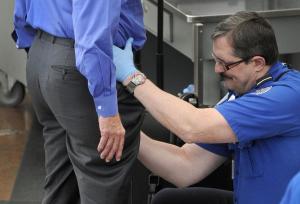
The man was identified by the media as a 26 year old active U.S. Army soldier with no immediately apparent motive.  And I sit here shaking my head, because this brings up not 1 but 3 recurring themes in our society that we simply refuse to address:

Mental healthcare is lacking, especially for our military.  I’ve watched enough of my fairly well-functioning (i.e., hold down jobs) friends let anxiety, depression, or other mental health conditions go untreated or under-treated because treatment is simply too expensive.  But for those without resources — such as the homeless, or those that come back from war injured or deeply traumatized — the rates of untreated mental illness are astounding.  A report from a year and a half ago noted that going to the VA to seek mental health treatment can result in waits up to 279 days, and yesterday the L.A. Times reported that there are 1,200 veterans in that city who don’t even have a roof over their head.  The cost to our society of letting mental illness go treated far exceeds what we would spend on treating it, and when we refuse to provide it to people who go to war for us, we are flatly failing our duty to those people.  I am certain the 13 people with bullet wounds in Broward County today would agree.

Gun-free zones don’t work.  As a Florida weapons license holder, I’m aware that Fla. Stat. 790.06(12)(a)(14) prohibits me from walking into the baggage claim area of an airport with a firearm, essentially making all airport structures “gun-free zones.”  I remember thinking how stupid this was while picking up a friend at FLL airport a couple years ago, because any law-abiding citizen before the security checkpoint is now a target for criminals who know they don’t have guns.  I can’t imagine how infuriating it would be to have left your weapon in your car, out of a desire to comply with the law, while helping mom with her suitcase, only to become the next victim.

Pre-checkpoint airport attacks are in vogue, and the TSA makes it worse.  Over the last decade, there have been several incidents of violence committed by individuals in airports prior to security screening.  Domodedovo airport bombing (2011), LAX airport shooting (2013), Ataturk airport bombing/shooting (2016), etc. etc. etc.  The TSA, by creating lengthy checkpoint lines that over the last year have often exceeded 1 hour, has created a target that, again, criminals know is unarmed and unable to fight back.  What is the point of putting your blue-gloved hands all over our bodies to ensure that we don’t hurt people on an airplane when any terrorist could just blow/shoot up the checkpoint instead?  To make sure that airplanes aren’t used as missiles 9/11-style?  Because we fixed that problem with re-enforced cockpit doors and changing our mindset from “comply with hijackers so they’ll let you go” to “fight them to the death in the sky, even if it means risking the plane.”  Airport screening should be quick and expedient, looking for the most dangerous items and ignoring your Swiss Army knife, bottle of water, and 10 oz. shampoo bottle, such that there is never a line of more than a few people.  This can be accomplished by adjusting policies, throwing out the scanners (or selling them to fascist regimes where they belong), and putting bomb-sniffing dogs at the checkpoints.

This shooting makes me angry, because it is a perfect demonstration of what we, as a society, are screwing up and refuse to fix.

Jon Corbett Available for Legal Assistant / Research / Paralegal

For the entirety of my adult life, my day job has been in technology.  Now in my third year of law school and having written over a thousand pages of federal complaints, motions & oppositions, discovery requests & responses, and appellate documents in my time as a civil rights advocate (most of which have been posted on this blog), I’m looking to begin my transition to doing law professionally.  I’m available to small firms and solo practitioners on either a full or part time basis.  Naturally, a preference for any firm that does civil rights advocacy (Civil Rights Act, Bivens actions, FTCA, ADA, employment discrimination, etc.), but I’m pretty good with contracts, torts, and consumer rights, too.

Please pass to your lawyer friends and contact jon [at] professional-troublemaker [dot] com.

TSA: We May Force You to Go Through Body Scanners Because… Well… We Can’t Tell You

tsagropeAt the end of 2015, the TSA snuck in a pre-holiday amendment to their body scanner opt-out policy: that passengers may “generally” opt for a pat-down instead of the body scanner, but the TSA reserves the right to require the body scanner.  I immediately filed suit, asking the U.S. Court of Appeals to reverse this arbitrary change made in the face of 94.0% public opposition to the body scanners and the fact that I made readily apparent in 2012: that the body scanners simply don’t work.

A year later, we finally have the government’s position on the matter.  First, I’m reminded that I’m complaining for no reason:

“AIT screening presents no greater intrusion upon passenger privacy than the walk-through metal detectors previously deployed at airport checkpoints”

…which is why 94% oppose them.

Next, I’m told that I shouldn’t concern myself with the matter, because only “selectees” will lose their right to opt-out:

“[T]he challenged AIT screening policy applies only to individuals who have been issued a boarding pass with an “SSSS” notation indicating that they have been selected for enhanced screening.  This notation generally means that the passenger in question is a ‘selectee.’  Selectees are individuals who are ‘[k]nown or suspected [t]errorists’ or who have been ‘identified as [posing a] higher risk’ to airline security ‘based on intelligence [redacted].’  Additionally, as of July 2016, TSA has instituted a policy under which [redacted] airline passengers are randomly designated as selectees for the purpose of a particular trip.”

…but that last sentence is, of course, the problem and, frankly, is what we all already know: that you can be Mother Theresa and still end up with a blue glove between your legs because because the TSA has randomly made you a “selectee.”

But, let’s ignore that for a moment.  There’s a more pressing question: Why does the TSA feel that someone with a higher “risk” level (whether because they are a suspected terrorist, or were randomly selected to be treated like one) should be screened by body scanner rather than a pat-down?

“[Redacted].  Covert tests also suggested selectees could [redacted] opting out of AIT screening in favor of a pat-down.”

Ah, that clears it up.  The TSA, allegedly, found some scenario where it’s easier to beat the pat-down than the body scanners, but doesn’t want to tell us what that is.  But, what about the very real scenarios where the body scanners are easier to beat than the pat-down?  That, of course, isn’t discussed at all.  Once again, the TSA blindly chooses these high-tech, high-price, highly-invasive gadgets when very effective alternatives exist.

The case continues as I get an opportunity to file a reply brief.  I’ll also be asking the court to appoint counsel with a security clearance to review the redacted brief and represent my interests, because hiding the rationale for a policy that is being challenged for arbitrariness from the person challenging it doesn’t exactly lend itself to a fair day in court.

Corbett v. TSA – Appellee Brief (Redacted) (.pdf)


Live Nation’s Insomniac Doubles Down on Discriminatory Medicine Policy

medicineIn May, I wrote that I filed suit against Insomniac, the subsidiary of Live Nation that puts on Electric Daisy Carnival (EDC), a 3-day music festival in Nevada that is the largest in the country.  The basis of the suit is that Insomniac prohibits all over-the-counter medicines from entering its festival, then sells the same medicines inside the festival at an inflated price, and additionally requires anyone bringing in prescription medications to show their prescription during a “consult” with a “safety officer” who has no medical qualifications nor any legal obligation to keep your info private.  All in the name of the “war on drugs,” of course.

Insomniac’s attorney, Greg Hurley of Sheppard Mullin, started off our lovely relationship with an unexpected 8:30 AM phone call yelling about how law students don’t know what they’re talking about and shouldn’t file lawsuits.  (Thanks for the tip, Greg!)  The tone of our relationship has continued to this day, with the Sheppard Mullin team refusing to participate in the case like good-faith officers of the court until motions for sanctions or other court intervention is threatened, and even just this month told me I’d be sanctioned for my frivolous lawsuit if I refuse to dismiss it.  (Good luck with that!)

Greg’s hot-headed temper notwithstanding, the interesting part of the legal side of the case is that Insomniac has doubled down, arguing to the court in a motion for summary judgment that what it’s doing is perfectly acceptable, and that if I don’t publicly disclose what my medical conditions are that require medicine (as they have, thus far, refused to agree to any confidentiality), or testify that I’ve never taken an illegal drug in my lifetime, I must just be a drug dealer:

In responses to Defendants’ discovery, Plaintiff has refused to disclose a medical condition impacted by these 2016 policies. Moreover, as Plaintiff has
refused to disclose whether or not Plaintiff uses, or intends to use, illegal drugs, it is reasonable to assume that this is merely an attempt to have a federal court strike a reasonable safety policy designed to protect against deaths from illegal drugs. It is hard to envision a clearer abuse of the ADA statute and the jurisdiction of this Court.

It is simply astounding that after filing suit over them treating those with medicine like drug dealers at the gates of EDC, their attorneys now give me the same treatment at the courthouse.  The Americans with Disabilities Act was designed to protect those with disabilities against being denied full access to public accommodations to whatever extent is reasonably possible.  Confiscating or harassing people over their medication at the festival gate is exactly the kind of thing the ADA prohibits.

I fully expect their motion to be denied.

Corbett v. Insomniac – Motion for Summary Judgment (.pdf)
Corbett v. Insomniac – Motion for Summary Judgment Opposition (.pdf)

Blog at WordPress.com.

Up ↑