Flash Factory Pays $10K to Settle Groping Lawsuit

Flash Factory SettlementGoing out on a Friday night shouldn’t involve having a security guard grab you between your legs “for your safety.”  And when nightlife security does it without obtaining the informed consent of each patron before the search, it’s sexual assault.

Now-defunct New York City nightclub Flash Factory learned this lesson the hard way as it agrees to pay out a $10,000 legal settlement to civil rights advocate and yours truly Jonathan Corbett, and co-plaintiff Elise Domyan, on top of a $50,000 default judgment already levied against its security contractor Ward Security Inc., owned by Walter Degolyer of Lake Grove, N.Y.  A motion is pending before New York County Supreme Court to hold Mr. Degolyer personally liable in the 2017 lawsuit.

Ms. Domyan relayed the following to me in response to the case closure:

“Sexual assault happens every day, and it is quite common for survivors to feel like they don’t have any recourse or a chance for justice.  I know that one lawsuit won’t change the world, but maybe it will give nightclub owners and security firms a moment’s pause in the future, or encourage other survivors to pursue legal action against their attackers.”

The settlement and judgment indeed offer strong incentive for bars and clubs to respect the physical autonomy of their patrons.  Hiring an independent security company does not absolve the establishment of liabilitynot in the Court of Yelp, and not in a court of law.  It is unclear why Flash Factory owners Michael Satsky and Brian Gefter closed, and then sold, their establishment late last year, but having a 2 out of 5 rating due to abusive staff, absurd lines for pre-paid ticket-holders, and $18 drinks, probably didn’t help.

As for Ward Security and Mr. Degolyer, who also go by Alpha 1 Security Group, Inc. and “AAA Security,” so far we’ve collected $10,000 from their surety bond, which New York requires from all security companies, and we work to collect the remaining balance through a variety of means available.  (If I were Mr. Degolyer, I’d be getting in touch to work out a settlement of the matter ASAP.)
U.K. “Knife Control” Gone Wild: Stop & Frisk Arrives in London to Confiscate Your Pointy Things

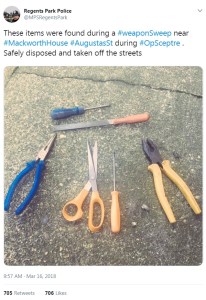
Confiscated Hand Tools
“Oi! You got a permit for those pliers?”  (Yes, this is a real Tweet)

The ordinary citizen, and even most police officers, in the U.K. cannot legally own a gun.  As a result, gun crime is fairly low, yet murder in London has still reached record highs, surpassing New York City, as a result of stabbings.

Their response?  To implement tight “knife control” and start stopping-and-frisking people on the streets to find people carrying around anything pointy.

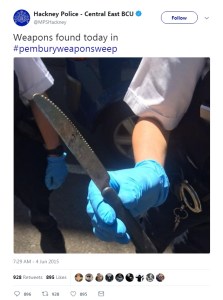
Police departments all over England are bragging on social media about the “weapons sweeps” they are conducting.  The recoveries have included ordinary scissors, screwdrivers, pliers, a file, and even a butter knife.  When questioned (well, mocked) about the butter knife on Twitter, Hackney Police said, “Thanks for your insightful & original retort. The fact remains, a ‘butter knife’ in the chest will kill as surely as a bayonet.”

Butter Knife
“Oi! You need a loicense to butter that toast!”  (Also a real Tweet)

What’s worse, they’re bragging about what they call “stop-and-search,” their version of the mostly-defunct “stop-and-frisk” that the NYPD used to unconstitutionally search 800,000 people in one year alone, finding weapons less than 2% of times.  The NYPD insisted that the program was responsible for a drop in crime until they were ordered to stop by a federal judge and crime stats in New York continued to improve.


It seems difficult to find the rules describing the circumstances under which English police may search an individual on the street, but as far as I can gather — and knowing they have no constitutional amendment against unreasonable search — it’s whenever an officer has reason to be suspicious.  (I welcome corrections if anyone can find an official policy.)  And good Brits will bend over and take it, because as this retired British police officer mused:

We hear the statistics that suggest intelligence led stop and search gets positive results in a third of all cases, but what we don’t know is what happens when an officer decides not to stop and search someone they are suspicious of. Does that person then go on to do something terrible?

No, actually, police are suspicious of everyone, and most will not go on to commit crimes with concealed screwdrivers.

Here in the States, I think there is reform we can do to make it more difficult for people who shouldn’t have a gun to get one.  But today we hear useful idiots like Larry King and retired Supreme Court Justice John Paul Stevens call for a full repeal of the Second Amendment — literally calling for the government to take our guns.

Apparently, that doesn’t stop murder: people are really good at finding ways to kill each other.  The correct solution is to remove the desire, whether motivated by mental illness, religious hatred, or otherwise.  The incorrect solution is what has led the U.K. on a path to tyranny and dry toast.

Is It *Really* Impossible To Get A Gun License in NYC? (Part VII — Corruption? You Can’t Prove It!)

This is the seventh installment of a series documenting an ordinary New Yorker attempting to exercise his Second Amendment rights: Part I (license application), Part II (application rejected), Part III (the lawsuit), Part IV (appeal filed), Part V (appellate briefing complete), Part VI (N.Y. Appeals Court Not Interested in Ending NYPD Corruption).


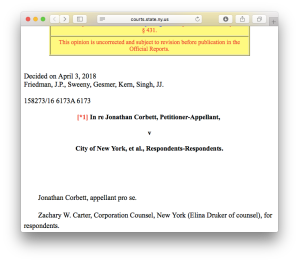
Appellate Division: Affirmed.Yesterday the Appellate Division of the N.Y. Supreme Court affirmed the lower court’s ruling dismissing my challenge to New York’s corrupt practice of issuing gun licenses only to those whom the NYPD feels have a “good reason” to have a gun — a practice that has resulted in corruption for a century now.  This result is, of course, not surprising: as the landmark case District of Columbia v. Heller, 554 U.S. 570 (2008), approaches its 10 year anniversary, New York courts still petulantly resist the mandate that firearm ownership is a right — not a privilege, and not requiring membership in a “militia” — subject to intermediate scrutiny or higher.

In this case, the Appellate Division has finally used “intermediate scrutiny” by name, which is a slow step towards acceptance of Heller.  Intermediate scrutiny is the lowest level of scrutiny that the U.S. Supreme Court has allowed for gun laws since Heller, and it requires that a regulation be: 1) substantially tailored, 2) to an important government interest.

As should be obvious, that’s a 2-part test, and while the “important government interest” part is easily satisfied (it’s certainly reasonable for the government to want to protect its citizens from gun violence), the Appellate Division has plugged their ears to the second part of the test.  During oral arguments, I specifically asked the judges to require that the most vague, invasive, and irrelevant questions on the gun license application, all of which ask if you have ever done something (e.g., taken a prescription painkiller under doctor supervision) be narrowed by temporal or other boundaries:

Justice Sweeny: “[The disputed questions are] not the be all and end all.  It could very well be the basis for further investigation.  Why is that not relevant?”

Jon: “Right, because they could narrowly tailor it.  They could say, ‘have you used [prescription painkillers] for more than a week?’  Have you done it within the last 5 years?  Any of these things would allow them to more narrowly tailor it.”

[Watch Oral Arguments] [More Details About Oral Arguments]

Their decision, of course, is silent on the matter, stating that the rules “are justified because they serve to promote the government’s” interest without any thought to tailoring.  In affirming the court below, the Appellate Division has made it clear that they refuse to set any boundaries whatsoever on gun license restrictions in this state.

Further, the court continues to ignore the persistent corruption in the NYPD Licensing Division:

“Petitioner has not established that the denial of his application was the result of corruption or other impropriety”

This ignores the fact that my original case in the lower court was dismissed before I had a chance to gather or present any such facts.  I got no period of “discovery” or any other procedure by which I could demand the turning over evidence.  Meanwhile, officers literally in the office where and when I submitted my gun license application have pled guilty to federal corruption charges, admitting they accepted cash in exchange for approval of gun licenses.  Under these circumstances, due process is lacking whether I can prove that my individual case was affected or not.

I look forward to petitioning New York’s highest court, the Court of Appeals, to hear this case.

Blog at WordPress.com.

Up ↑