Briefed: Can the TSA Eliminate the Pat-Down “Opt-Out?”

petSince the nude body scanners were introduced by the TSA as primary screening in Fall 2010, they have always maintained that use of the technology is optional: that if you wanted, they would instead simply molest you using their new “pat-down” rather than use radiation to image your nude body.  Not exactly a pretty choice, but it was some choice nevertheless.

Five years later, after all the dust had settled over the lawsuits by passengers who felt that the TSA’s new screening techniques were unconstitutionally invasive (and down-right stupid considering that despite being the most intrusive search they had ever implemented, they were blatantly ineffective), the TSA doubled-down on their scanners and announced to passengers that they reserve the right not to honor “opt-out” requests in the future.  This new announcement flew in the face of the 94% of the public who formally told the TSA to ditch the scanners, and me being one of that 94%, I immediately filed suit in the U.S. Court of Appeals for the 11th Circuit.  Two other lawsuits were filed by EPIC and CEI, alleging that the TSA improperly disregarded that 94%.

It’s amazing how long these things take to progress.  It’s 7 months into the lawsuit and I just filed my principal argument, the appellant’s brief — a written statement of the entire case.  Those 7 months were filled largely with the TSA bickering about how much information they had to release to me, which resulted in the end with several thousand pages landing on my doorstep.  I’ll be posting those pages, known as the “administrative record,” shortly (scanning thousands of pages is an effort!), along with a few highlights (including, “How Any Terrorist Can Get Pre-Check,” an exposé on why the Pre-Check system is bullshit), but what was most interesting about them is they showed zero basis for their decision to eliminate the opt-out.  As I explain in my brief:

The Administrative Record is illuminative on the reasons for adopting the body scanner and pat-down program as primary screening in 2010 [Ed – Not that they were good reasons, but they were reasons.]. There are many documents that address the effectiveness of the body scanners and provide some evidence of cost/benefit thought process and procedures by which the program is tested. See, e.g., Admin. Rec., Vol. 4, p. 3893 (results of body scanner field testing). However, the elephant in the room is that there is no discussion on the effectiveness of the pat-down component of the program, nor a comparison between how likely a body scanner is to find a dangerous item on a passenger as compared to a pat-down.

Full brief below…

Corbett v. TSA IV – Appellant’s Brief (.pdf)


Civil rights advocacy is expensive!  Want to contribute to the fight against police abuse, TSA assholery, and other civil rights issues? Donate via PayPal, Venmo, Chace QuickPay, Bitcoin, or check
Detained, Removed From Airplane By Feds @ LAX

In the history of my advocacy, I’ve been kicked out of airports three times (for refusing to allow the TSA to “touch my junk”).  I’ve had airport police called at least a couple times. But having the feds come down the jetway just for me?  That was a new experience I had last Wednesday at Los Angeles International Airport.

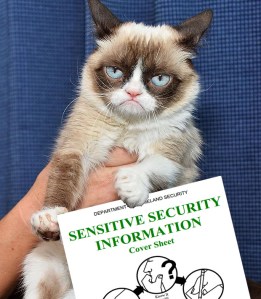
Grumpy Cat with SSI
An artist’s rendition of the TSM upon finding my documents

I went through the security line as usual, opting out of the nude body scanners, but one of my bags was flagged for extra screening.  Upon opening it, they were shocked to find… TSA documents, bound into several books, labeled “Sensitive Security Information” (“SSI”).  “These are our documents,” a sassy Supervisory Transportation Security Officer exclaimed at me before fetching the highest-ranking traveler molester TSA staff member at the checkpoint, a suited Transportation Security Manager (“TSM”) who wanted to know how I got those documents and why I had them.

As you guys probably guessed, I have them because the government sent them to me during litigation, and I was traveling with them because I have a brief due based on those documents in Corbett v. Transportation Security Administration, 15-15717 (“Can the TSA make the body scanners mandatory?”) next week.  They contained mundane details of how the TSA came to the decision to implement the body scanners and then to make them mandatory under certain circumstances, rather than any kind of epic secrets ISIS would moisten themselves over.  But I’ll be damned if I have to explain my reading material to the TSA, so I told them they were documents lawfully in my possession and I didn’t feel compelled to share anything further.

The bag check and the pat-down were soon completed, finding nothing other than my “concerning” documents, but I was instructed to “wait” and not to touch my bags, as airport police were on their way because they needed “someone else to make the decision.”  “How are airport police supposed to determine whether it’s a problem if I have ‘your’ documents,” I asked Mr. TSM.  He shrugged, and then airport police arrived and asked him exactly the same question, then wandered over to the side to let the TSA handle it.  Kudos to Airport Police for not buying into their bullshit as they sometimes do in other airports.

Unsatisfied, the TSM calls the Federal Security Director’s office.  The FSD is basically a “regional director,” typically overseeing several airports in a geographic area.  The FSD’s office sent an assistant to come to the checkpoint while they found someone who could actually clear me.  The assistant was friendly enough, and we spoke a little.  After about 45 minutes had passed and it was approaching final call for my flight, I said to her, “It’s really a shame that the TSA is going to detain me for this long and cause me to miss my flight over the contents of paper when they’ve already determined that I have no hazardous items,” to which she replied, “Oh, you’re not being detained.  We don’t detain people!”

Well that’s funny, since I was told to “wait” and not to touch my bags.  The current standard for whether or not one is being detained was first contemplated in Terry v. Ohio, 392 U.S. 1 (1968) as “whether a reasonable person would feel like they were not free to leave.”  I must disagree with the assistant, as it seemed clear to me that I was not free to leave until someone other than the TSM (such as the assistant) made the call, but I packed my bags, walked to my gate, and boarded my plane.

Of course, the story does not end there.  After boarding, putting my stuff in the overhead, and taking my seat, an airline employee comes on board and says, “Mr. Corbett, the TSA would like to speak with you off the plane, can you show me where your bags are?”  Ugh.  I do so, and meeting me on the jetway was a smiley man (along with the original TSM) who showed me his ID: “TSA Inspector.”  TSA Inspectors are the only TSA employees that are law enforcement officers.  His position is, essentially, equivalent to an FBI Special Agent, although I’m sure far less trained given the lower pay grade associated with the job.  He seemed to understand that the documents were for litigation and pressed me for a few minutes to explain my business, which I politely declined.  After copying down the information from my ID, he miraculously allowed me to return to the plane, to face the looks of the flight attendants (who, to their credit, largely seemed understanding that the TSA is absurd) and passengers.

So there you have it… how you can be harassed and treated like a terrorist for possessing “suspicious” paper.  The best part?  The documents I had didn’t actually contain any SSI — they were redacted copies for public distribution.  I’m tempted to print books with an SSI cover sheet and the U.S. Constitution underneath it.  Or, maybe just 100 copies of the 4th Amendment underneath the cover sheet, and I can tear one out and give it to them each time they think it’s acceptable to detain people without probable cause (let me know if you’d like one to travel with, perhaps I’ll print a few dozen and mail them out if there’s interest!).


Civil rights advocacy is expensive!  Want to contribute to the fight against police abuse, TSA assholery, and other civil rights issues? Donate via PayPal, Venmo, Chace QuickPay, Bitcoin, or check

Blog at WordPress.com.

Up ↑